What Makes a Megalodon Tooth Valuable?
Size is perhaps the first characteristic people notice, but it is far from the only consideration when valuing a Megalodon tooth. Collectors look at the tooth as a complete specimen. A large example with significant damage or restoration may be less desirable than a smaller tooth with excellent enamel, well-preserved serrations and a strong overall appearance.
Several characteristics can distinguish a particularly fine example.
Size
Large Megalodon teeth can be particularly sought after, especially when impressive dimensions are combined with good preservation.
Size should always be considered alongside condition, however. A slightly smaller tooth of exceptional quality may be more desirable than a larger but heavily worn or restored specimen.
Serrations
Megalodon teeth have finely serrated cutting edges. On well-preserved fossil teeth, these serrations can remain remarkably clear despite their great age.
The quality and extent of the surviving serrations can therefore contribute to the desirability of an individual specimen.
Enamel
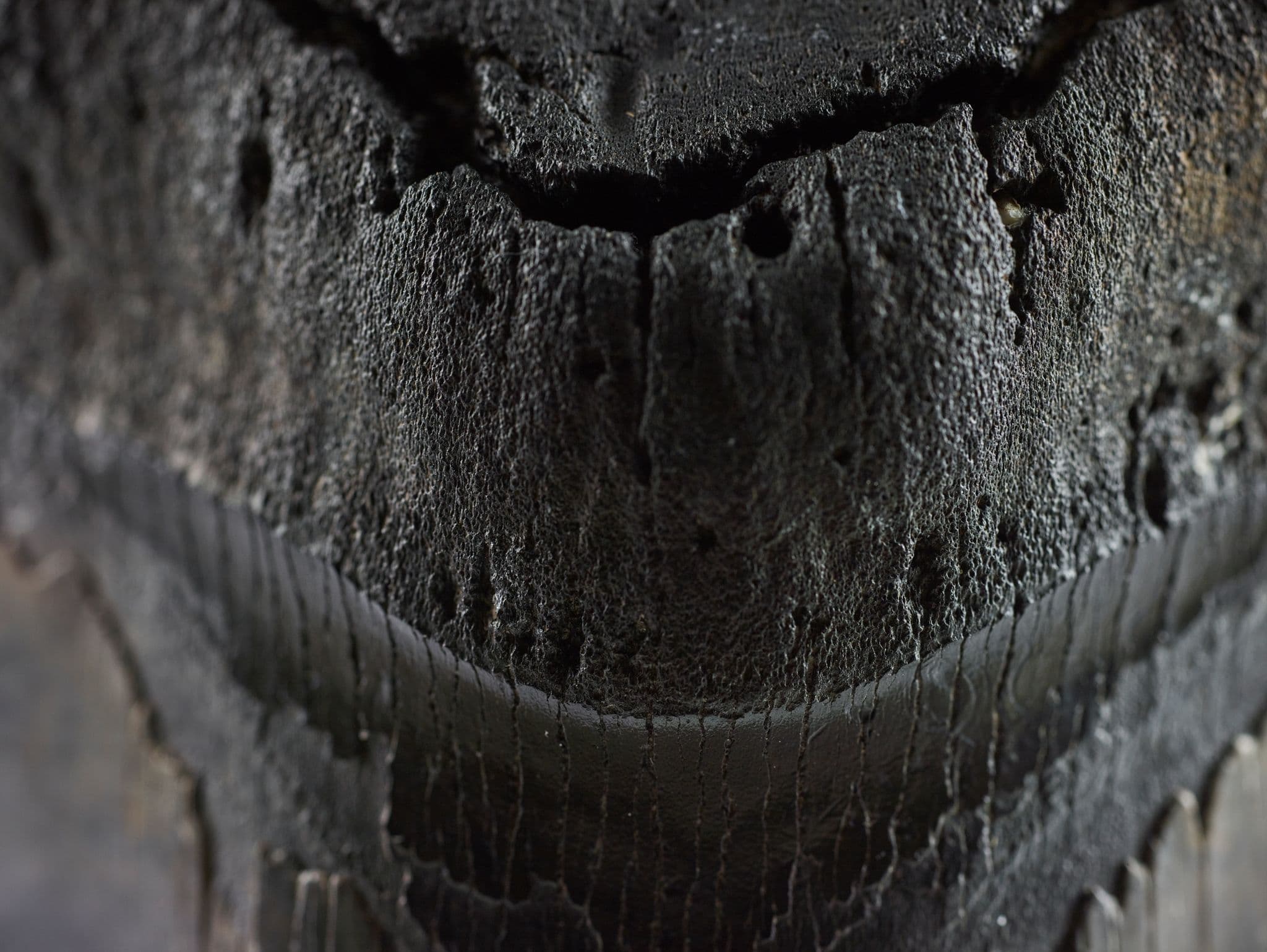
The enamel forms much of the visible surface of a Megalodon tooth and has a considerable impact on its appearance. Chips, cracks, erosion and areas of missing enamel can affect the overall quality of a specimen, while well-preserved surfaces can make a tooth particularly striking.
Root and Bourlette
The broad root gives a complete Megalodon tooth much of its characteristic form and may vary considerably in its state of preservation.
Between the enamelled crown and root is an area known as the bourlette. Its survival varies between specimens, and a clearly defined bourlette can contribute to the completeness and visual quality of a particularly well-preserved tooth.
Does Size Matter When Valuing a Megalodon Tooth?
Yes, but bigger does not automatically mean better. Exceptionally large Megalodon teeth can attract considerable collector interest, particularly when their size is accompanied by excellent preservation. A large tooth with substantial damage, however, may be less desirable than a smaller specimen retaining finer original detail.
Shape, symmetry, serrations, enamel, root preservation, colour and restoration all need to be considered alongside the dimensions of the tooth. This is why Megalodon teeth are best assessed individually rather than valued according to size alone.
Why Are Megalodon Teeth Different Colours?
One of the most striking characteristics of fossil Megalodon teeth is their extraordinary variety of colours.
Examples can appear grey, black, brown, cream or blue-grey, while some display more unusual tones and patterns. These colours are the result of fossilisation rather than the original appearance of the tooth during the shark’s lifetime.
As a tooth lies buried within sediment over millions of years, the surrounding geological conditions and minerals can influence its eventual appearance. This helps explain why specimens recovered from different locations can look dramatically different from one another. For collectors, particularly attractive natural colour can add considerably to the visual appeal of a tooth.
Where Are Megalodon Teeth Found?
Megalodon inhabited warm and temperate seas across a wide geographical range, and its fossilised teeth have been discovered in many parts of the world.
Important finds have been made in the United States, particularly along parts of the Atlantic coast, as well as in Central and South America and other regions where suitable marine deposits survive.
For anyone considering selling a Megalodon tooth, information about where it was discovered can be useful. Locality can provide geological context and form an important part of the specimen’s provenance.
Old collection labels, invoices and records showing where and when a tooth was acquired should therefore be kept with the specimen wherever possible.
Why Are Megalodon Teeth So Well Preserved?
Sharks present an unusual case in the fossil record. Their skeletons are principally composed of cartilage rather than bone, which is less likely to fossilise. Teeth, however, are highly mineralised and far more resistant, making them much more likely to survive.
Like modern sharks, Megalodon continually produced and replaced teeth throughout its life. As a result, teeth dominate the fossil record of the species while complete skeletal remains are exceptionally scarce.
This also means that Megalodon teeth themselves are not necessarily rare. For collectors, the distinction is often one of quality: exceptionally large, complete and beautifully preserved examples are considerably harder to find.
Does Restoration Affect the Value of a Megalodon Tooth?
Megalodon teeth may show natural damage, later repairs or restoration, and understanding the difference can be important when assessing a specimen.
Damage may have occurred during the animal’s lifetime, during fossilisation, when the tooth was recovered or through subsequent handling. Other specimens may have been deliberately restored to replace missing areas or improve their appearance.
Restoration does not necessarily make a Megalodon tooth unsuitable for auction, but its extent should be understood and taken into account when assessing the specimen. If you know that your tooth has been repaired or restored, include this information when requesting a valuation.
What Does an Exceptional Megalodon Tooth Look Like?
There is no single characteristic that makes a Megalodon tooth exceptional.
An outstanding specimen might be distinguished by unusual size, remarkable preservation, finely retained serrations, an intact root, attractive natural colour or an especially well-proportioned shape. The finest examples tend to bring several of these qualities together.
This is also why two Megalodon teeth of similar dimensions can differ considerably in desirability. The quality of the individual specimen matters as much as the number on the ruler.