

Lot 148
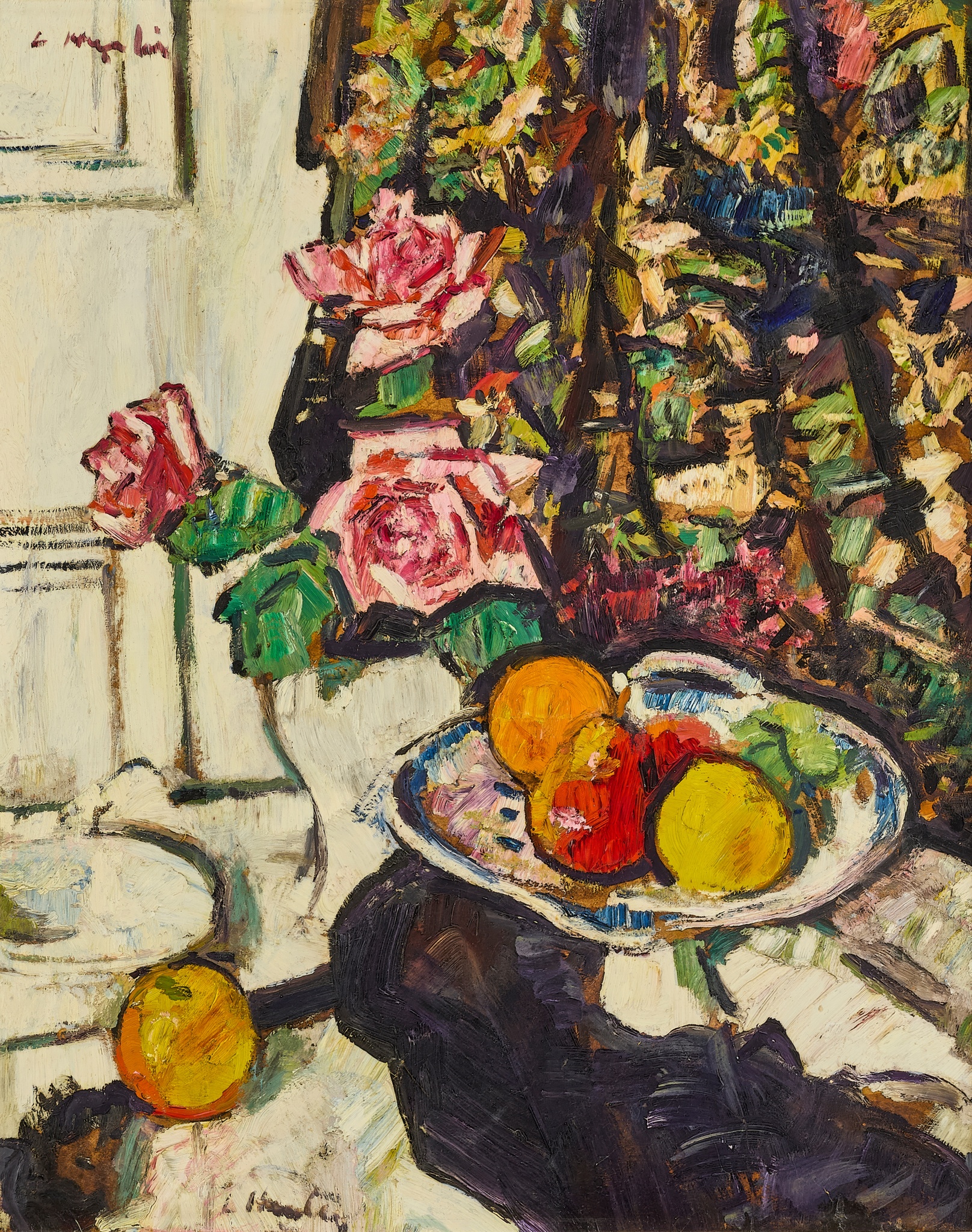
GEORGE LESLIE HUNTER (SCOTTISH 1877-1931)
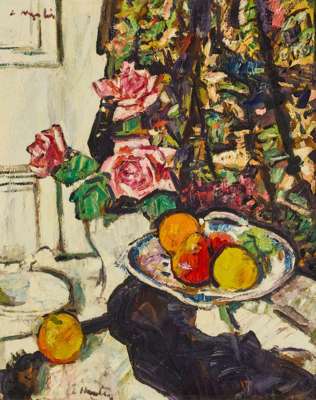
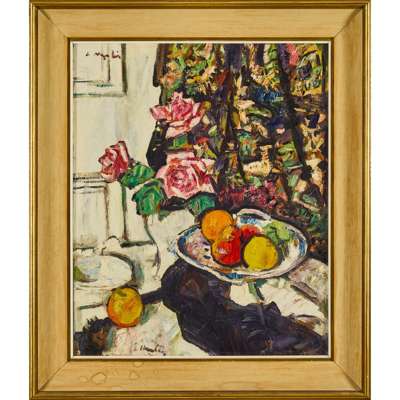
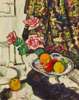
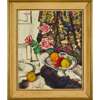
STILL LIFE WITH PINK ROSES AND FRUIT
Scottish Paintings & Sculpture
Auction: Evening Sale ft. A Century of Scottish Colourists Part II | Lots 90 to 169 | Thursday 03 December 2026 from 6pm
Description
Signed twice, oil on board
Dimensions
63cm x 51cm (30in x 20in)
Footnote
George Leslie Hunter’s unconventional training began with lessons with a local ‘lady artist’ in Rothesay on the isle of Bute, continued whilst part of San Francisco’s bohemian art world of the 1900s and developed during trips to the Continent, including to Glasgow, London and Paris, as well as to New York, as the years progressed towards the First World War. From 1906 until his death in 1931, Glasgow was the base for a peripatetic career which involved long spells spent in Fife and the south of France in particular.
Throughout, Hunter practised the genre of the still life. At first, he looked to France’s nineteenth-century artists including Jean-Baptiste Siméon Chardin, Edgar Degas, Henri Fantin-Latour and Edouard Manet, as well as to Dutch old masters including Willem Kalf, two of whose paintings he could see on display at Glasgow Art Gallery (see Alice Strang, The Scottish Colourists: Art and Life, Edinburgh, 2026, p.69). Still life paintings were often the highlights of solo exhibitions mounted in Glasgow from 1913 and later in Dundee, Edinburgh, London, Birmingham and New York.
Still Life with Pink Roses and Fruit is a beautiful example of Hunter’s still lifes of the 1920s. He was based in first one then another studio in the same building at 104 West George Street in Glasgow for much of the decade. A corner of his studio in depicted in the current work, which reveals how he came to master composition, colour and technique to create beautifully balanced paintings which are yet vibrant and energetic. Of all the Colourists, Hunter was most drawn to the post-Fauve work of Henri Matisse and was delighted when the dealers Alexander Reid and Etienne Bignou, as well as his fellow Scottish Colourist, S. J. Peploe, compared his work favourably with that of the French modern master. (see Alice Strang, op.cit, p.89).
Thickly laden brushstrokes add physical texture to visual pattern, particularly in the titular flowers and the Persian curtain draped on the wall behind them; this was a favoured motif in a celebrated series of still lifes of the period to which the present painting belongs. The careful delineation of the panelling of the studio door to the back left contrasts with the freedom of other passages, such as the summary depiction of the black and white cloth gathered around the compotier of highly-coloured fruit. Much of the overall image is white, yet one’s overall impression is of the strength and boldness of Hunter’s palette. A confident signature at the upper left reveals the artist’s satisfaction with his efforts.
Hunter’s pride in his still lifes is made clear by his decision to exhibit them at the Royal Glasgow Institute between 1916 and 1931 and at the Royal Scottish Academy between 1915 and 1930. They were often singled out for praise by reviewers of his solo exhibitions, even if others could not comprehend their daring innovation. Addressing this point, the critic of the Revue du Vrai et du Beau declared: ‘It must not be forgotten that Hunter does not paint for the present but for the future. In time his pictures will acquire an invaluable patina and it would appear that prudence counsels him to prefer the approval of the future to a passing renown.’ (as quoted by T. J. Honeyman, Introducing Leslie Hunter, London, 1937, p.101)
