Lot 109
WILLIAM MCTAGGART R.S.A., R.S.W. (SCOTTISH 1835-1910)
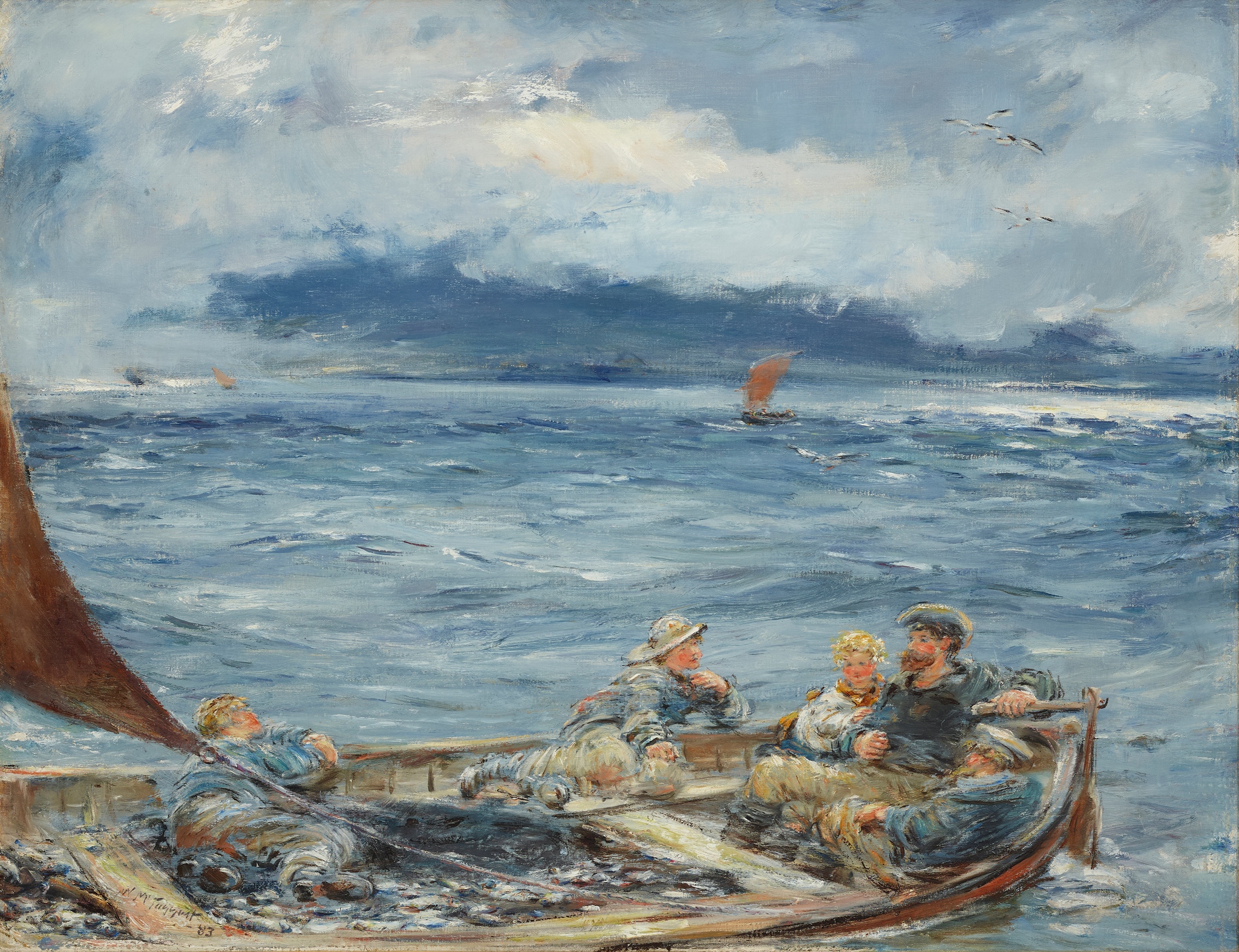
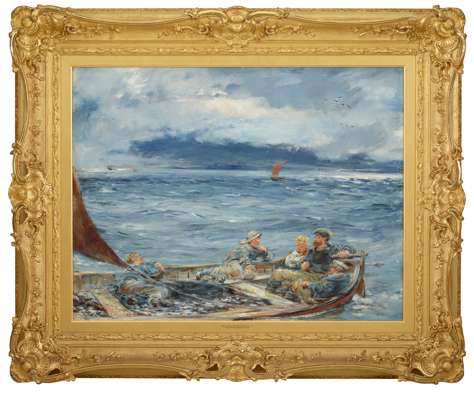
MIST RISING OFF THE ARRAN HILLS
Scottish Paintings & Sculpture
Auction: Evening Sale ft. A Century of Scottish Colourists Part II | Lots 90 to 169 | Thursday 03 December 2026 from 6pm
Description
Signed and dated '83, oil on canvas
Dimensions
84cm x 109cm (33in x 43in)
Provenance
Mr Robert Hendrick
J. J. Kirkness
Sothebys, Gleneagles, Scottish and Sporting Pictures and Sculpture, 26 August 1997, lot 1422 where acquired by the present owner
Exhibited:
Aitken Dott & Son, Edinburgh, 32 Paintings by William McTaggart R.S.A., 1901 and tour to Glasgow and Dundee
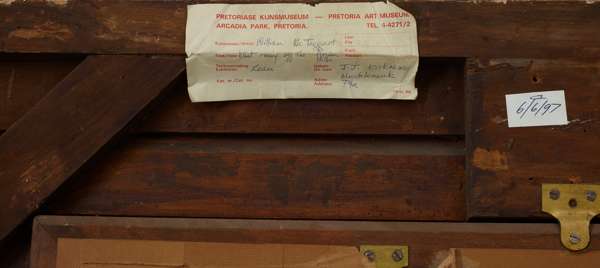
Pretoria Art Museum, Pretoria (lent by J. J. Kirkness)
Literature:
James L. Caw, Scottish Painting, Past and Present, Edinburgh, 1908 (illustrated)
James L. Caw, William McTaggart: A Biography and an Appreciation, Glasgow, 1917, p.250
Footnote
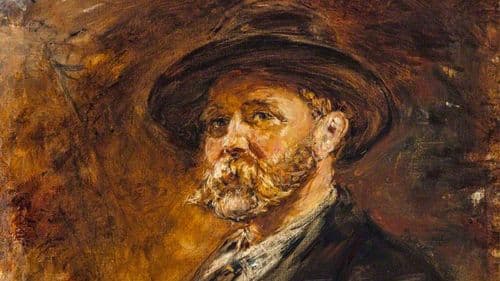
William McTaggart (1835–1910) was an important Scottish landscape painter of the nineteenth century. Born in 1835 at Aros, Kintyre, into a crofting family, McTaggart developed a strong attachment to the Scottish landscape, particularly the west coast where he grew up. At an early age, he was apprenticed to the Glasgow apothecary Dr John Buchanan, who recognised his artistic ability and introduced him to the artist Daniel Macnee. Encouraged to pursue a formal art education, McTaggart moved to Edinburgh in 1852, where he studied at the Trustees Academy under Robert Scott Lauder. He became an Associate of the Royal Scottish Academy in 1859 and a full Academician in 1870.
Initially concentrating on portraiture and figure painting, McTaggart increasingly turned towards landscape and coastal subjects from the 1870s. Scottish fishing communities and rural life became important themes in his work and he regularly travelled along both the east and west coasts, visiting places including Arran, Tarbert and Iona. He was particularly interested in the relationship between people and their surroundings, often depicting everyday working life as part of the wider landscape. His attachment to Scotland also extended to his attitude towards exhibiting. As the foreword to William McTaggart 1835–1910 observes: “He was independent to a fault and the integrity of his vision of Scotland led him to the introspective conclusion that he did not want his paintings to be exhibited outside Scotland.” (p. 7).
By the 1880s, McTaggart’s painting had become increasingly expressive, with less emphasis on fine detail and a greater interest in the effects of light and weather. He often worked outdoors and his freer handling and loose brushwork allowed him to capture the movement and atmosphere of the landscape.
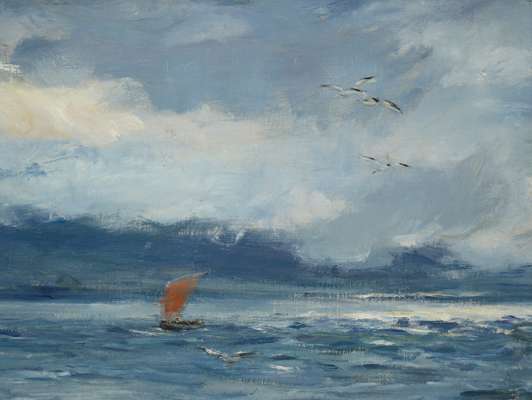
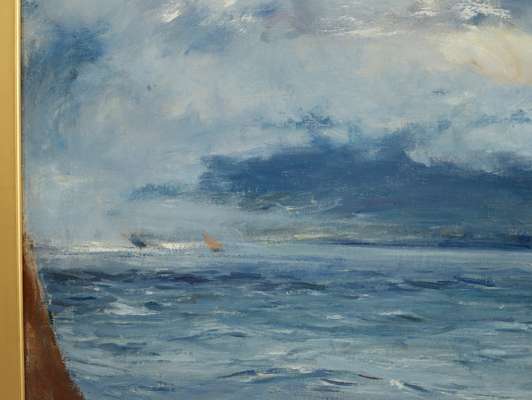
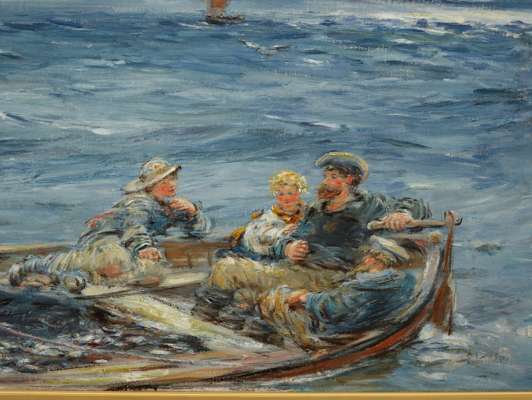
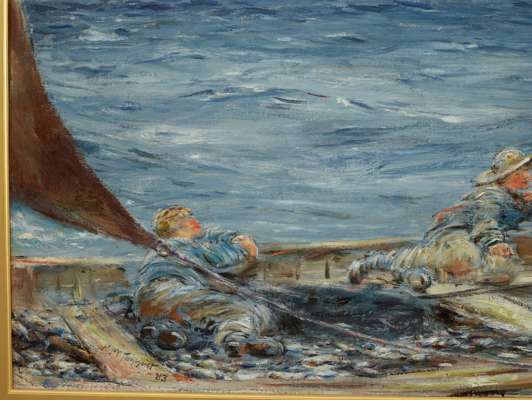
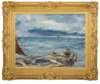
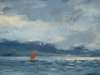
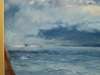
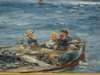
Mist Rising off the Arran Hills, dated 1883, comes from an important period in McTaggart's development. It brings together two subjects that featured throughout his work: the lives of Scottish fishing communities and the surrounding coastal landscape. In the foreground, a fisherman steers his boat with his family gathered around him. The day's catch can be seen at the bottom of the boat, whilst the children sit back in relaxed positions, with the youngest clinging closely to their father. The catch suggests they are returning from a day's fishing. Two further sailing boats can be seen in the distance, their small forms emphasising the expanse of water and the distance between the boats. The distinctive profile of Arran, perhaps the granite peaks around Goat Fell, emerges through the mist.
McTaggart uses a restrained palette of blues, greys and whites throughout the composition. The blue and white of the figures' clothing is echoed in the sea and sky, visually connecting the fishermen with their surroundings. Although McTaggart uses much the same colours throughout, subtle changes in tone and brushwork distinguish the different elements of the composition. The loose handling of the distant hills conveys the mist hanging over them.
The present painting can be identified in a photograph reproduced on page 95 of Lindsay Errington's William McTaggart 1835–1910, published in 1989 to accompany the Royal Scottish Academy exhibition of that title. It shows McTaggart standing to the left in his studio, with his second wife, Marjorie Henderson, seated beside him, and Sir James L. Caw, his future biographer, standing nearby. The present work can be identified hanging at the upper right. The photograph also provides an interesting record of the frames McTaggart chose for his paintings, which were characteristic of his taste.