Lot 125
SIR JOHN LAVERY R.A., R.S.A., R.H.A., P.R.P., H.R.O.I., L.L.B. (IRISH 1856-1941)
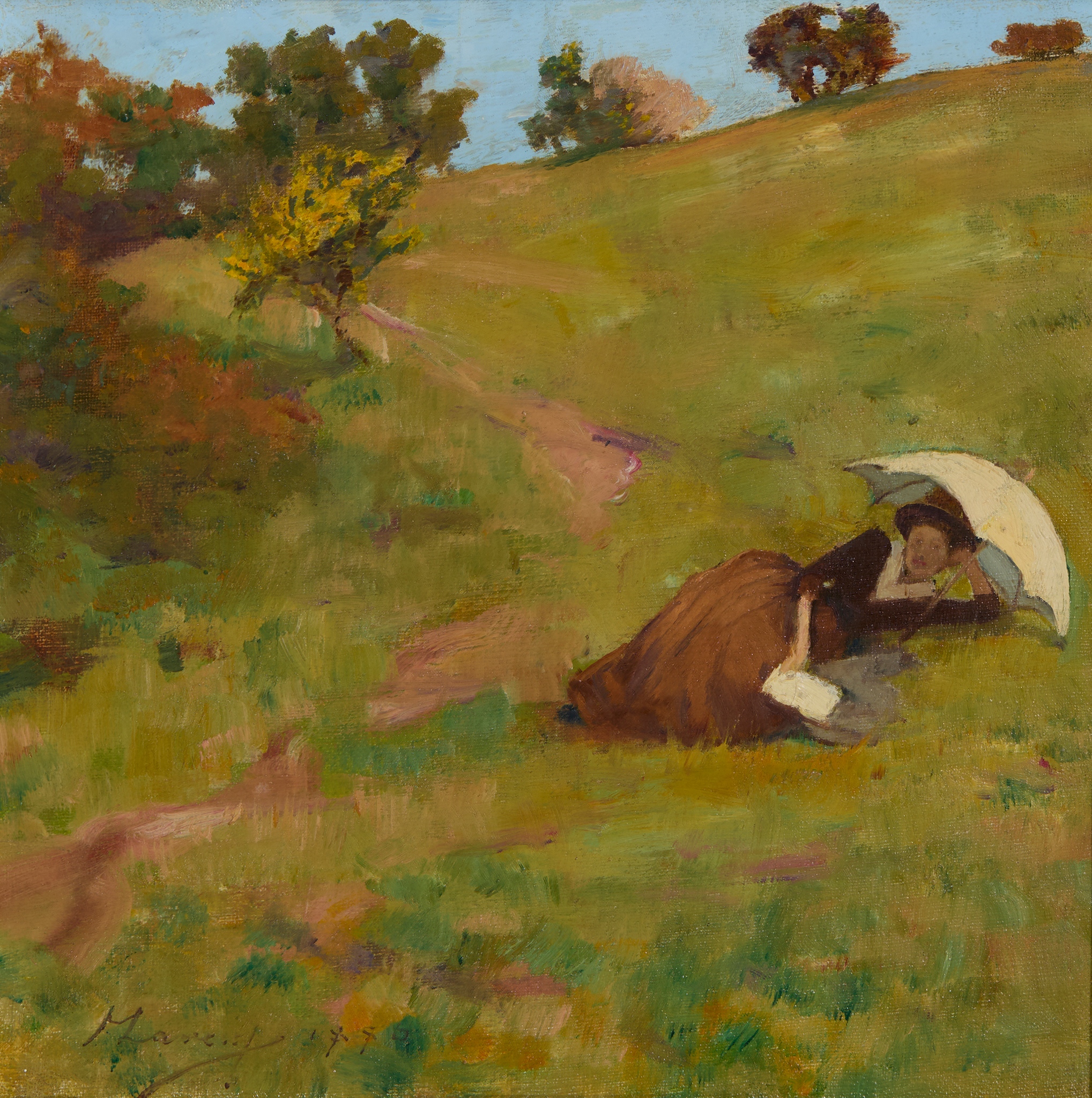
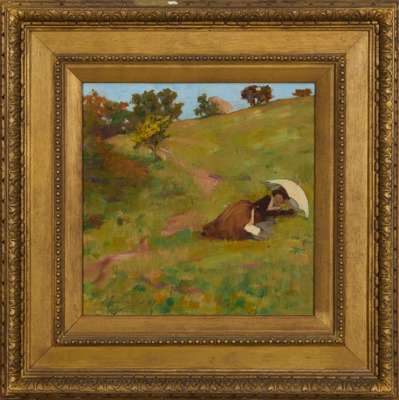
A SUMMER AFTERNOON
Scottish Paintings & Sculpture
Auction: Evening Sale ft. A Century of Scottish Colourists | Lots 88 to 168 | Thursday 04 June 2026 from 6pm
Description
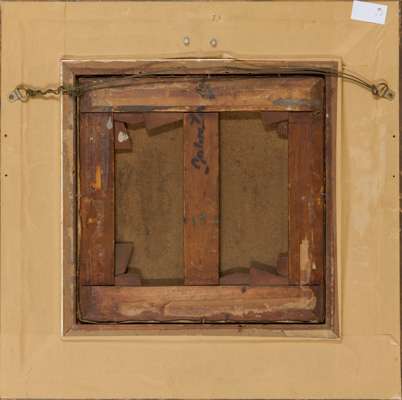
Signed and dated 1886, oil on canvas
Dimensions
28cm x 28cm (11in x 11in)
Footnote
Exhibited:
Clark Hall, Paisley, Portraits, Pictures and Sketches painted in the Neighbourhood, November 1886
Hunt Museum, Limerick, Lavery and Osborne, Observing Life, 2019, unnumbered, p.20, illustrated p.21
Heading up the hill into the Gleniffer Braes, to the south of Paisley, the artist stroller observes a young woman under a parasol, reading a book. She looks up as he approaches. Beyond her, where the red earthen path reaches the hill crest, the gorse is in flower.
Aware of the dialogue between the Naturalism of Jules Bastien-Lepage and the Impressionism of Claude Monet, by the time of his return to Scotland Lavery had seen that modern French artists were breaking the landscape into prismatic taches. These he observed in the broken foreground colours of tufts and hollows under foot on the Gleniffer slopes. The lush chrome greens in foreground grasses drop to paler, warmer hues at the brow of the hill and are intensified by a backdrop film of cobalt blue. Colour sensations were vivid on such a day when one can smell the vegetation and feel the heat.
Although essentially a private domain, the Fultons threw open the braes as an area where all the people of Paisley could roam freely, on high days and holidays. They provided the perfect venue for annual free ‘Glen Concerts’ at which, in the following year, Lavery was photographed recording the scene. On quieter days, as here, members of the Fulton clan and their staff would make use of the braes for recreational purposes. The present study is likely, with The Pond at the Glen, Paisley, to have been one of those included in the painter’s first solo exhibition in the Clark Hall, in November 1886 (see lot 124). The perfect expression of this peaceful haunt is Lavery’s A Summer Afternoon, 1886.
We are grateful to Professor Kenneth McConkey for writing this catalogue entry.