Lot 124
SIR JOHN LAVERY R.A., R.S.A., R.H.A., P.R.P., H.R.O.I., L.L.B. (IRISH 1856-1941)
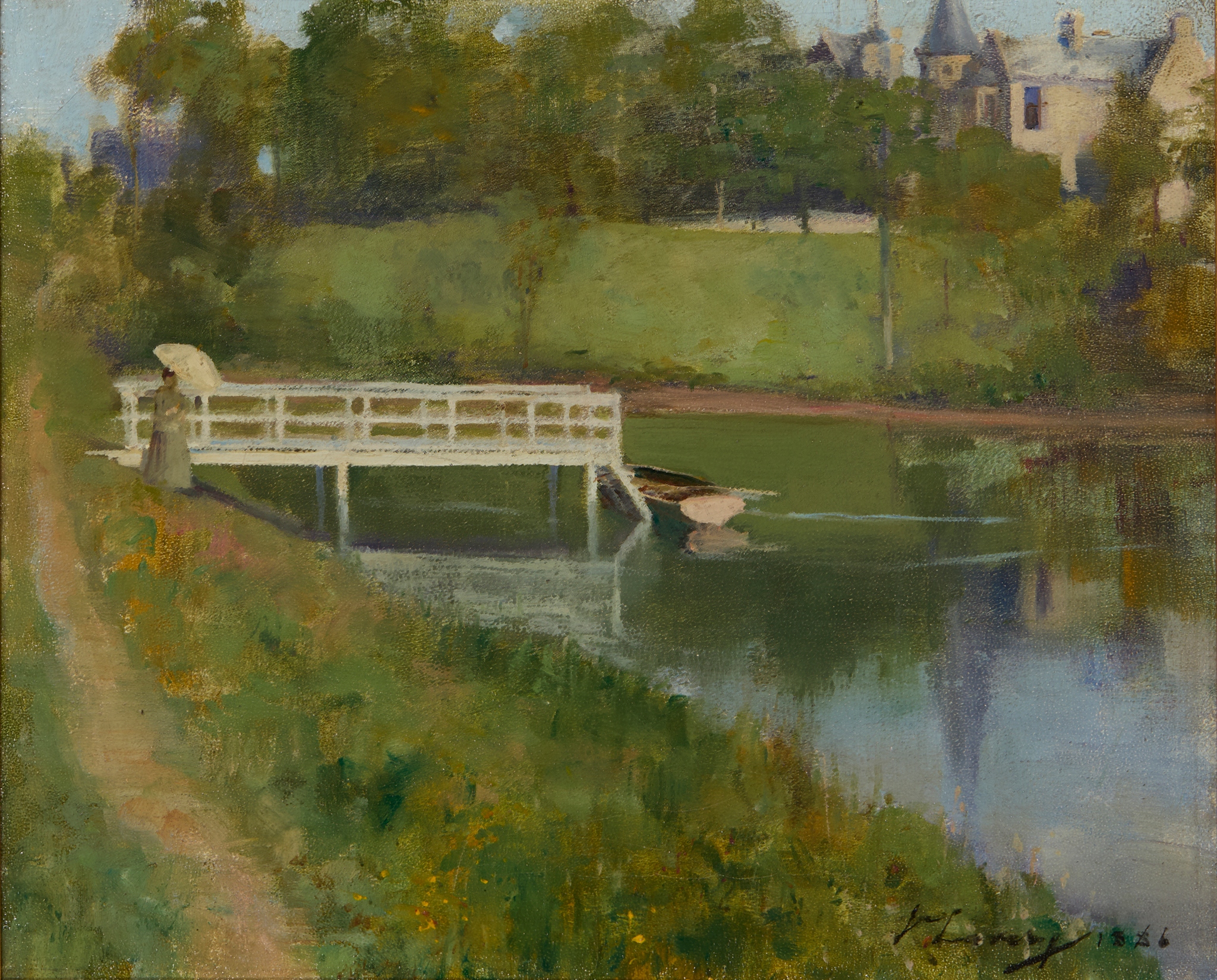
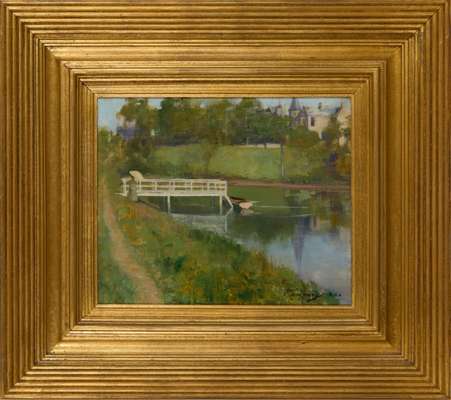
THE POND AT THE GLEN, PAISLEY
Scottish Paintings & Sculpture
Auction: Evening Sale ft. A Century of Scottish Colourists | Lots 88 to 168 | Thursday 04 June 2026 from 6pm
Description
Signed and dated 1886, oil on canvas
Dimensions
25.5cm x 30.5cm (10in x 12in)
Provenance
Ewan Mundy Fine Art Limited, c.1985
Private Collection
Exhibited:
Clark Hall, Paisley, Portraits, Pictures and Sketches painted in the Neighbourhood, November 1886
Hunt Museum, Limerick, Lavery and Osborne, Observing Life, 2019, unnumbered, p.18, illustrated p.19
Footnote
Once upon a time the path from a country house led down along the side of a pond where a young woman was spotted by a painter, working quietly on a small canvas. The sun was shining as she opened her parasol and before she passed him, he had placed her in his picture close to the little jetty, to which a rowing boat was tied. The scene is one to delight a French Impressionist, were it not for the fact that the baronial pile up on the bank in the background, Glenfield House, places the incident precisely on the outskirts of Paisley, the ‘cottonopolis’ of the west of Scotland.
Here the artist, John Lavery, was being patronized by local industrialists of great wealth. One in particular, James Fulton, whose family inherited the house along with their textile dyeing and finishing works, was one of biggest employers in the town, and was now, in 1886, affording the artist a residency. Born in Belfast and orphaned at the age of three, Lavery’s start in life had been inauspicious. Brought up by relatives in Ulster and the west of Scotland, his career began as a photographer’s assistant, while learning to draw in classes for working men at the Haldane Academy, part of Glasgow School of Art.
Times were nevertheless, hard. Following the collapse of the city bank in 1878 poverty was widespread and Lavery was struggling to make ends meet. Seeking further training and his fortune, he left for Paris in 1881. During his absence the seeds of economic recovery began to bear fruit and Lavery’s successes in France had gone before him. Friendship with the Fultons began within months of his return at the end of 1884, with the mill-owner offering the painter a cottage adjacent to the present pond to act as his studio while he painted the portraits of his daughters, Alice and Eva, (Paisley Museum Collection), and other works in the district. Quite evidently Lavery delighted in the setting and although a checklist has not survived, it is safe to assume that being painted ‘in the neighbourhood’ this canvas, A Summer Afternoon (lot 125), and other works such as Waterfall, The Glen, Paisley would have been displayed in his first solo exhibition at the end of the year.
Suave, self-confident, painted en plein air, and spontaneously composed, the present work demonstrates a maturity found elsewhere in more ambitious canvases such as the celebrated Tennis Party, 1885 (Aberdeen Art Gallery). Few works can so accurately be placed in time and space, when a valuable social historical record becomes a moment of aesthetic delight.
We are grateful to Professor Kenneth McConkey for writing this catalogue entry.