Lot 100
WILLIAM MCTAGGART R.S.A., R.S.W. (SCOTTISH 1835-1910)
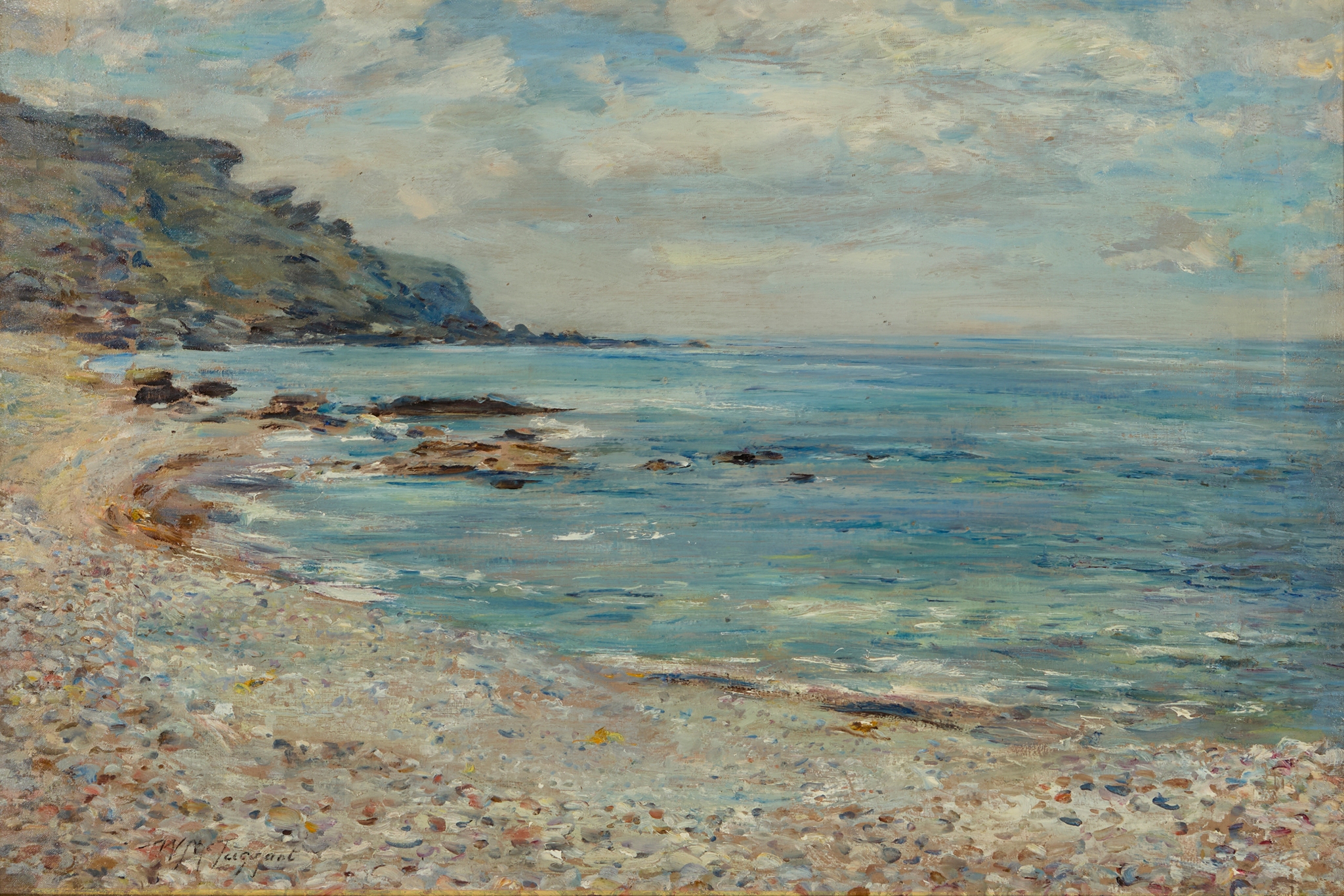
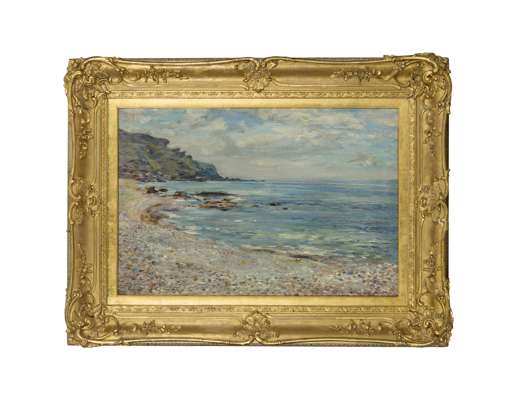
PEBBLED BEACH, CAULDRON BAY, MACHRIHANISH

Scottish Paintings & Sculpture
Auction: Evening Sale ft. A Century of Scottish Colourists | Lots 88 to 168 | Thursday 04 June 2026 from 6pm
Description
Signed, oil on canvas
Dimensions
67cm x 98cm (26.5in x 38.5in)
Provenance
R.B. Steven Esq, Edinburgh;
The Fine Art Society Ltd., 1995
Literature: James L. Caw, William McTaggart, James MacLehose and Sons, Glasgow, 1917, p.275
Footnote
William McTaggart (1835–1910) is remembered as one of the most important figures in nineteenth-century Scottish art, and these works demonstrate two distinct stages of his career.
The painting Children by a Stream has a strong Pre-Raphaelite quality. Like the works of the Pre-Raphaelites, McTaggart’s early paintings are highly detailed, with careful use of colour and a focus on groups of figures set within landscapes. These characteristics are comparable to the descriptive works of William Holman Hunt and John Everett Millais, which McTaggart likely encountered at the Manchester Art Treasures Exhibition in 1857. In this composition, a group of children gather in the foreground, their attention absorbed by an object held in the boy’s hand. Slightly apart, the youngest child turns towards figures in the background, lifting their hat in a gesture of greeting and subtly linking the two groups.
As McTaggart’s career developed, his style and technique underwent a significant transformation. He moved away from finely detailed compositions towards a much looser approach, where the figures almost merge into their surroundings through expressive, swirling brushstrokes. This can be seen in Children on Rocks by the Sea. Here, McTaggart enhances the viewer’s experience by evoking the power of the sea and the force of the wind along the coast through his handling of the paint. The children appear to shield themselves against the elements, while McTaggart conveys the gritty atmosphere, sand whipped into the air and spray crashing against the rocks, through textured application and energetic brushwork.
Kintyre was a major source of inspiration for McTaggart. From 1876 onwards, he returned there regularly with his family and many of his most important paintings were painted in this area, likely painted outdoors, en plein air, on the shores of Machrihanish Bay. In this example, Pebbled Beach, Cauldron Bay, Machrihanish McTaggart appears captivated by the expansive light across the water. Rather than depicting the dangers of the sea, he presents a calm, still day, with hardly a breeze and no white horses visible. The sea glows a turquoise blue, inviting the viewer to feel the warmth of the sun while gazing across the open bay. This sense of stillness contrasts directly with his more turbulent coastal scenes.
Ultimately, these works highlight the breadth of McTaggart’s artistic development, from the careful detail and narrative clarity of his early paintings to the expressive freedom and atmospheric intensity of his later style. While his technique evolved significantly, his enduring focus on children, landscape and the natural world remained constant.