

Lot 95
Browning, Robert
Rare Books, Maps & Manuscripts
Auction: Rare Books, Maps & Manuscripts
Description
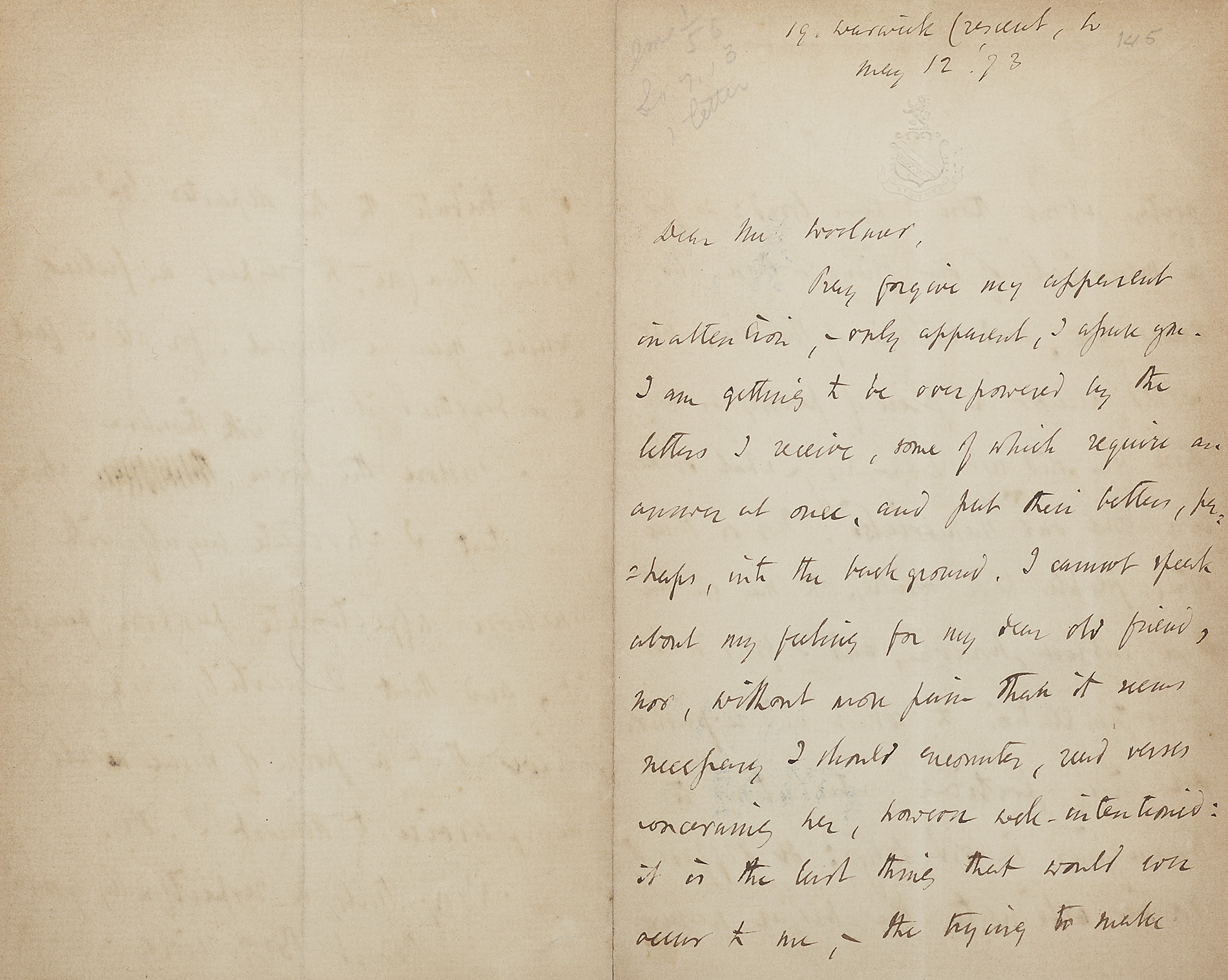
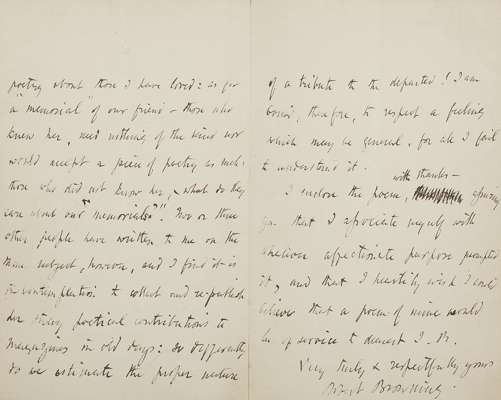
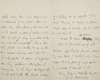
Letter written and signed by Robert Browning to Mr Woolner, dated 10th? May 1873?, in which Browning replies to what can be assumed to be Mr Woolner's request for a poem to honour the memory of a deceased friend, Browning writes that he wishes he, "...could believe that a poem of mine would be of service to dearest I.B.", 1 folded leaf, 22.1cm. x 18.1cm, armorial crest in blind with motto 'virtue', first and last page a little dust-soiled, very slight closed tear to centre fold, couple of light notes in pencil
Footnote
Note: It is not certain who '"I.B." or "Mr Woolner" are, however two likely candidates are Thomas Woolner (1825-1892) and Isabella (or Isa) Blagden (1816/17-1893).
Isa Blagden was born in the East Indies and, whilst her nationality is oficially cited as Swiss in the register of the Protestant cemetary in Florence, where she is buried, she was in fact rumoured to be the illegitimate daughter of an English father and an Indian mother. After being educated in london, Blagden began to write plays, novels and poetry. In 1850, Isa Blagden moved to Florence and became very friendly with the Brownings. Elizabeth Barrett Browning encouraged Blagden to begin writing novels. Her works included AgnesTremorne, The Cost of a Secret and The Crown of a Life.
It is possible that Thomas Woolner was the recipient of Browning's letter. Born in 1825, Woolner began attending the Royal Academy Schools in 1842. In 1847, Woolner met a new studio neighbour, Dante Gabriel Rosetti, and became involved with the Pre-Raphaelite Brotherhood. One source quotes William Holman Hunt's observation that Woolner had a, "burning ambition to do work of excelling truthfulness and strong poetic spirit." In 1852, Woolner decided to turn his hand to gold prospecting in Australia but his efforts yielded few results and by 1853, he had taken up sculpting in Melbourne. Woolner returned to England in 1854 and became a successful sculptor of portrait medallions and busts, as well as being comissioned for several small religious works. In 1877, Woolner became professor of sculpture at the Royal Academy, but retired after five years, never having given a lecture!
Oxford Dictionary of National Biography