

Lot 88
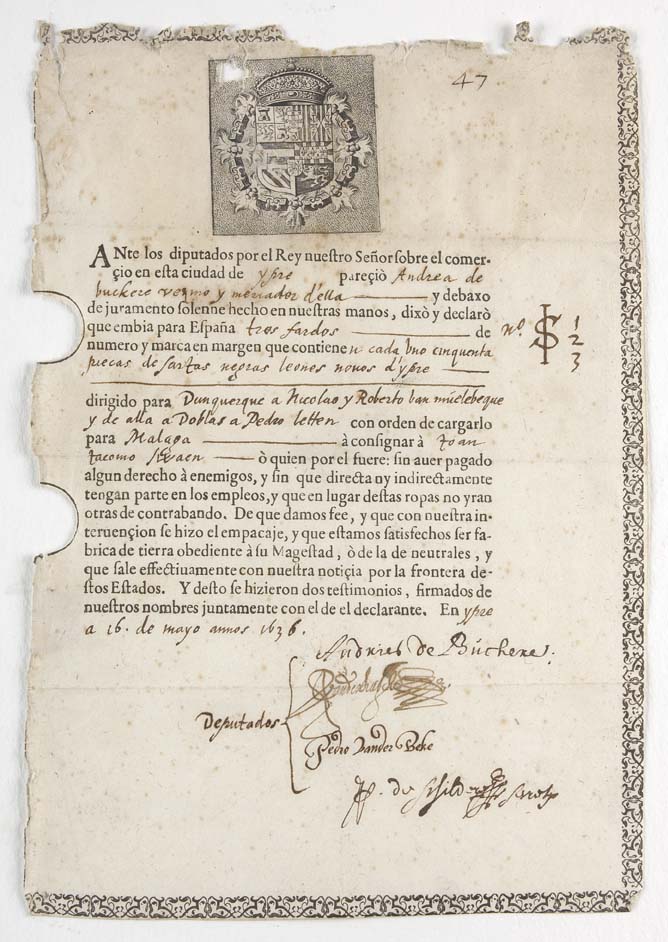
Spanish Netherlands
Rare Books, Manuscripts & Photographs
Auction: Rare Books, Manuscripts & Photographs | 09 May 2007
Description
Licence granted by two deputies of King Philip IV on 16th May 1636 at Ypres to Andrea de Buckere, merchant, permitting him to transport three bales each containing fifty pieces of black cloth (?) made in that town to Dunkirk, with instructions for Nicholas and Robert van Muelebeque (?) etc. to convey them to Joan Jacomo Swaen (?) at Malaga. Pro-forma document, 11" x 71/2", Roman letter, approx. 14 lines of print plus Ms. additions, the latter stating the parties and commodities involved and the date and showing 4 autographs, including those of Andrea de Buckere and Pedro van der Beke: the second was one of the two Spanish deputies, engraved arms, probably of Philip IV, floral border round 3 sides, though largely worn away along top, left-hand edge also frayed, hole through engraved surface (not touching coat-of-arms), tear through one corner, paper fragile and lightly foxed, contemporary Ms. writing in parts of the document left blank for the purpose, giving names and other details
Footnote
Note: Untraced in Palau. Not in Goldsmith, BMC. STC. Spanish & Portuguese 1601-1700, etc.
In 1633 the southern provinces of the Low Countries reverted to direct rule by Spain, and their commerce thus became regulated by that country, as is exemplified in the present document. For many years, moreover, the alliance between France and Holland meant that the Spanish Netherlands were subject to attack from both sides, and this insecurity is reflected in the stipulation here that no duties are to be paid to enemies for the goods involved, nor are the said enemies to have any share in their conveyance. The Ms. bears witness to the difficulties in which the great cloth centres of Flanders found themselves as the country became enmeshed in the struggle between Spain and the northern powers. The name of the consignee at Málaga is also of interest as suggesting the existence of a Flemish trading community in Spain at this period.
The place of printing is not stated, but is likely to have been in Spain rather than Flanders, the document being perhaps one of a type having a standard wording suitable for use anywhere in Spanish territories, and blank spaces left for the ms. additions needed.