

Lot 302
Sutherland, Invernesshire and the Highland Clearances, 1802-1827
Printed Books, Maps and Manuscripts
Auction: 11 July 2006 at 12:00 BST
Description
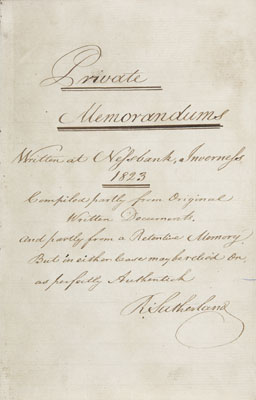
Private Memorandum book of Captain Robert Sutherland of Nessbank, formerly of the 72nd Regiment of Foot, commencing 'I Robert Sutherland, was born at Taumachy in the Parish of Rogart, County of Sutherland, in the month of June 1760.' In 1798 Sutherland describes his return after '11 years in the East Indies, with £7600 in Bills payable' having obtained the rank of Captain, detailing his loss of money through the financial advice of Sir John Lubbock, his posting with his Regiment to Ireland in 1800, and appointment as Captain of one of the Companies of Independent Invalids at the Tower of London. In 1801 he journeys north from Findhorn to Dornoch, the prospect of war with France requiring him in 1803 to rejoin the Invalids at Edinburgh and then Stirling Castle. In 1806 Doctor James Straith purchases a house for him at Forres for £700, in 1807 he spends the summer with his Father in law, the Rev. Doctor Bethune, Minister of Dornoch, and in 1808 purchases rashly the Farm of Drummey in the Parish of Golspey : 'by this precipitate measure I must give up my comfortable house at Forres and commence Farmer, a profession of which I had no practical knowledge''. On 8th August 1809 he reports at length on the Meikle Ferry accident when the ferry was crossing from the coast of Sutherland to the Ross-shire coast carrying passengers for a market to be held in Tain: 'persons crowded into the Ferry Boat [which] sunk in a few minutes after setting off, by which misfortune 99 persons were drowned, 12 only being saved out of all the number that embarked… We held a meeting of the few respectable people that could be assembled at Dornoch to consider of a subscription for collecting & burying the dead bodies & to stimulate the exertion of the fishers and country people to discover and to search along the shore for such as the sea might cast up… all but four or five who were probably covered by the sand, were decently buried in the churchyard of Dornoch… The expense incurred on this account, as well as the great distress occasioned by the loss of Fathers, Mothers, and others, who were the Support of whole Families, now become destitute, rendered further measures and great exertions necessary.' A committee is formed, Sutherland being appointed chairman. 'Subscriptions were received from every part of Scotland, a good many from England and some from the East Indies as well as the Cape of Good Hope. In whole £3400 was collected of which nearly £3000 were distributed amongst the sufferers in the most exceptional manner.'' This disaster prompted the building of the bridge at Bonar Bridge in 1812.1811 has the laconic comment ''Nothing particular occurred for some years''. 1816 refers to the return of Doctor Walter Ross Munro from Calcutta, and his death, his 'will [being] contested by his widow'.In 1816 the 'crops were universally bad and late and were not cut down until November. The produce very deficient, the quality bad, and great apprehension entertained of a scarcity - if not of famine, all over the County'. 'From the failure of last year's crop I gave away a considerable quantity of victual to poor people in the utmost distress, who could not pay for it.' Sutherland gives detailed accounts of his investments, especially financial mistakes 'in an unguarded moment I was tempted to sell out of the stocks and purchase the estate of Flemington in the parish of Ayton, Berwickshire, consisting of about 163 English acres, and rented at £620 per annum, for which I was to pay £11,800. He gives precise details of his will and Trust disposition and its beneficiaries, and reviews, with no little satisfaction, his financial and social position "possessed of a landed estate of nearly £600 of yearly rent… respected and universally esteemed by all classes of my countrymen.. in favour with the Noble Family of Stafford… appointed a Deputy Lieutenant, a Justice of the Peace, a Trustee of the Roads and a Magistrate of Dornoch.'Although evidently not prepared to criticize Lord Stafford, Sutherland refers to the effect of the highland clearances: 'The situation of the Sutherland tenantry becoming every year more circumscribed in consequences of the new system adopted by Lord Stafford, and his managers, in placing the Estate of Sutherland under sheep - instead of being under cultivation as hitherto - my half brother resolved to leave the County, and embarked in the month of May, for Picton, Nova Soctia, with his family, and was accompanied by Andrew Sutherland & his family, with several others from Sutherland, for whom I hired a vessel from Aberdeen. I assisted both John and Andrew to pay their passage, as well as to procure many things useful to them'1820 refers to great alarm among agriculturalists, 'cattle & every description of farm produce fell in price' and 'a great outcry against high rents… there being no chance of the same high prices which were obtained during the war' In 1821 Sutherland abandons farming, sells the lease of Drummey and moves to Inverness, building a new House, naming it 'Nessbank, from its situation on the Bank of the Ness'. 1821 refers to a relation gone to New South Wales 'now comfortably settled in Van Diemans Land' and 1822 to Duncan Campbell embarking for Picton, Nova Scotia. Sutherland provides detailed accounts of the sale of Drummey (£2800 1s 3d), the purchase and building of Nessbank (£1220) and of the costs of three further houses built at Nessbank (£2289 5s 6d). He lists all his relations with their names and place of residence, detailing all the legacies made to them, and his investments in consoles, the Inverness Gas & Water Co. and the Scots Union Insurance Co.. The final entry, on 15 December 1827, states that he will not call upon the Principle of the Heritable Bond for £5000 from Major Fraser Newton for five years (if I live so long). An obituary of 'Captain Robert Sutherland of Nessbank formerly of the 72nd Regiment of Foot, appears in the Inverness Courier of 30 January 1828, 107 pages, 8vo, half morocco binding, covers detached, early gatherings loose, a few leaves with small inkstain at extreme inner margin.