Lot 25
SIR CEDRIC MORRIS (BRITISH 1889-1982) ‡§
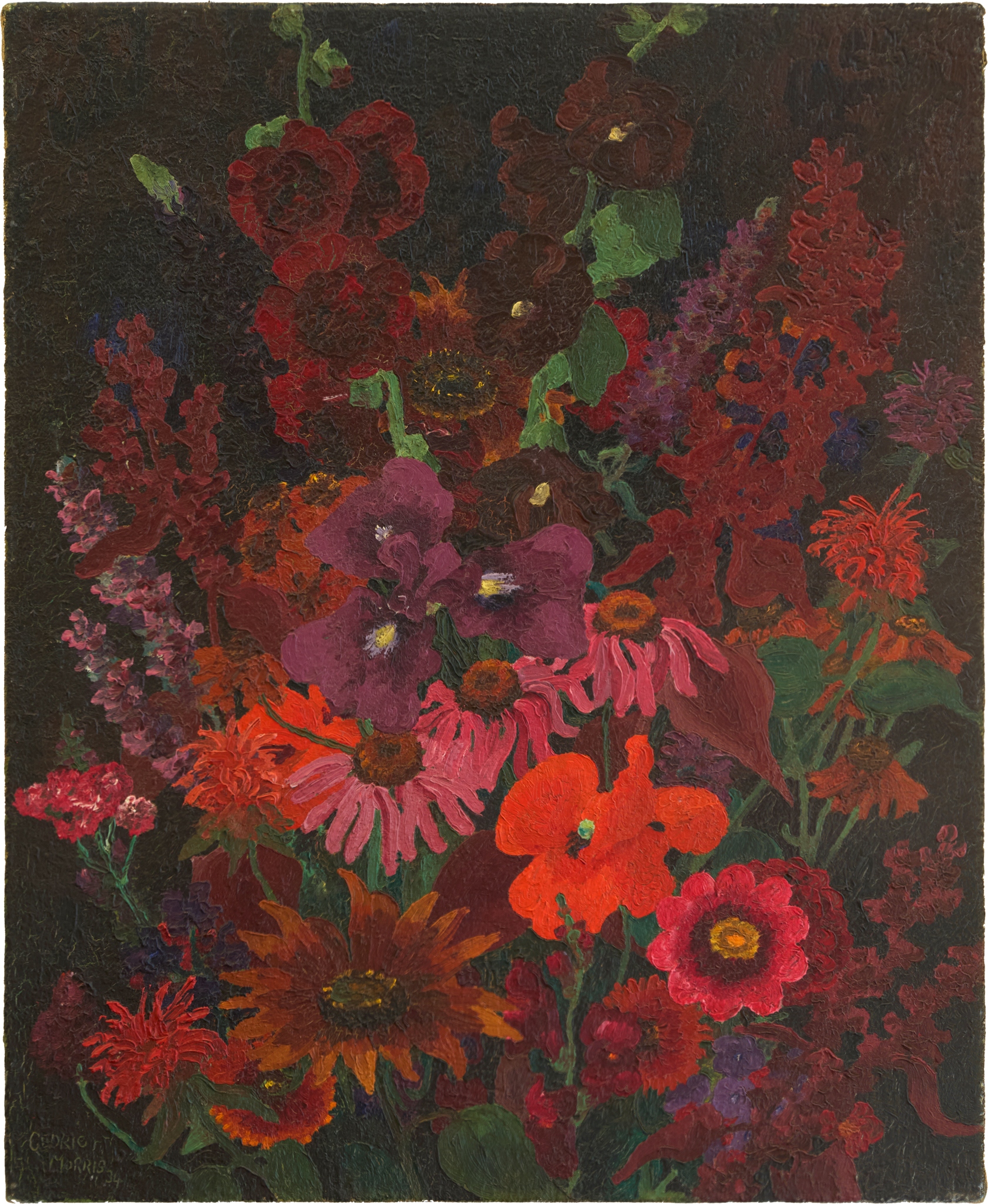
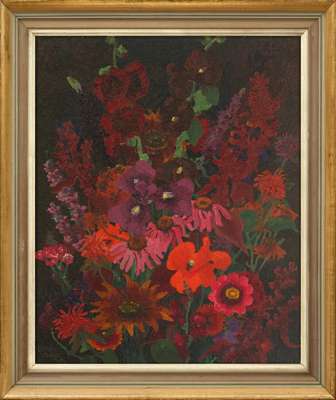
EXPERIMENT IN RED, 1934
Auction: 30 October from 10:00 GMT
Description
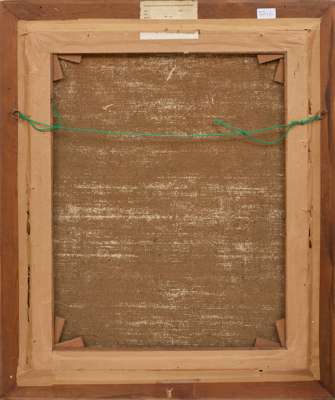
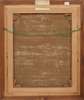
signed and dated (lower left), inscribed ‘DARK FLOWERS Cedric Morris 1934’ (on the stretcher) possibly in the Artist's hand, oil on canvas
Dimensions
68.5cm x 55.5cm (27in x 22in)
Provenance
New Grafton Gallery, London, from whom acquired by Kathleen Firmin, Firmin Gallery, Nairobi, June 1975;
Monaco Fine Arts, Nairobi, where acquired by the present owner, March 2006.
Footnote
Exhibited:
New Grafton Gallery, London, Cedric Morris - Retrospective Exhibition, 19 June - 9 July 1975, no. 11.
Experiment in Red of 1934 by Cedric Morris is an exceptional example of the flower paintings with which he made his name as one of Britain’s most important artists of the twentieth century. However, for over 50 years, it has been untraced, quietly tucked away in Nairobi, Kenya. Its return to its country of origin represents an important opportunity to re-assess Morris’s contribution to British art history as an artist-plantsman.
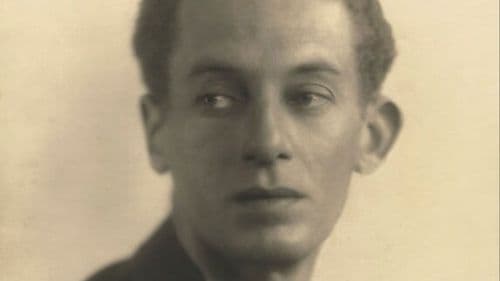
Morris was born in Sketty, Swansea in 1889. His unconventional art training included attendance at various Parisian academies, such as the Académie Delacluse, before the First World War. Time was spent in the midst of artistic circles in Newlyn, Paris and London, with his partner since 1918, the artist Arthur Lett-Haines, before a move to The Pound farmhouse in Higham, Suffolk in 1929. By this point, Morris had achieved a rare combination of critical admiration and commercial success, with solo exhibitions in Rome, The Hague and London, inclusion in group exhibitions in New York and Venice and membership of the London Artists Association and the Seven and Five Society.
Experiment in Red epitomises the thrilling independence from London’s commercial art world that Morris achieved at The Pound during the 1930s. It was here that he was able to establish the first of his ambitious and impressive gardens, whilst the present painting was created in the year in which he first planted irises, of which he became a celebrated breeder after the Second World War.
The artist Joan Warburton recalled of The Pound:
At the back of the house lay a garden which ran down a slope to a pond … and beyond a marvellous view of the whole valley. The garden was a series of low-hedged beds, Cedric’s studio was beside the house in the garden. To go in there quietly when Cedric was painting the favourite of all his flowers, irises, was a revelation. (as quoted by Richard Morphet in Cedric Morris, Tate Gallery, London, 1984, p.48)
Following the move to Suffolk, Morris ended his contract with the dealers Arthur Tooth & Sons Ltd, resigned from society memberships and concentrated on first growing and then painting the products of the four acres of land which were now his to cultivate. The extraordinarily direct and physical depiction of flowers in Experiment in Red, rendered in clearly delineated and generously loaded brushstrokes, bears out his friend, the plantswoman Beth Chatto’s remark that ‘Cedric could not have painted flower pictures with so remarkable a degree of insight if he had not known the plants intimately by being a ‘dirty hands gardener’ on his knees from dawn to dusk.’ (quoted by Richard Morphet, op.cit., p.86).
The present painting reveals how Morris was as experimental on canvas as he was in the soil, exploring in both solutions to the challenges of combining different tones of red and related areas of the colour spectrum in paint as well as in garden borders. In this, he may have been guided by Gertrude Jekyll’s Colour Schemes for the Flower Garden, which was published in 1925.
Morris’s skills as a visionary horticulturalist are clear to see, whilst the symbolism of the selected flowers adds another layer of interpretation to the painting. The purple iris at its centre is most likely to be the cultivar ‘Pioneer’, raised by Arthur Bliss in 1924 and therefore a newcomer in breeding terms. Other flowers featured include Hollyhock, whose blooms in the Victorian Language of Flowers represent fecundity and ambition, Snapdragon (freedom), Catmint (love), Cone Flower (justice), Corn Poppy (sleep and latterly military remembrance), Sunflower (pride), Clary (wisdom) and Sweet William (sensitivity).
Thrust to the very frontal plane of the image, the various flowers depicted are used to light the edge-to-edge composition through the varying brightness of their petals. In addition, the varying sizes of the flower heads are orchestrated to create a formal rhythm across the thickly-woven support, which climaxes at the image’s centre. Morris’s mastery of colour is clear in the selection and combination of a broad tonal spectrum of orange, red, pink and purple, offset against various shades of green. Shallow perspective and a black background exclude narrative context and forces all the viewer’s attention onto the specimens presented. It illustrates Tate Curator Mary Chamot’s description of Morris’s work in 1937 as a ‘decorative mosaic of colour’ with ‘brushwork which produces an almost tapestry-life effect’ (Country Life, 1937, p.97), as well as Morphet’s praise of its ‘richness, simplicity and tactility’ (Richard Morphet, Morris, Sir Cedric Lockwood, Oxford Dictionary of National Biography, 2009).
The artistic freedom underlying the painting is encompassed in its title, Experiment in Red. At especially creative periods throughout his career, Morris used this titling, such as the ‘Experiment in Texture’ and ‘Textures’ works of the 1920s (examples held in the collections of Tate and Gainsborough’s House. He was to return to his exploration of the titular colour in Essay in Red of 1959 (untraced), shown in his solo exhibition of that year at The Minories, Colchester.
Indeed, a revival of interest in Morris’s achievements was witnessed in the 1960s and 1970s, including the retrospective exhibition mounted by the National Museum of Wales and the Welsh Arts Council in 1968. A further retrospective was held by David Wolfers at his influential New Grafton Gallery in London in 1975. Wolfers had been introduced to Morris by the artist and collector Natalie Bevan, who formerly co-owned Morris’s paintings Paysage du Jardin no.2 of 1931 and The Blue Poppy of 1932, which were sold by Lyon & Turnbull in 2026 and 2025 respectively (Letter from Wolfers to Morris of 11 October 1974, Personal Papers of Cedric Morris and Arthur Lett-Haines, Tate Archive, TGA 83176). Experiment in Red was one of twenty-nine works shown by Wolfers, covering his career from 1922 to 1963, of which Greek Wallside, Turkey (no.18) and Palace at Oeiras, Portugal (no. 27) are now in the collection of Gainsborough’s House. Such was the exhibition’s success that its run was extended to 14 July 1975 (letter from Wolfers to Morris of 14 July 1975, TGA 83176).
As Wolfers reported to Morris, Experiment in Red was ‘sold at your preview party to the owner of the Firmin Gallery in Nairobi’, for the sum of £325 (letters of 27 November 1975 and 1 October 1975, TGA 83176). The gallerist referred to was Kathleen Firmin (née Barry), who – following the death of her photographer and mountaineer husband Arthur Firmin – ran a gallery that specialised in hand-tinted prints of Arthur’s photographs, as well as paintings and prints. As Morris had travelled in north Africa in 1921, 1925 and 1926, it was fitting that Kathleen selected Experiment in Red, believing it would appeal to the cultured community of the capital of Kenya – then, as now, one of the most important cities in the Commonwealth, geopolitically, economically and culturally. It was, in fact, during a royal tour of the Commonwealth, on behalf of her ailing father, King George VI, that Queen Elizabeth II came to Kenya for the first time in February 1952 and it was during this tour, at Treetops Lodge, north of Nairobi in the Aberdare National Park, that she received the tragic news of her father’s passing, thus becoming queen.
Experiment in Red passed to Linda Lomonaco, Kathleen Firmin’s long-time assistant (who had worked with her hand-tinting Arthur’s prints). Linda went on to run Monaco Fine Arts Ltd in Nairobi, from where Experiment in Red was acquired by the present owner in 2006. After five decades in Africa, its return to the UK allows European admirers of Morris and of Modern British Art to savour a painting which embodies Richard Morphet’s declaration that:
Cedric is one of the most exceptional colourists in twentieth century British art. It is not only the intensity of his colours that tells, but above all the originality and the strange beauty of the relationships between them which he established … he not only made each painting’s basic elements of colour, material and composition come alive in its own right in ways uniquely his own, but he fused them with a personal vision of extraordinary directness. (Morphet, op.cit., p.87)
We are grateful to David R. Mitchell, Curator, Muddy Feet Consulting for his help with our research.