Lot 84
TRISTRAM HILLIER R.A. (BRITISH 1905-1983) §
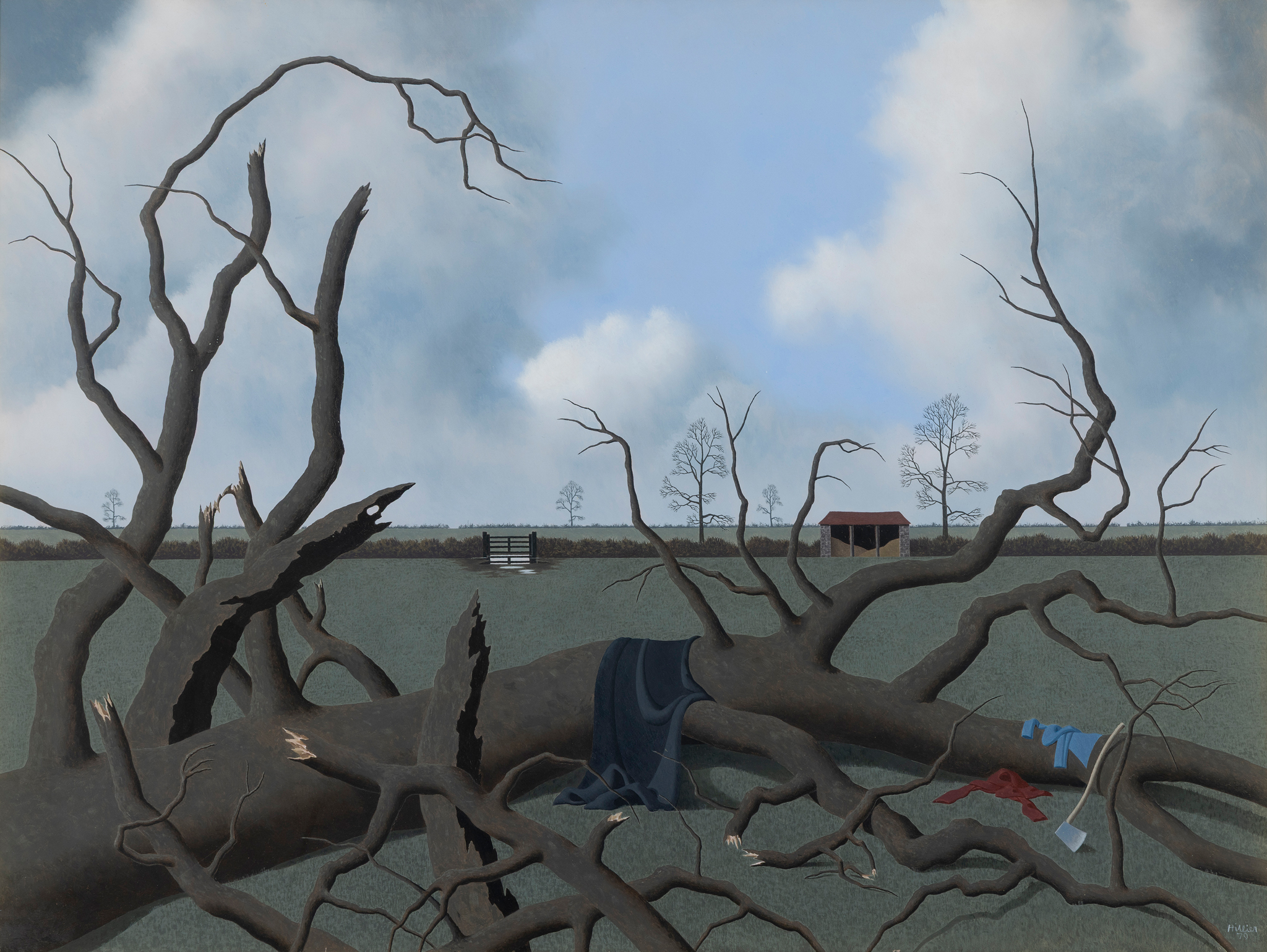
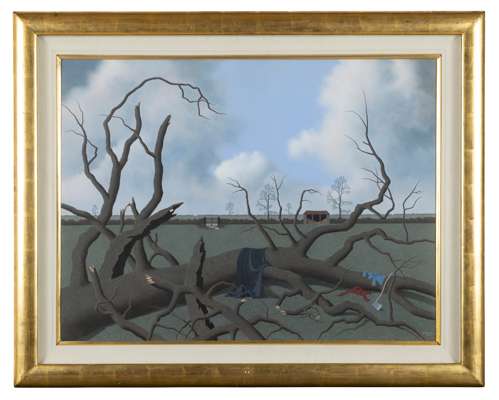
FALLEN ELM, 1979

Auction: MODERN MADE | Lots 1 - 422 | Fri 01 May at 10am
Description
signed and dated (lower right), oil on canvas
Dimensions
60cm x 79cm (23 5/8in x 31in)
Provenance
with The Lefevre Gallery, London;
with The Everard Read Gallery, South Africa;
Sothebys, London, 20th Century British Art, 11 December 2006, lot 51 (as Fallen Elm), where acquired by the present owner;
Private Collection, London.
Footnote
This work was first exhibited under the title ‘The Death of an Elm’ and this is the title under which it will be recorded in the forthcoming catalogue raisonné of the artist’s paintings being prepared by The Estate of Tristram Hillier.
We would like to thank the Estate for their assistance in cataloguing the current work. If any owners of works by Hillier would like to put them forward for consideration for the catalogue raisonné please contact the department.
Exhibited:
Lefevre, 1980, cat.no.8, illustrated (b&w).
Literature:
Pery, pl.121, p.144, illustrated;
Exh.cat, Taunton, 2019, fig.25, p.39, illustrated.
Born in Peking, China, in 1905, Hillier moved to the UK shortly after his birth, making Britain his home. He briefly returned to Peking in 1917 following the tragic deaths of his mother and brother. In 1926, he was offered a place at the Slade School of Art in London while also attending evening classes at Westminster School of Art. Under Bernard Meninsky, Hillier adopted a geometric approach to his drawings, which clashed with the traditional methods favoured at the Slade. After 18 months, following Meninsky’s advice to “go to Paris,” Hillier left London to further his studies.
Before arriving in Paris, he spent the summer in Cassis, in the south of France, where he befriended artists including Vanessa Bell and Roger Fry. Upon arriving in Paris, he trained under André Lhote and at Atelier Colarossi, immersing himself in the vibrant avant-garde scene of the 1920s and 1930s. He encountered many Surrealist ideas and aesthetics, which profoundly influenced his approach to composition, space, and symbolism. Hillier was particularly inspired by Giorgio de Chirico and Max Ernst, and he also crossed paths with Braque, Matisse, and Picasso.
Hillier’s association from 1933 with ‘Unit One’, a modernist group that was founded by Paul Nash and included important artist such as Henry Moore, Barbara Hepworth and John Armstrong, saw his place in the Surrealist and avant-garde circles solidify. Exhibiting with the group positioned him as one of Britain’s leading Surrealist artists.
Hillier’s paintings often feature dreamlike landscapes, deserted streets, and architectural forms immersed in an eerie stillness, reflecting the Surrealist fascination with the unconscious, mystery, and the uncanny. Unlike some contemporaries who embraced more abstract techniques, Hillier combined precise detail with Surrealist ideas, creating works that were both technically precise and emotionally evocative.
This painting by Hillier highlights his restrained and atmospheric approach to Surrealism, combining technical precision with a quiet sense of unease. The composition is dominated by a fallen, leafless tree whose twisted, skeletal branches stretch across the foreground, forming a jagged, lifeless structure. Draped over the centre of the trunk is a dark cloth, which could be a shroud, further adding to this feeling of death.
In the background, a flat, open landscape extends towards a low horizon, where a small, isolated building and sparse trees emphasise distance and desolation. The sky is filled with heavy yet softly rendered clouds, enhancing the stillness of the scene, creating an almost timeless atmosphere. Hillier’s Surrealism functions through suggestion rather than distortion, using unexpected juxtapositions and precise detail to evoke an idea of tension. The fallen tree may symbolise decay, loss, or aftermath, while the distant building, axe and clothes hints at a human presence without actually painting a figure in. Through a controlled use of colour and detail, Hillier constructs a contemplative yet unsettling image that reflects the Surrealist fascination with mystery, absence, and the unconscious.
Hillier travelled widely throughout his life, spending time in England, France, China and later Spain and Portugal. The Iberian landscape, in particular, proved enduringly significant. He worked from sketches and photographs made on his travels, developing them into carefully constructed studio paintings upon his return to Somerset, where he eventually settled in the 1950s. Today Hillier’s work can be found in the collections of Tate Gallery, Manchester Art Gallery, along with many private collections.