

Lot 109
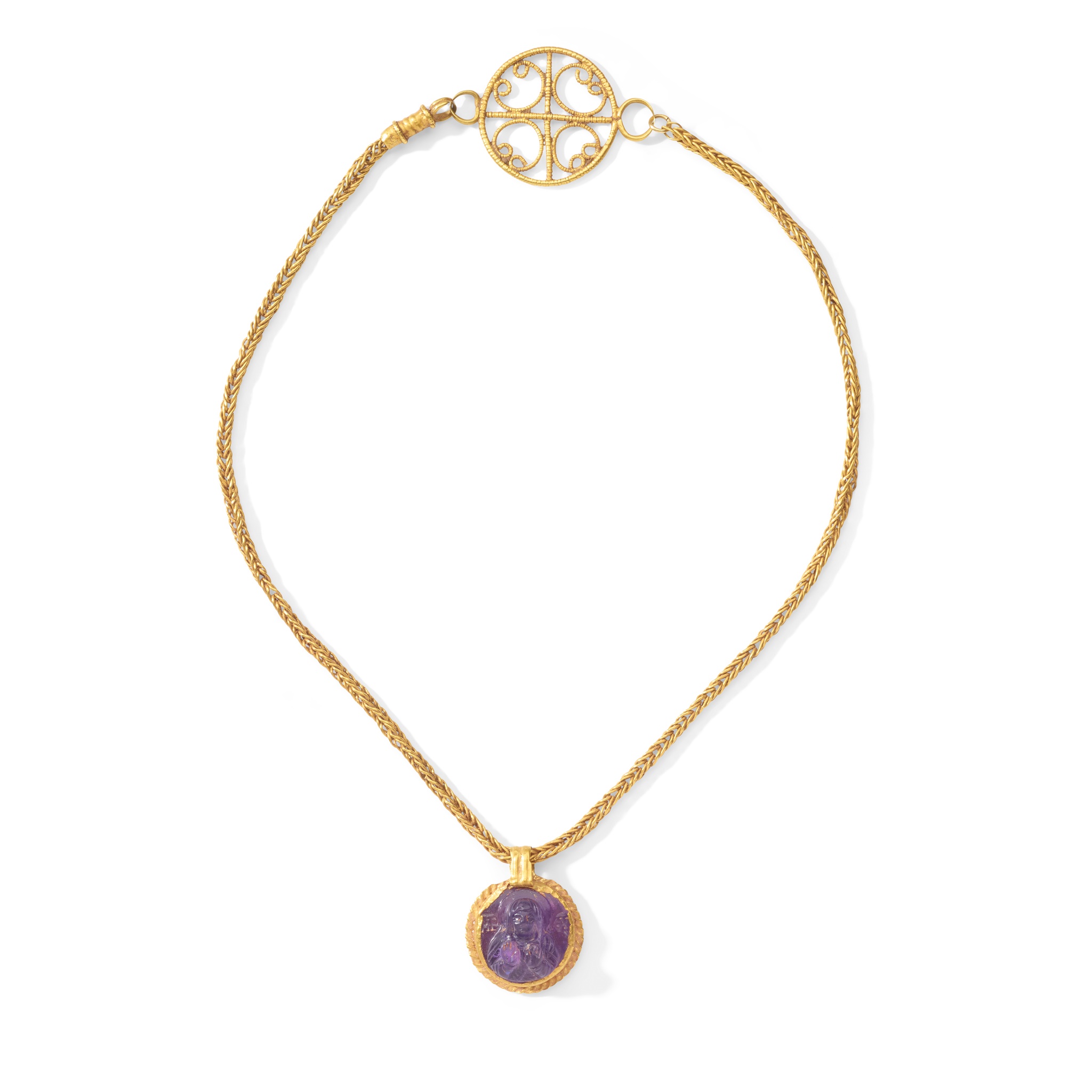
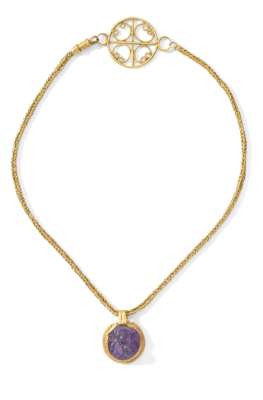
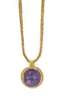
A Byzantine gold and amethyst pendant,
11th - 12th century A.D.
Auction: 06 March 2024 from 10:00 GMT
Description
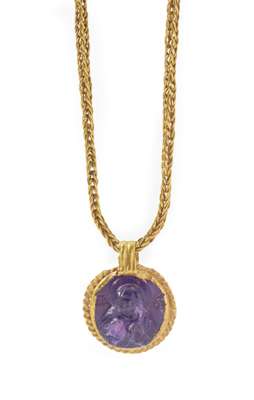
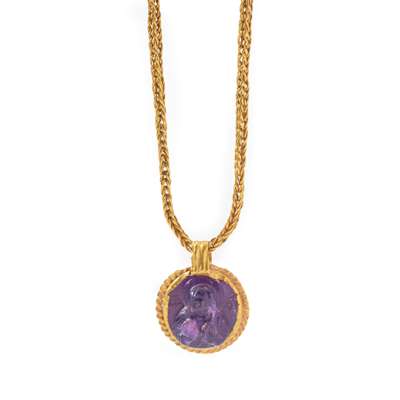
The circular amethyst cameo sculpted in high relief with a half-length bust of the Virgin orans, wearing tunic and maphorion, her hands raised, with the palms opened in front of her bust, framed by an identifying Greek inscription M-P ΘV, the gold mount with a circular bezel and integral loop for the attachment of a gold link chain
Dimensions
Lengths: pendant 2.8cm, necklace 34.0cm
Provenance
Provenance:
Private collection, United Kingdom, acquired from the below in 2007
Phoenix Ancient Art, New York, previously in a private US collection
Please note that this piece has been checked and cleared against the Interpol database
Footnote
The present piece is an exceptional and rare depiction of the Virgin orans. A beautiful example of middle Byzantine gem cutting, in style it may be compared with another, made for the emperor Nicephorus III (1071-1081) and now residing in the Victoria and Albert Museum (accession no. A.1:1, 2-1927).
The practice of glyphic art, which was quite popular among Romans, persisted during the early Byzantine era. However, it experienced a hiatus in the East between the 7th and 10th centuries due to Arab invasions. During this time, stone cutting disappeared in the Levant. Interestingly, Western Carolingian workshops revived this specialized craft, discovering and adapting various techniques for working with rock crystal. This revival was significant as rock crystal had become scarce in the West following the fall of the Roman Empire. Byzantium, after overcoming the iconoclastic crisis, once again embraced glyptic art. However, this revival primarily focused on religious themes depicting Christ, the Virgin Mary, and the saints, often in half or full-length representations. Nevertheless, the range of stones used during this period was more limited compared to earlier centuries, with a particular emphasis on the use of softer and more manageable jasper. Sapphire and amethyst were reserved only for the most prestigious and luxurious objects.