

Lot 81
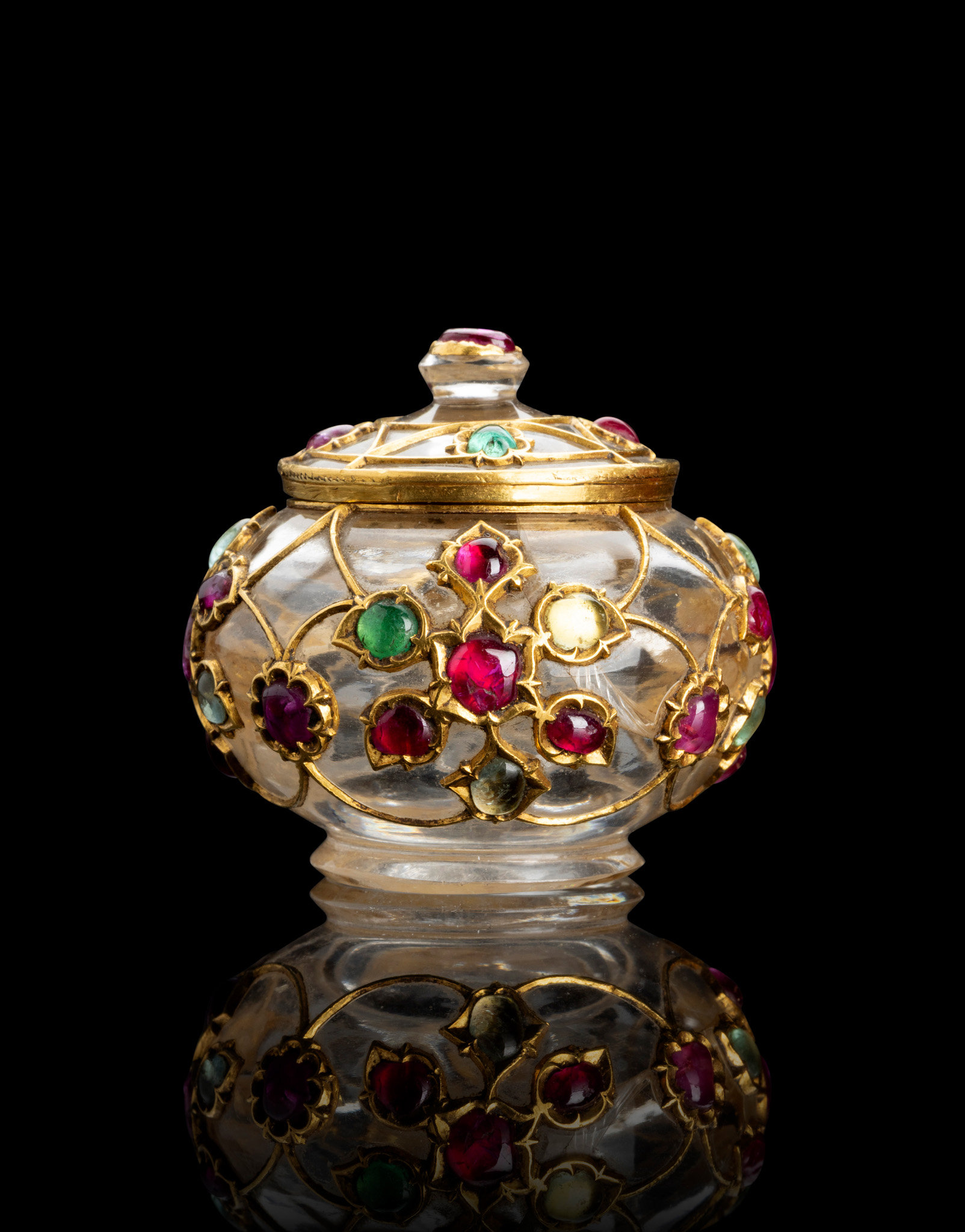
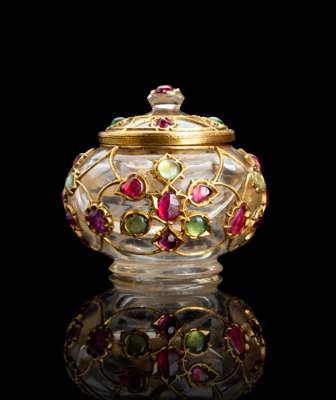
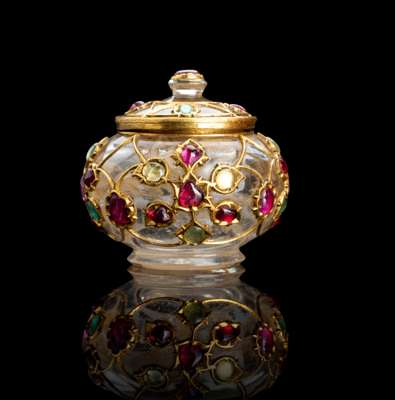
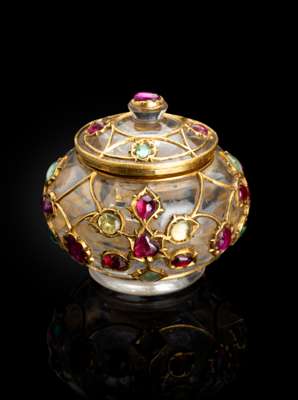
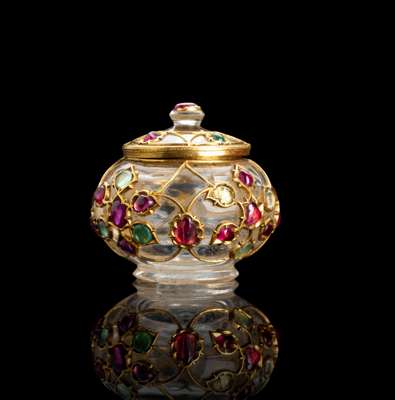
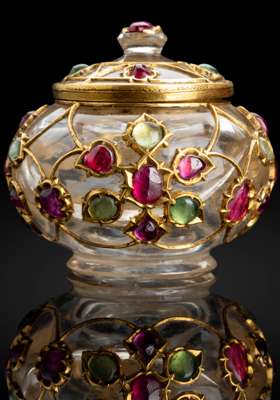
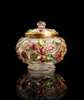
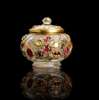
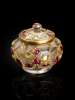
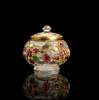
A SUPERB ROCK CRYSTAL LIDDED BOX SET WITH RUBIES AND EMERALDS
INDIA, MUGHAL OR DECCAN, CIRCA 1650-1700
Auction: 09 December 2026 from 14:00 GMT
Description
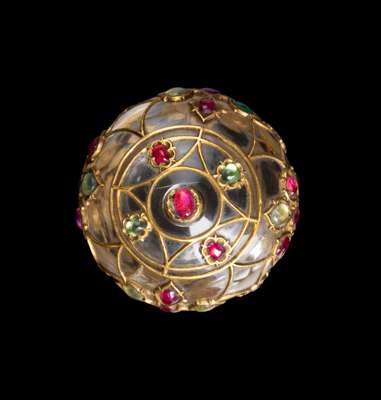
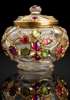
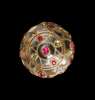
the rock-crystal globular vessel carved and inlaid with gold and kundan-set with rubies, emeralds, pale beryls and pink sapphires, standing on a low foot, the lid fitted to the body with a gold collar and also kundan-set with rubies and emeralds, the cusped settings in a highly distinctive format in six-pointed stars
Dimensions
45mm high, 42.5mm diameter
Footnote
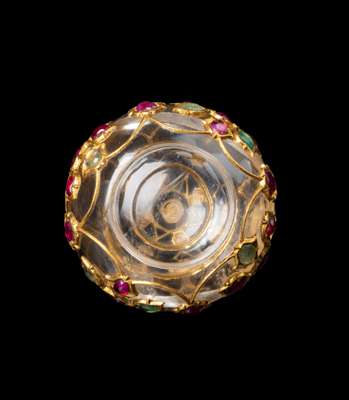
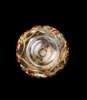
This small rock crystal box may be for cosmetics or ointments. It is in the form of a slightly flatted sphere, standing on a splayed low foot which has a concave surface, decorated with inlaid gold wire placed in a lattice and standing proud of the surface, kundan-set with foiled cabochon gems including rubies, pink sapphires, emeralds and pale beryls (for the sake of convenience, the gems will hereafter be called rubies and emeralds). The gems are set around the body in four loose six-pointed stars, each with a central ruby in a six-pointed cusped setting surrounded by six further gems comprising three rubies and three emeralds, in carved floret settings each with a pointed top and small claw-like intrusions. These stars alternately have a ruby and an emerald in the upper floret. A gold lozenge-shaped lattice links the side florets to four single rubies in cusped settings and continues under the rosettes in simple curved lines. The circular aperture has a gold collar into which the corresponding gold rim of the lid fits closely creating a low pedestal. The lid is domed, with an integral knop on the top, concave on the underside, and is similarly set with gold and gems, having a ruby set in the knop on the top of the lid, and four stones, alternately ruby and emerald in cusped settings linked by a gold lattice and two simple concentric circles of gold.
The gems are foiled which balances the tones of red and green, while the stones themselves are of varying colour intensity. The red gems vary from ruby red to paler pink sapphire, while the green gems also vary from a deep emerald green to a pale, almost colourless, beryl. The effect of the foiling is to create more even colour tones in this most jewel-like of small objects.
The principal characteristic of this rock crystal box lies in the gem-settings placed within a lattice. These are highly distinctive with a cusped six-pointed setting at the centre of each of the four stars, and lobed and clawed settings for the single rubies between the stars. The four gems on the lid have similar lobed and clawed settings. The settings are also distinguished by small lines of gold placed across the edges and in the cusps of the settings, creating outlines reminiscent of European Gothic style.
Rock crystal objects with settings of this type are unusual. There are two pieces decorated in this manner in the al-Sabah collection, Kuwait, comprising a cup of rock crystal, with a gold lattice having a series of eight-pointed stars of rubies in cusped settings and individual gems similarly set at the intersections of the lattice lines (Al-Sabah collection, no. LNS 368 HS; M. Keene with S. Kaoukji, Treasury of the World: Jewelled Arts of India in the Age of the Mughals, London: Thames and Hudson in association with the al-Sabah Collection, 2001, p. 33, no. 2.7 (dated India, Deccan or Mughal, later 16th-early 17th century); Salam Kaoukji, Adornment and Splendour. Jewels of the Indian Courts, London: Thames and Hudson, 2023, pp. 334-5, cat. 137 (early 17th century), and a box of rock crystal, with a gold lattice set with single rubies and emeralds in lobed cusped settings (al-Sabah Collection, Kuwait, no. LNS 209 HS; M. Keene with S. Kaoukji, Treasury of the World: Jewelled Arts of India in the Age of the Mughals , London: Thames and Hudson in association with the al-Sabah Collection, 2001., p. 35, no. 2.11 (dated as India, Deccan or Mughal, late 16th-early 17th century); Kaoukji 2023, pp. 336-7cat. 138 (early 17th century).
Other rock crystal objects set in this manner include a small rock crystal flask with a gold lattice and similar cusped settings was in the Al Thani Collection (Navina Najat Haidar and Courtney Ann Stewart, Treasures from India. Jewels from the Al-Thani Collection, New York: Metropolitan Museum of Art, 2014, pp. 32-3, dated 1650-1700; Susan Stronge, Bejewelled Treasures. The Al Thani Collection, London: Victoria and Albert Museum, 2015 (dated as circa 1800); Amin Jaffer (editor), Beyond Extravagance. A Royal Collection of Gems and Jewels, 2nd edition, New York Assouline, 2019, p. 116, no. 20, dated 1650-1700; Christie’s New York, 19 June 2019, lot 236, dated 1650-1700.). This flask is a close parallel to the box both through the decoration and the form of the base, with a very similar splayed foot with a slightly concave surface. Another small rock crystal box is in the Metropolitan Museum of Art, New York is in the same group and should be dated to the same period as this box, the al-Sabah collection pieces and the Al Thani flask (Metropolitan Museum 95.14.12, dated on the museum website as 18th century).
This setting type has not been isolated in the literature, and there is some scholarly disagreement on the dating of objects decorated in this manner. Salam Kaoukji notes that this type of setting was favoured in the early 17th century (Salam Kaoukji, Adornment and Splendour. Jewels of the Indian Courts, London: Thames and Hudson, 2023, p. 335). Manuel Keene and Salam Kaoukji dated the pieces in the al-Sabah collection to the later 16th century or early 17th century and placed them in the Deccan or Mughal India; Kaoukji later revised these dates to the early 17th century (Salam Kaoukji, Adornment and Splendour. Jewels of the Indian Courts, London: Thames and Hudson, 2023, pp. 335 and 336). The Al Thani flask was dated to 1650-1700 by Haidar and Courtney 2015 and in Jaffer 2019, while Susan Stronge considered it to date from circa 1800. This late dating cannot be sustained when the settings on the flask are compared to gem-set objects known to date from the late 18th century, such as inlaid dagger hilts.
Gem-set rock crystal from the Mughal workshops or from the Deccan is rare, and few pieces are published compared to jade vessels. Rock crystal was expensive at the Mughal court, highly valued by the emperor Jahangir who admired a small European rock crystal box he was given in 1615 (Jahangir, The Jahangirnama, trans. Wheeler Thackston, Washington D.C.: Freer Gallery of Art, Smithsonian Institution,1999, p. 174). The European traveller Niccolao Manuccci noted the value of rock crystal later in the same century (Niccolao Manucci, Storia Do Mogor or Mogul India, translated by William Irvine, 4 vols., London: John Murray 1907-08, reprinted new Delhi: Oriental Books Reprint, 1981, vol. II, p. 376).
The workshop that produced this rock crystal may have been at the Mughal court, where objects of this brilliance were appreciated by the emperors, but could also have been at one of the Deccani sultanates. A Deccani provenance could be indicated by the six-pointed star motif in place of a floral design: geometric rosettes and stars were favoured by Deccani craftsmen while a flower with a swaying stem is characteristic of Mughal decoration. Taking the comparative group discussed above into account and the possible place of manufacture, a dating of 1650-1700 for this gem-like box appears reasonable.
We are grateful to Michael Spink for the cataloguing of this lot.