

Lot 66
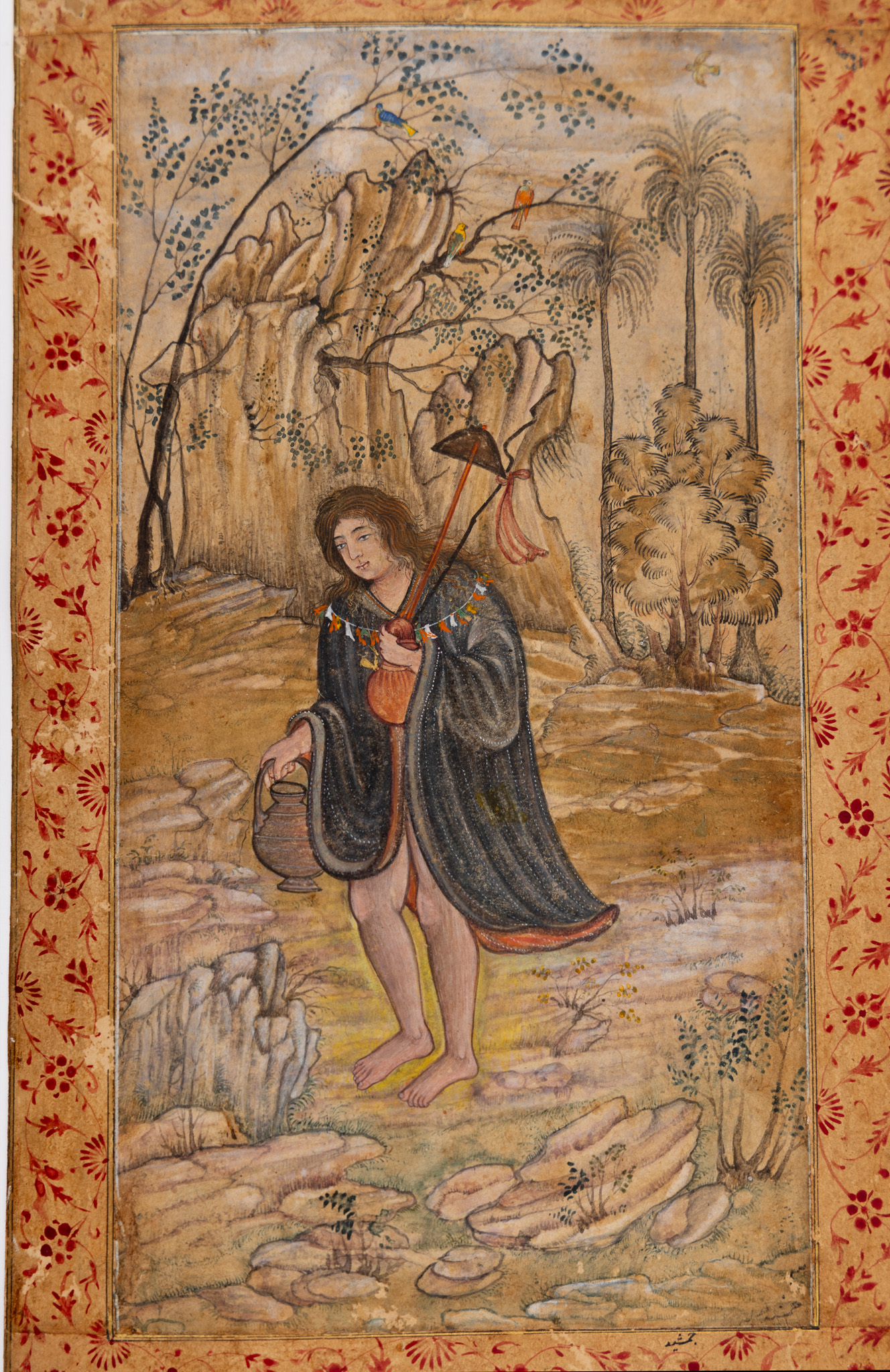
A WANDERING ASCETIC IN A ROCKY FOREST LANDSCAPE ‡
MUGHAL INDIA, SIGNED JAMSHID, CIRCA 1590
Auction: 09 December 2026 from 14:00 GMT
Description
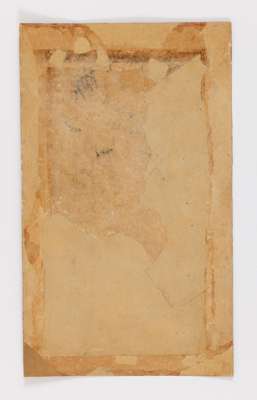
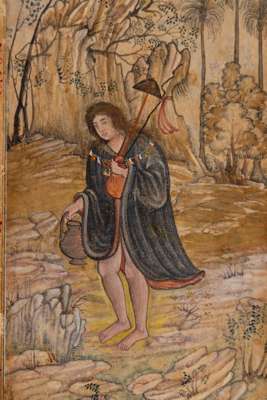
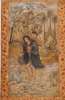
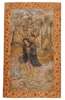
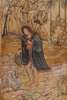
gouache and ink on paper, depicting a bare-footed ascetic with brown flowing hair with a faint impression of a halo around his head, wearing a blue and red cloak draped over his upper body, holding a water container in his right hand and a tall fan-like staff in his left hand, the background comprised of rocks, trees and fauna, a rocky mountain-scape behind with delicate trees in the background, including three palm trees, three coloured exotic birds in the trees, bottom right hand corner of the image faintly signed ‘Jamshid', the red and gold floral border signed in black ink ‘Jamshid’
Dimensions
folio 23cm x 13.8cm, image 19.7cm x 10.4cm
Provenance
Formerly the French trade, mid-20th century.
Private American collection.
Footnote
This superb painting with the figure of the soulful ascetic dressed in a cloak wandering in a rocky landscape strongly reflects an European influence which became popular during the reign of Akbar (r. 1556-1605).
Akbar first met a Portuguese delegation led by Antony Cabral during the siege of Surat in 1573, the start of his serious interest in European art and culture. Father Jerome Xavier, a nephew of Saint Francis, led the third Jesuit mission to Lahore in 1595, staying at the courts of Akbar and Jahangir for twenty-two years. Although all attempts to convert Akbar to Christianity failed, he readily accepted gifts from Europe including in 1580 the great polyglot bible published by Plantin in Antwerp. It was by this broad-minded, cultured ruler Akbar that artists in the Mughal atelier, much influenced by their contemporaries in Europe, were first acclaimed (see A. Das, Mughal Painting during Jahangir's Time, Calcutta, 1978, pp.229-242 and Sotheby's, Fine Oriental Manuscripts and Miniatures, 1984, lot 36).
The present painting appears to be a copy after an European engraving of a Christian saint, depicting a familiar Indian subject - a wandering ascetic. The treatment of the face, the halo, hair and robe reflects European influence, while the fan, sticks, and pouch containing rice are rooted in Indian tradition. In addition, the use of ink on the contours of the trees and the pouch, suggest the artist's interpretation of the ‘engraving' style. Studies of ascetics such as the present example provided artists with an opportunity to demonstrate their mastery of the human figure and their ability to model drapery.
The adaptation of European imagery by Indian artists developed into a distinctive genre within the Mughal artistic repertoire during Akbar’s reign. The present painting may be compared with the well-known painting, The Dervish, circa 1590, by the Mughal artist Basawan, now in the Musée Guimet, Paris (illustrated in A. Okada, Indian Miniatures of the Mughal Court, Paris, 1992, fig. 95, no. 92). Basawan’s interest in depicting dervishes led him to portray them both in independent drawings and miniatures and within larger illustrated imperial manuscripts. The most striking similarity is the inclusion of the palm trees in the background which are present on our painting. Another painting that may have acted as an inspiration to this painting, is Basawan's ‘A Muslim Pilgrim Learns a Lesson in Piety from a Brahman’, folio from a Khamsa (Quintet) of Amir Khusrau Dihlavi dated to c. 1597–98, which is in the The Metropolitan Museum of Art (see object number MMA13.228.29). The pilgrim has a similar stance to our ascetic and his robes are treated in the same manner, as well as the details observed in the rocks and the natural surroundings.
Our painting is signed twice by ‘Jamshid’, once in the lower right hand corner of the image and again in black ink on the floral border. Jamshid was a contemporary of Basawan and Mahesh which would explain certain similarities in style. He is recorded as having contributed to the Babur-nama of circa 1591 [folio 257r] and the Jami al-Tawarikh of circa 1596 [folio 296r] (see M. Cleveland Beach, The Imperial Image: paintings for the Mughal Court, Freer Gallery of Art, 1981, p. 222 and 225. A relatively minor artist compared to his contemporaries but clearly an artist who was greatly influenced by his Master tutors.