

Lot 4
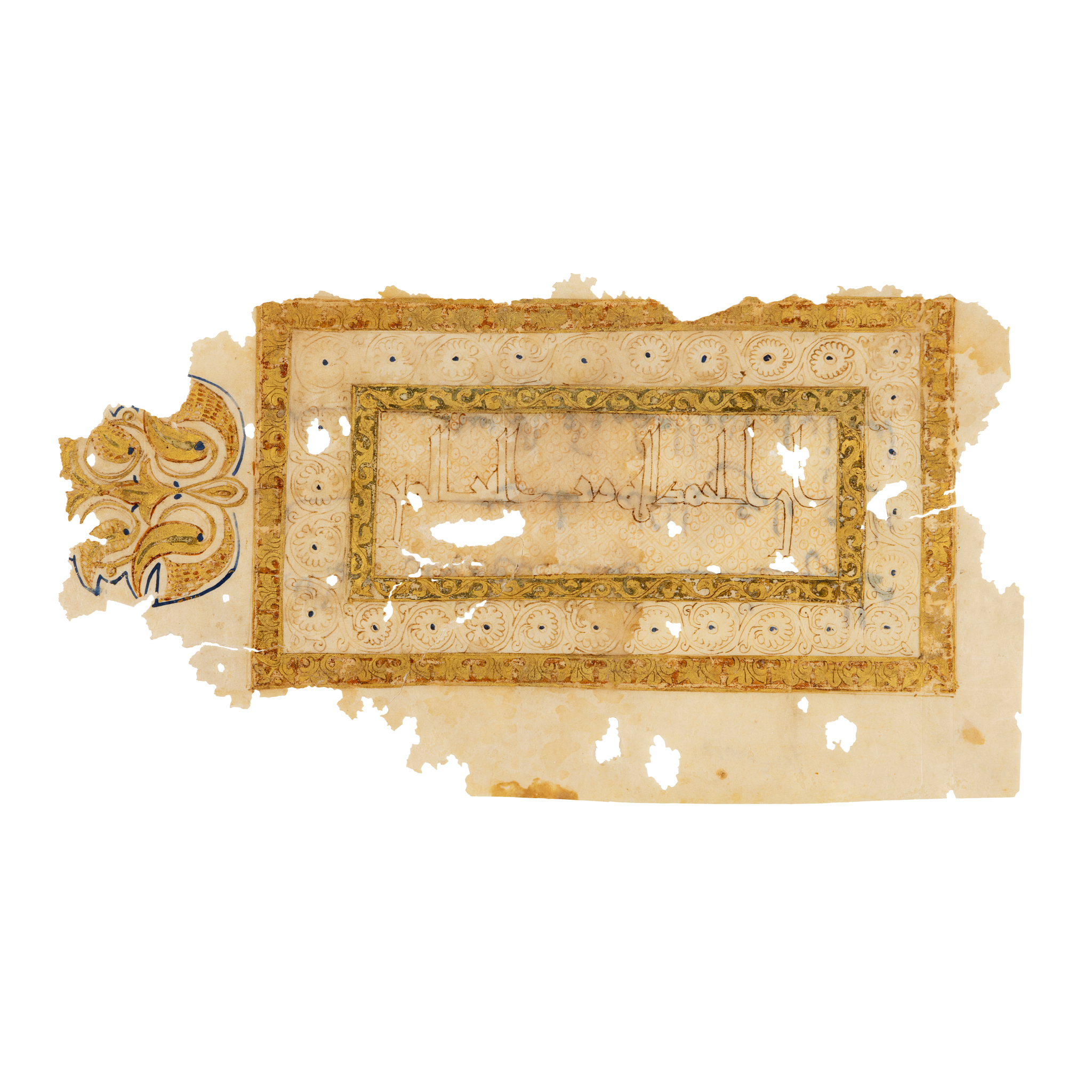
A FINELY ILLUMINATED ABBASID QUR'AN FINISPIECE
NORTH AFRICA OR NEAR EAST, 9TH CENTURY
Auction: 10 June 2026 from 14:00 BST
Description
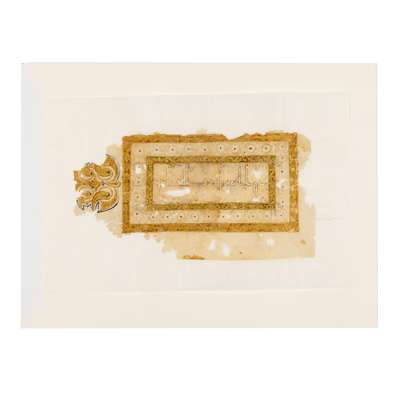
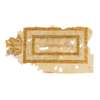
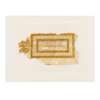
Arabic manuscript on vellum laid down on rice paper, through the centre one line of kufic script in sepia ink comprising Qur'an chapter 10, end of verse 10, the enveloping rectangular panels illuminated in bands of gold and colours with continuous vegetal and floral designs, to one side of the outer rectangle, a stylised arabesque half-palmette element
Dimensions
approx. 27cm x 15cm
Provenance
Acquired from the London art market in circa 1995.
Footnote
This exceptionally fine fragment originally formed the finispiece (illuminated final page) of the 10th volume of what must have been a truly splendid 60-part Qur’an. Its decoration demonstrates a sophisticated mastery of geometric design, where simple elements such as lines, circles, and rectangles are combined into intricate and harmonious compositions. The closest comparison to the present finispiece is the carpet page from a Qur’an now in the J. Paul Getty Museum (inv. no. 83.MM.118.2.10.recto). This shares a very similar aesthetic of delicate floral and vegetal elements drawn in reserve on a shaded background, as well as interlaced borders of gold on red and a large palmette extending from the main panel. This manuscript has been attributed to the 9th century, of either North African or Iranian production [see Sahragard, M., “Northern Africa or Central Iran? An Investigation into the Production Place of a Fragmentary Kufic Qur'an at the J. Paul Getty Museum” in Getty Research Journal, No. 19 (2024), pp. 3-17, esp. pp. 6-8 fig. 1]. Other comparable 9th century illuminated elements are in the Khalili Collection (inv. no. KFQ 78) and the Chester Beatty Library (inv. no. Is 1407) [see Déroche, F., The Abbasid Tradition: Qur’ans of the 8th to 10th Centuries, The Nasser D. Khalili Collection of Islamic Art vol.1, The Nour Foundation in association with Azimuth Editions and Oxford University Press: 1992, pp.123–4 cat.67; Arberry, A.J., The Koran Illuminated: A Handlist of the Korans in the Chester Beatty Library, Hodges, Figgis & Co., Ltd: 1967, p. 5 no. 6 and pl. 15].
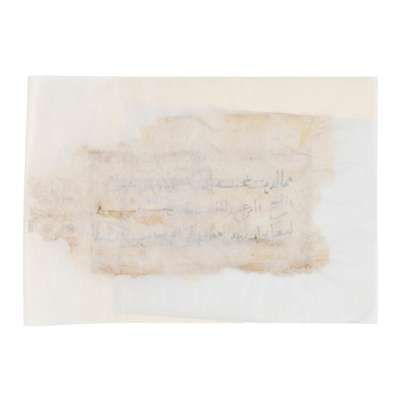
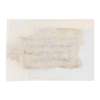
On the reverse, written upside down, are three lines of text from a waqf deed in cursive script, datable to the 10th or 11th century. The text is very damaged, but it is possible to decipher the beginning of the first line, mimmā amara bi-tahbīsihi li-llāh (‘what was given as an endowment to God’), and that of the second, ila masjid Ibn ʿAbd al-Muttalib (‘to the Mosque of Ibn ‘Abd al-Muttalib’). The latter offers the possibility that this fragment might once have been endowed to the famous Mosque of Hamza Ibn ‘Abd al-Muttalib, which is named after the Prophet’s uncle and is built near the site where he fell at the Battle of Uhud (just outside Madina) in 3 AH/625 CE. There are other mosques with this name so the theory must be treated with some caution, but a manuscript as fine as the one from which this finispiece came would surely have been an appropriate endowment for such a storied place of worship.