

Lot 20
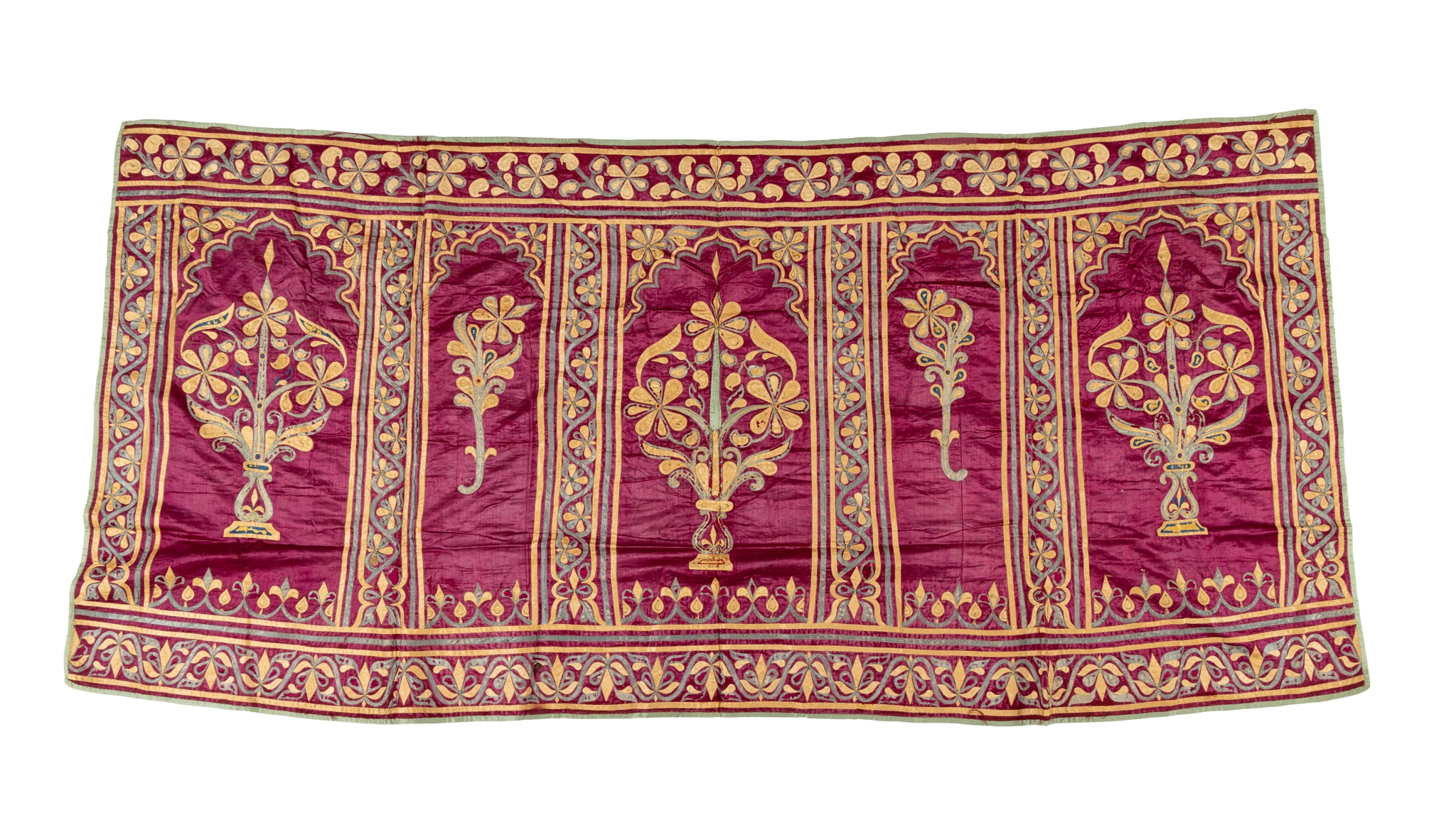
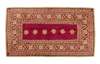
A RARE GROUP OF OTTOMAN SILK APPLIQUÉ TENT PANELS
TURKEY, 18TH CENTURY




Auction: 10 June 2026 from 14:00 BST
Description
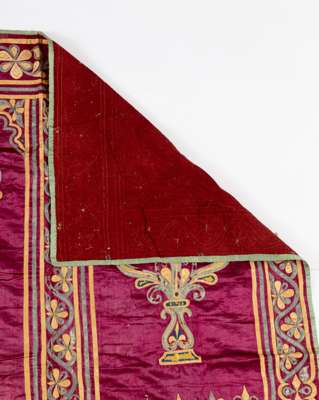
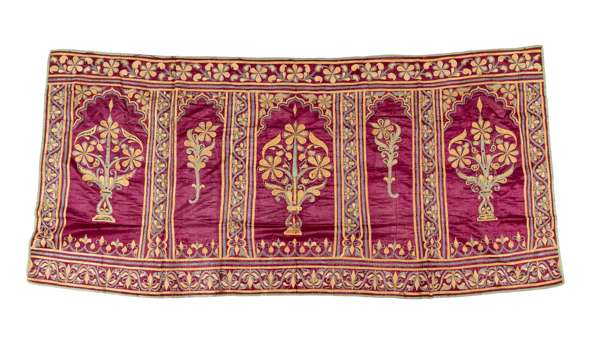
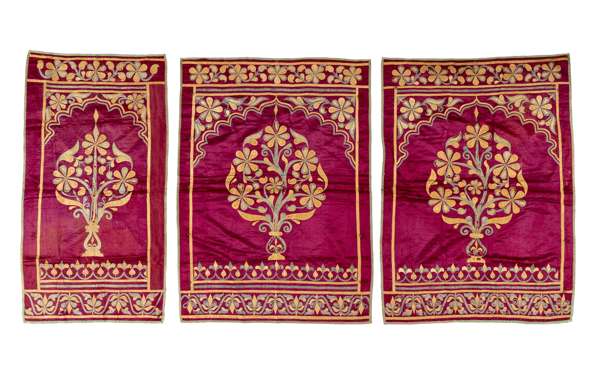
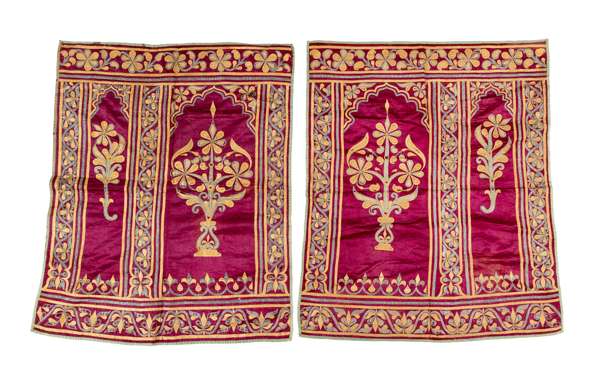
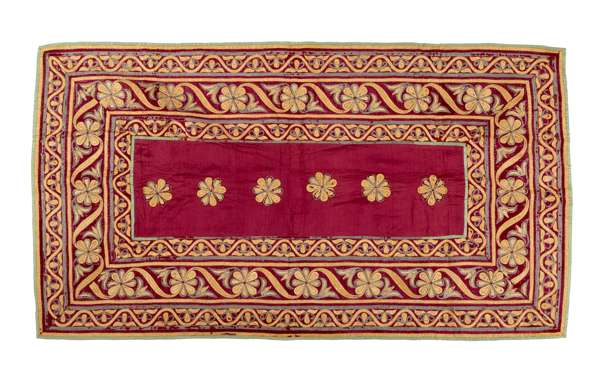
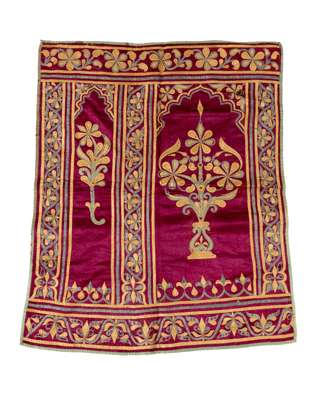
comprising six panels of various rectangular sizes, the burgundy silk ground applied and sewn with light silver-blue and yellow silk strips, the majority of the panels with decoration forming a vase with issuing branches and floral stems or a single stem within a lobed arch, inner borders with continuous meandering vegetal designs, one rectangular panel with a single band of six vertical flowerheads through the middle, enclosed by three narrow bands of interlace, hemmed in light turquoise, backed in cotton
Dimensions
smallest 100cm x 52cm; largest 97cm x 215cm
Footnote
These magnificent panels, which would originally have formed part of the inner shell of a luxurious tent (hazine), are superb examples of 18th century Ottoman textile production. They are in excellent condition and retain their original, vibrant colour scheme of yellow and silver-blue on a rich burgundy purple background, comparable with examples in museum collections across Europe and Türkiye.
Reflecting its origins as a fighting force which was constantly on the move, tents held a longstanding significance within the Ottoman empire. Writing in the 15th century, the Spanish traveller Pero Tafur wrote that “The Grand Turk and his people are always in the field in tents, both winter and summer. . . although the city is close at hand”, and any early Ottoman cityscape should also be understood as having a temporary extension of portable fabric dwellings [see Singer, A., “Enter, Riding on an Elephant: How to Approach Early Ottoman Edirne” in Journal of the Ottoman and Turkish Studies Association, Vol. 3, No. 1 (May 2016), pp. 89-109, p. 104]. This love of the luxury tent city, a place where the Sultan could self-represent as both nomadic warrior and refined ruler, continued into the 18th century. In the Surname, a book devoted to the fifteen days of festivity around the circumcision of Sultan Ahmet II’s sons in 1720, an entire double-page spread is devoted to images of the grand tent city erected in Istanbul’s Ok Meydani for the celebrations [see Atil, E., “The Story of an Eighteenth-Century Ottoman Festival” in Muqarnas, Vol. 10 (1993), pp. 181-200, p. 185 and fig. 3].
By the time that the present panels were made, tents were much less for war than for pleasure. Ottoman elites could enjoy the natural surroundings in which these temporary pavilions were arranged, and the floral appliqué designs seen here would have echoed such idyllic settings. If one considers the floral motifs set within arches featured on the present panels, then for the viewer standing within such a tent the impression would have been of being inside a covered arcade, looking outward toward a garden framed between the archways. Beyond the illusory impression of infinite space, this might even have had paradisical associations [Dimmig, A., “Fabricating a New Image: Imperial Tents in the Late Ottoman Period” in International Journal of Islamic Architecture, Volume 3 Number 2 (2014), pp. 341-72, pp. 343-51].
An 18th century dating for the present panels is made by comparison with a tent now in the Askeri Müze ve Kültür Sitesi, Istanbul (inv. no. 26379). This previously belonged to Sultan Mahmud II (r. 1808-39) and is dated 1224 AH/1809 CE. It features many of the same elements as the present example, including a reddish-purple background, sunburst motifs, and scalloped arches, but the much more solid floral designs on the present panels suggest a slightly earlier dating [see Atasoy, N., Otag-i Humayun: The Ottoman Imperial Tent Complex, Aygaz: 200, pp. 79-81 fig. 23]. Another tent, in the Czartoryski Museum, Kraków (inv. no. XIV-892), resembles the present example in its use of two colours within the same appliqué element to suggest shading. This can also be seen in the present example, where silver is used for the edges of leaves and stems. The Kraków tent has been dated to the late 18th or early 19th century [Dimmig, op. cit., pp. 357-60]. A similar attribution may be given to the present tent panels.