

Lot 308
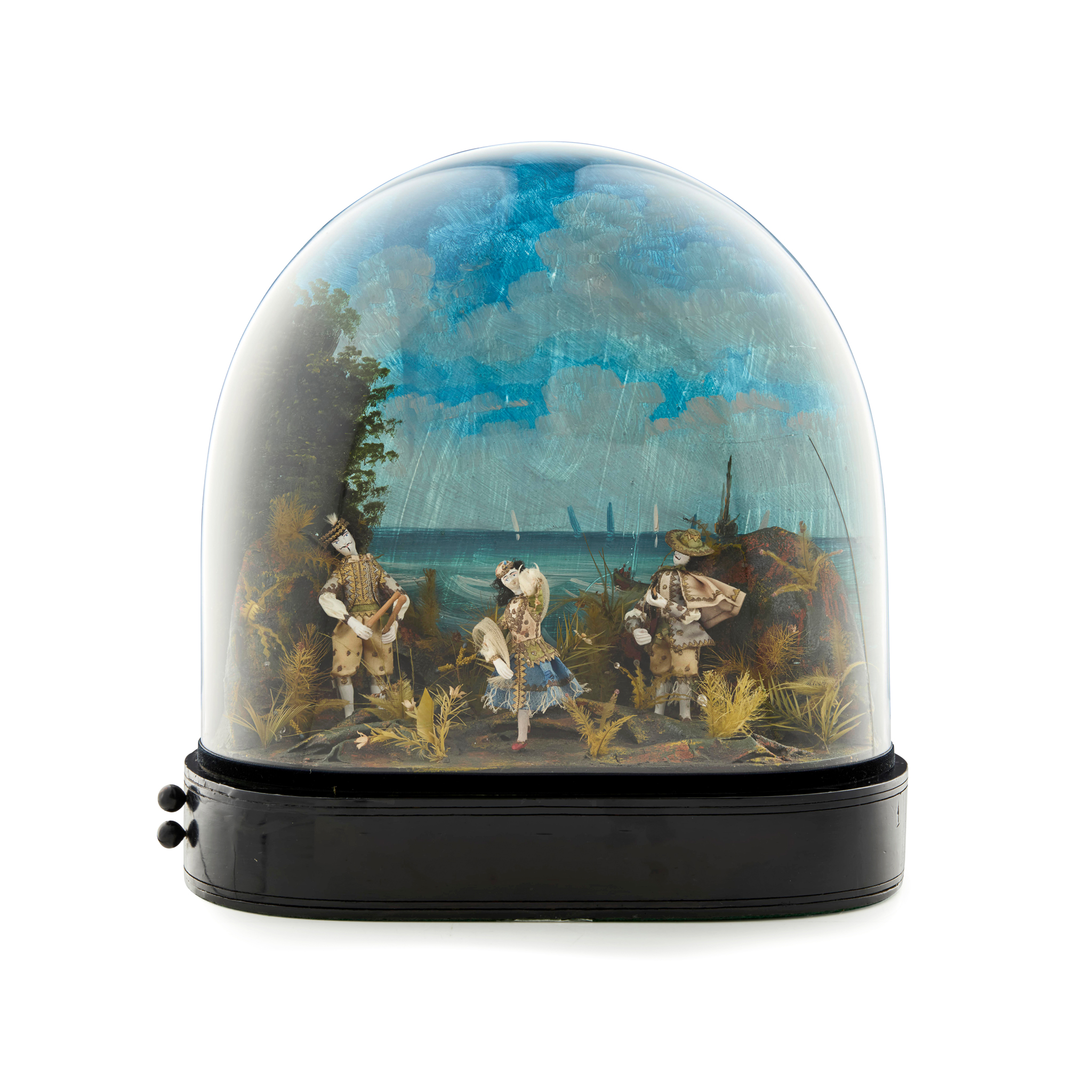
GLASS DOMED VICTORIAN AUTOMATON DIORAMA
LATE 19TH CENTURY

Auction: Day One | Wednesday 18 Feb at 10am | Lots 1 to 352
Description
depicting an exotic scene of two musicians and a lady, in gilt embellished costumes, dancing on a far-away shore surrounded by flowers and foliage, the back of the dome painted with a seascape of ships on the waves, raised on an ebonised base
Dimensions
37.5cm high, 34cm wide
Footnote
The umbrella term ‘automata’ can meaningfully include any device that is capable of independent movement. However, we can divide automata into those that are functional (clocks and watches) and those that are fanciful. Fanciful automata often incorporate mimetic acts into their movements, giving the impression of a living thing; for example, flowers blooming, people blinking, or animals feeding.
Stories of automata can be dated to the 8th century BCE, and fascination with them as a feat of engineering has continued until the 18th century. While the arrival of the Industrial Revolution and its rapid technological development may have cast a shadow on the mechanics of the automaton, it did not dampen human interest in these devices. They were no longer sources of interest as technological marvels; instead, they became the focal point of conversations surrounding human will in the technological age. In Thomas Huxley’s “On the Hypothesis that Animals are Automata” he posited that people were conscious automata, operating through reflex more often than motive which opened up discussions as to how much of human action is intentional and how much is done on reflex. The commonality between people and automata is perhaps why automata remain popular to this day.