

Lot 76
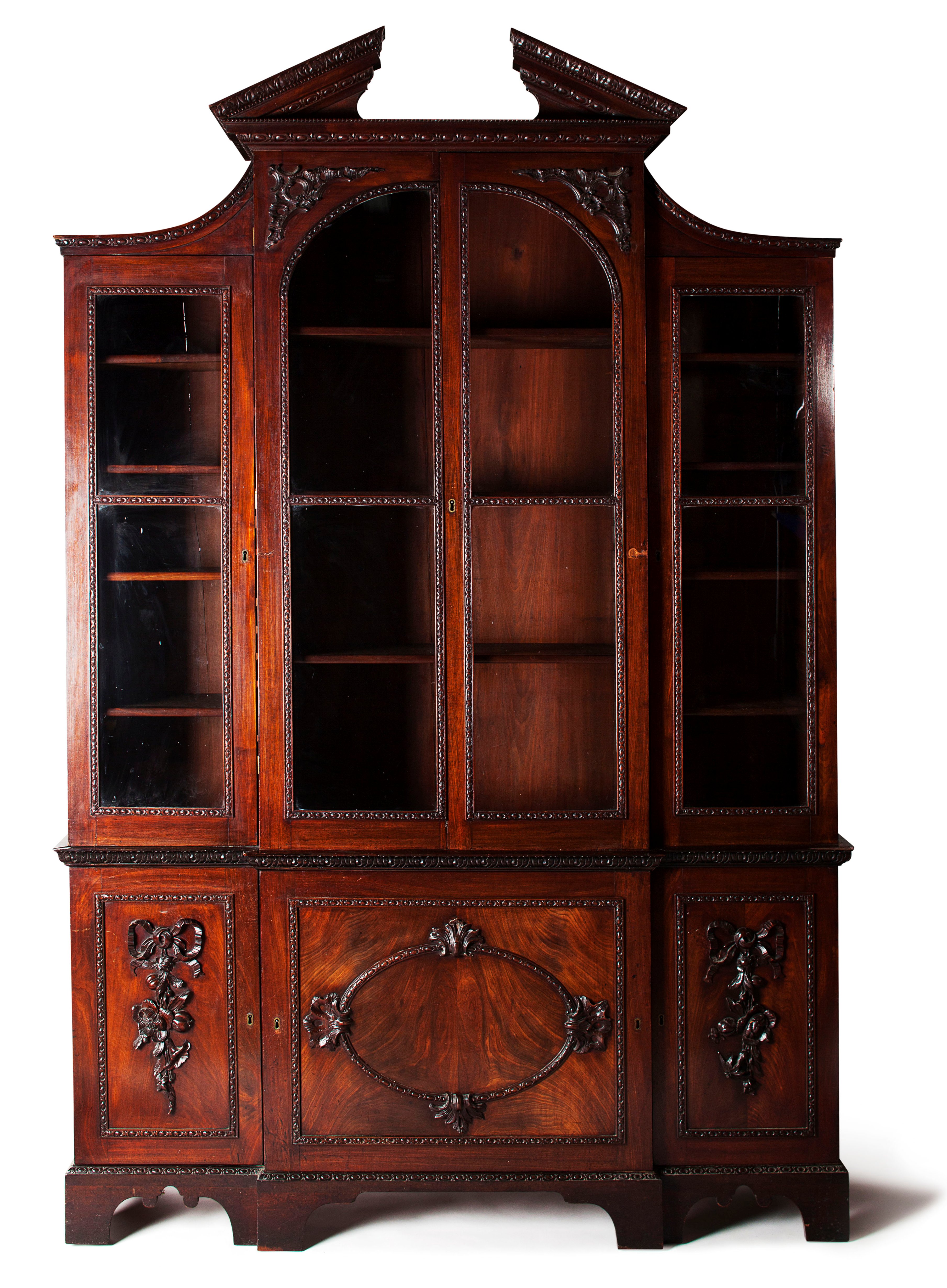
GOOD GEORGE II MAHOGANY BREAKFRONT BOOKCASE IN THE MANNER OF VILE AND COBB
CIRCA 1755
Auction: 14 January 2015 at 11:00 GMT
Description
of shallow breakfront outline, the broken arch pediment above a pair of doors with arched glazed panels and foliate carved corner mouldings opening to shelves, flanked by further set back glazed doors; the lower part with a central cupboard door with oval mouldings marked at the sides with acanthus carving, flanked by cupboard doors carved with ribbon tied fruit and foliate trails, raised on shaped bracket feet
Dimensions
166cm wide, 250cm high, 40cm deep
Footnote
Provenance:
Collection of B. Coppinger Prichard; Property from a Highland Estate.
Featured in The Dictionary of English Furniture, vol. I, Antique Collectors' Club, Woodbridge, p.84
Note:
The partnership of Messrs. Vile & Cobb was first listed in the London Directory in 1750 and continued with great success until 1765 when William Vile retired with John Cobb continuing to trade until 1778. William Vile is considered the principle cabinet maker of the two, while John Cobb was listed as an upholsterer. This arrangement was rather typical of the period for furniture makers. They are considered to be Thomas Chippendale's greatest rivals and their work of the period is arguably some of the finest English made furniture produced in the mid 18th century. Favoured by George III and Queen Charlotte, a great deal of their work was by Royal commission.
Although no published designs exist for the firm and they did not mark their furniture, known pieces produced by Vile & Cobb provide a visual guide to the characteristics they typically employed. Straddling the divide between the heavy architectural style of Palladianism as executed by William Kent in the 1730s and 40s and the lighter and more feminine Rococo style of Thomas Chippendale gaining popularity in the 1750s, Vile and Cobb produced furniture of the highest quality. A signature motif employed by Vile is the carved acanthus clad oval or circular moulding found on door panels, often flanked by further carved details like pendant fruit swags as seen on the present bookcase. A bookcase of similar proportion and outline illustrated in Anthony Coleridge, 'Chippendale Furniture', pl 33, and described 'in the style of Vile' is nearly identical to the present bookcase with the addition of more elaborate carved mouldings to the pediment and mullions.
The present bookcase appears in Ralph Edwards 'The Shorter Dictionary of English Furniture', pg 53, pl 9 with no attribution or mention in the text with the exception of the caption accompanying the illustration stating it comes from the Coppinger Prichard Collection. It is believed the bookcase was purchased by the present owner's family from Frank Partridge & Son from whom they purchased much of the furniture in the collection.