

Lot 301
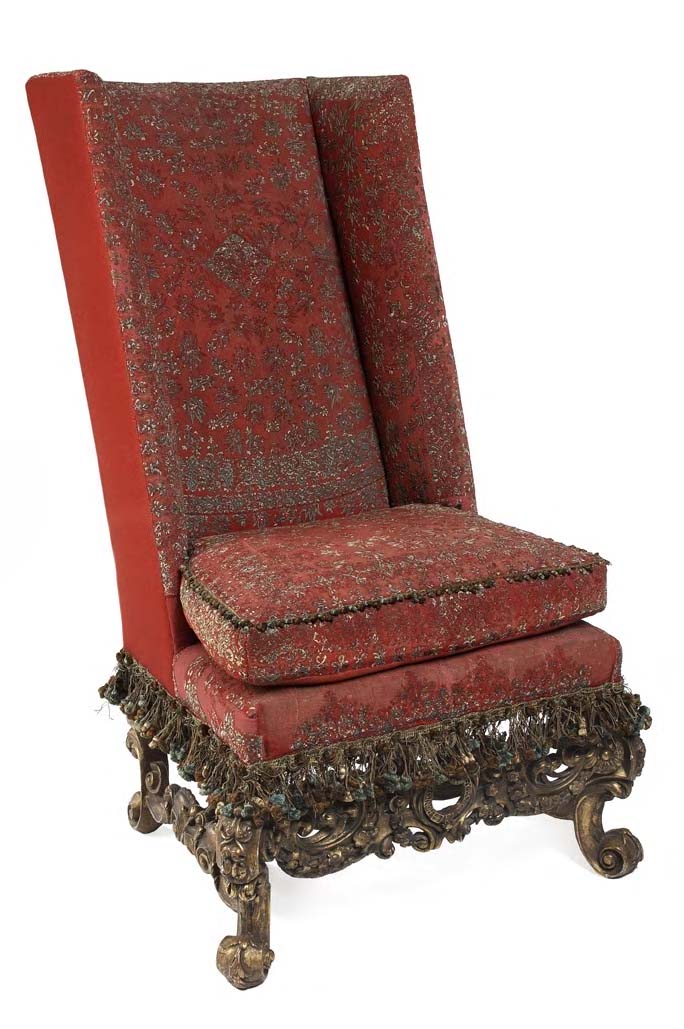
An important carved giltwood and upholstered high back chair, late 17th century,
Auction: 29 March 2006 at 12:00 BST
Description
the red wool fabric covered in restored panels of the original 17th century silver thread needlework, the loose seat cushion above a tassel-hung seat, the acanthus carved S-scroll legs with corner rosettes, joined by conforming husk-carved stretchers, the front apron with a central emblem of the Knights of the Garter, inscribed 'Honi Soit Qui Mal Y Pense', with scroll motifs and foliate garlands to either side
Dimensions
121cm high, height to seat edge, 39cm, 65cm wide, 62cm deep
Footnote
Provenance;
Comissioned by the 3rd Duke of Hamilton for his apartments at Holyrood House Palace, Edinburgh and thence by descent
Notes;
The Palace of Holyroodhouse grew up on the site of an Augustinian monastery founded by King David I of Scotland in 1128. As Edinburgh became recognised as the capital of Scotland, the kings preferred to stay at Holyrood as opposed to Edinburgh castle, mainly because of its hunting parks. As a result, palace buildings began to slowly overshadow the abbey. James IV made additions before his marriage to Mary Tudor in 1503, though sadly none of this work now survives.
His son, James V, constructed a huge tower, which still stands today, and then between 1535-1536 created a new west front for the palace. He died in 1542 and his practically newborn daughter Mary, Queen of Scots was sent to France. When her husband the King of France died, she returned to Scotland in 1560. She is the Scottish monarch most emotionally and dramatically linked to Holyroodhouse, her husband Lord Darnley murdering her secretary David Rizzio in her outer chamber. Her rooms in the tower later became a Georgian and Victorian tourist attraction, remaining basically unchanged from the mid 18th century until the early 20th century.
Her son James VI succeeded the English throne in 1603 as James I, and had the palace renovated in 1617 for his return. It was renovated again in 1633 for the Scottish Coronation of Charles I. The palace was then damaged by Cromwells' troops during the Civil War but the Stuart Charles II ordered that the palace be restored and improved, taking a personal interest in the plans and works. Work began in 1671 and James V's tower became the matrix for the new classical architecture, the three orders of Doric, Ionic and Corinthian being followed in the internal facades. The notorious old royal apartments in the tower were not as lavishly decorated or altered as other floors and were assigned to the Queen, Catherine of Braganza.
In 1679 the palace became a private residence for Charles II's brother, James Duke of York, who in 1685 became James VII of Scotland and James II of England. He left the palace in 1682 and on his departure the 3rd Duke of Hamilton expanded in to the James V Tower rooms, which necessitated buying additional furniture in the style of the day. The expansion was a natural move, as Charles I had made James, 1st Duke of Hamilton, the Hereditary Keeper of Holyrood.
Margaret Swain, in her essay for the Furniture History Society, 'The State Beds at Holyroodhouse', states:
"The Duchess's bed and japanned furniture had all been bought in London in 1682. John Ridge, upholsterer, charged £218. 10s. od. Sterling for 'a crimson and gould velvet bett, loyned with satin with 8 chairs and velvet cases, a feather bed and bolster, quilts, Japanned glass and stands a footstool blankets….' "
In the same essay she discusses the Hamilton inventories in detail. An inventory of 1684 lists the following:
In my Lady's Bedchamber
'………A Japan painted table & two stands with ane looking glass conforme…four armed chairs with four other chairs and a footstool all painted conforme to ye tables and stands……'
The late 17th century japanned armchair offered in this sale (lot 302) is probably one of the four japanned chairs mentioned above and was part of the order from London in 1682, executed by the Duke and Duchess of Hamilton. It is then likely that it stood in the Mary Queen of Scot's Bedchamber and became part of the folklore associated with that room.
The date of 1682 is also significant, for in that year it is recorded that the William, 3rd Duke of Hamilton, was invested as a Knight of the Garter, the 486th such member. The giltwood chair offered from Holyroodhouse has an ornately carved front apron with the Most Noble Order of the Garter motto of 'Honi Soit Qui Mal y Pense' carved into a central belt. It is probable that 3rd Duke had the chair and possibly a suite, specially commissioned while in London, and it clearly stands as a manifestation of the pride he felt in becoming a member of one of the oldest and noblest orders. Edward, Prince of Wales established the order in 1348, the garter referring to an armour strap and the motto translating to 'Evil/Shamed be he that thinks evil'.
The chair is probably from the same hand as a giltwood settee still at Holyroodhouse. This important settee includes the garter but also the cypher of the Duke of Hamilton, carved into the cresting and into the twin scroll apron rails. This settee is illustrated in, The Dictionary of English Furniture, revised and enlarged by Ralph Edwards, (1954 edition), Volume III. p.73, fig.6.
The importance in which both chairs were and came to be held, can be seen in early 20th century photographs, here illustrated, where they are both enclosed in glazed cases. An earlier Victorian oil painting by Swarbreck of 1861, currently hanging the King's Closet at Holyroodhouse, details the Chamber and the two chairs behind the bed closely resemble the offered lots.
In the 1740s, the architect William Adam redecorated the 1st floor tower rooms in the latest Georgian taste and the notorious 2nd floor rooms were not updated. The more baroque furnishings, including the beds ordered in the late 17th century, were moved up into these apartments. The Duke's housekeeper became by tradition entrusted in showing visitors the 2nd floor rooms and the myths linking 17th century furnishings with 16th century events became established. It was not until 1903 that Sir Herbert Maxwell, president of the Society of Antiquaries of Scotland, significantly altered and re-arranged these rooms.
The following extract from Ian Gow's book 'The Scottish Interior', discusses the history of the decorations in the Queen's Bedchamber in more detail.
Mary Queen of Scot's Bedchamber at Holyrood
1838
Mary Queen of Scot's Bedchamber at Holyrood was the most famous room in Scotland and this status is confirmed by its scoring the largest number of record drawings, engravings and lithographs. The finest views are these large lithographs by Swarbreck of 1838 which are also the earliest. Swarbreck takes advantage of the new medium to present an exceptionally detailed and apparently truthful record without exaggeration, down to the eccentric vertical, rather than horizontal, placing of the fenders. The latter is a reminder that the Bedchamber represented a new type of room the sole function of which was to be inspected by tourists and thus it necessarily stood beyond the reach of fashionable norms and conventional housekeeping standards. The Bedchamber's tenacious hold on popular taste arose not only from its proving exceptionally visually rewarding in matching up to the expectations of tourists but it also came a story of operatic intensity - the brutal murder of David Rizzio. In addition the abandoned Palace could provide a rallying point for incipient romantic nationalism as James Ballentine's poem shows:
"Is there a Scot but feels his heart
Pierced to the core by sorrow's dart
While gazing sadly on
These ancient mouldering Abbey walls
These lone deserted Palace Halls
That vacant kingless throne."
The extraordinary feature of the rooms was that their decorations and contents had accrued by accident. If a stage designer working to a brief by Mrs Radcliffe, or perhaps rather more appropriately Sir Walter Scott, had been asked to devise a bedroom for the Martyred Queen, they could scarcely have contrived a more atmospheric setting than that created by the cumulative effect of the ancient, armorial ceiling, the rose damask four poster, the requisite yardage of curious old tapestry and the fantastic tattered hangings of the Royal Closet. In reality their development arose because the sixteenth-century tower had been the only part of the Palace to come through the destruction of the Civil Wars unscathed. In Charles II's reconstruction it formed the matrix of the new classical Palace and was refitted to form the Queen's Apartment but, because in practice neither sovereign or consort ever resided in the building, these rooms were appropriated by the Duke of Hamilton who claimed this privilege as Hereditary Keeper. The Hamiltons refurnished the newly repanelled and plastered rooms in princely style with magnificent beds and seat furniture in cut velvet and damask with elaborate fringes. During the 1740s the Duke of Hamilton employed William Adam to modernize the first floor rooms, and his Duchess was given a fashionable new bed. Because of their historic interest as the oldest rooms in the Palace of Hamilton apartments naturally attracted visitors. In 1760 the Duchess of Northumberland recorded in her diary:
" I went also to see Mary Queen of Scots' Bedchamber, a very small one it is,
From whence David Rizzio was drag'd out and stab'd in the ante room where
Is some of his blood which they can't get wash'd out."
As the visitors multiplied it seems that the second floor rooms, which were in less constant use, were increasingly made over to tourism. Showing the rooms became an important duty and profitable perquisite of the Duke's housekeeper. The abandoned Duchess's bed of the 1680s took on a major role in the drama as the resting place of Mary Queen of Scots. Its great beauty and tattered condition made it well fitted for such stardom as, in Sir Walter Scott's words, 'the couch of the Rose of Scotland'. The other Baroque lumber supplied and able supporting cast and, from time to time, further relics accrued.
Something of the character of a tour of the apartments can be gleaned from the many editions of the guide-book which were available. That of 1818 states:
" In the floor above are Queen Mary's apartments, in which her own bed, and Many articles of furniture still remain. The bed is of crimson damask, bordered with green stalk tassels and fringes, and now almost in tatters. The cornice of the bed is of open figured work in the present taste, but more light in the execution than any modern one…The armour of Henry Darnley and James VI is shewn in the room from which Rizzio was dragged out to be murdered…In this suite of apartments there are some very good pictures…The furniture is said to be the same used in the time of Queen Mary. Chairs covered with crimson velvet, and highly ornamented with coronets upon the backs, etc."
Because the housekeeper was tipped for her services it was perhaps only natural that each object should, be woven into an ever-improving storyline which had been tried and tested through visitors' reactions. In the primitive state of furniture history, these housekeeper's tales may have given little concern but, one suspects, from time to time she must have had a tough time with the smattering of more learned tourists who were able t bring the attuned eye of the antiquarian to these surroundings and there is a growing unease in the published accounts of reconciling the eye with the mind. In his commentary to Scotland Delineated, John Parker Lawson MA, poured scorn on the ensemble:
"In the north-west towers are Queen Mary's Apartments and those of the Duke Of Hamilton. The former containing furniture of no greater antiquity than the Time of Charles I. In the west front of the tower is the Queen's bedchamber, The walls covered with tapestry, and a very decayed bed is shown as that on which Mary reposed. The Queen's reputed dressing-room in the south-west. Turret is entered from this room, and also the closet in the morth-west turret from which Riccio was dragged in the presence of Mary to be inhumanly murdered. In the Queen's Presence-chamber, as it is called, are shown several articles, some of them housewifery, alleged to have belonged to Queen Mary and Lord Darnley, particularly the pretended boots, lance and iron breast-plate of the latter, the whole of which are evidently spurious. This apartment also contains a profusion of pictures and prints, chiefly of the seventeenth century, of no great merit."
Such debunking, however, had little effect on the room's popularity and it is amusing to note that Parker's pompous text accompanied a spirited illustration by the artists, George Cattermole, showing moment of the abduction in front of the same offending bed. Antiquarian draughtsmen now had problems with their views but although R.W. Billings omitted a degree of clutter, it is interesting to see in the accompanying text, which was supplied by John Hill Burton, the caution of the historian wrestling with the visual satisfaction derived by the artist from the contemplation of the same ensemble:
"A winding stair in one of the round towers leads to the oldest portion of the Palace, commonly known as 'Queen Mary's apartments'. Although the guides who professionally show these rooms annually to an endless succession of visitors probably tell as many fables as the rest of their craft, it is impossible to follow them through the scene of so many strange incidents without a felling of lively interest, even while it is necessary to preserve a wholesome scepticism regarding the fingers that have accomplished certain beds, and especially the genuineness of some paintings. The old panelling, the mouldering bedsteads and high backed chairs, and even the miserable pictures making visible progress towards decay, convey a more real effect of venerable age to the mind than many antiquities whose far better claims to genuineness are neutralised by their more spruce and well kept condition."
Literature;
Margaret Swain, 'The State Beds at Holyroodhouse', The Furniture History Society, 1978.
Ian Gow, 'Holyroodhouse, Edinburgh', Country Life, 23rd November 1995.
Ian Gow, 'Mary Queen of Scot's Bedchamber at Holyrood, 1838', The Scottish Interior, Edinburgh University Press, 1992
Ralph Edwards, 'The Dictionary of English Furniture', revised 1954 edition, page 444, plate 5.