

Lot 198
Ellicott, London (1703-1772)
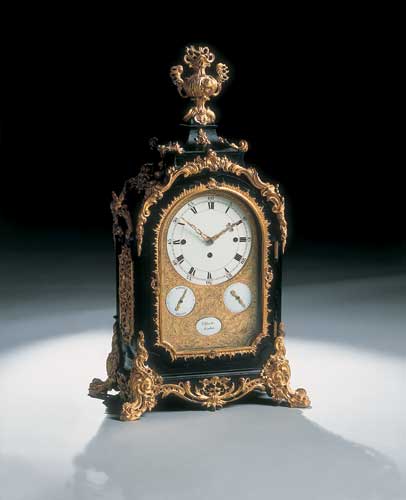
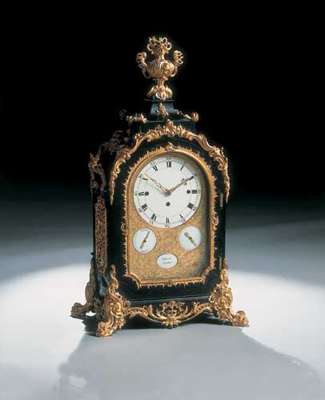
A George III ebonised and ormolu mounted table clock
Auction: 30 June 2001 at 12:00 BST
Description
the five pillar three train movement with anchor escapement, bell striking and quarter chiming on eight bells, the later painted circular dial with subisidiary enamel strike/silent calendar dials and with name plate below, set within chased gilt surround centred by a neo-Classical urn, the similarly engraved back plate signed Ellicott, London, the ebonised arched case with pagoda top, set with exceptional ormolu Rococo mounts, urn finial and scroll feet, later sound panels to the sides and similarly mounted glazed doors to front and rear
74cm high
Footnote
John Ellicott II (1706-1772) was one of the foremost English clockmakers of the 18th century. He was a Fellow and Council member of the Royal Society and clockmaker to George III. Ellicott is principally famous for his compensation pendulum, his watches and his musical table clocks, which were always housed in particularly fine cases. He worked with his son Edward from 1760, taking him into partnership in 1769 from which time they were know as John Ellicott & Sons. Clocks signed simply Ellicott seem to date from this decade.
Ellicott worked extensively for the export market and particularly for King Ferdinand VI of Spain; it would seem reasonable to suggest that this clock was made with such a client in mind.
There is a magnificent walnut cased table clock in the Victoria and Albert Museum (Britten col. pl. V) with silver gilt mounts possibly by George Michael Moser, which are directly comparable to the mounts on this clock. Moser made exceptional watch cases for Ellicott and although he is not known to have made clock mounts these are attributable to him by association.
Bibliography
Alan Smith ed. International Dictionary of Clocks Country Life 1979
Britten's Old Clocks and Watches 9th ed. London 1982
David Thompson Antique Horology XXIII 1997 pp306-321, 429-442