Lot 114
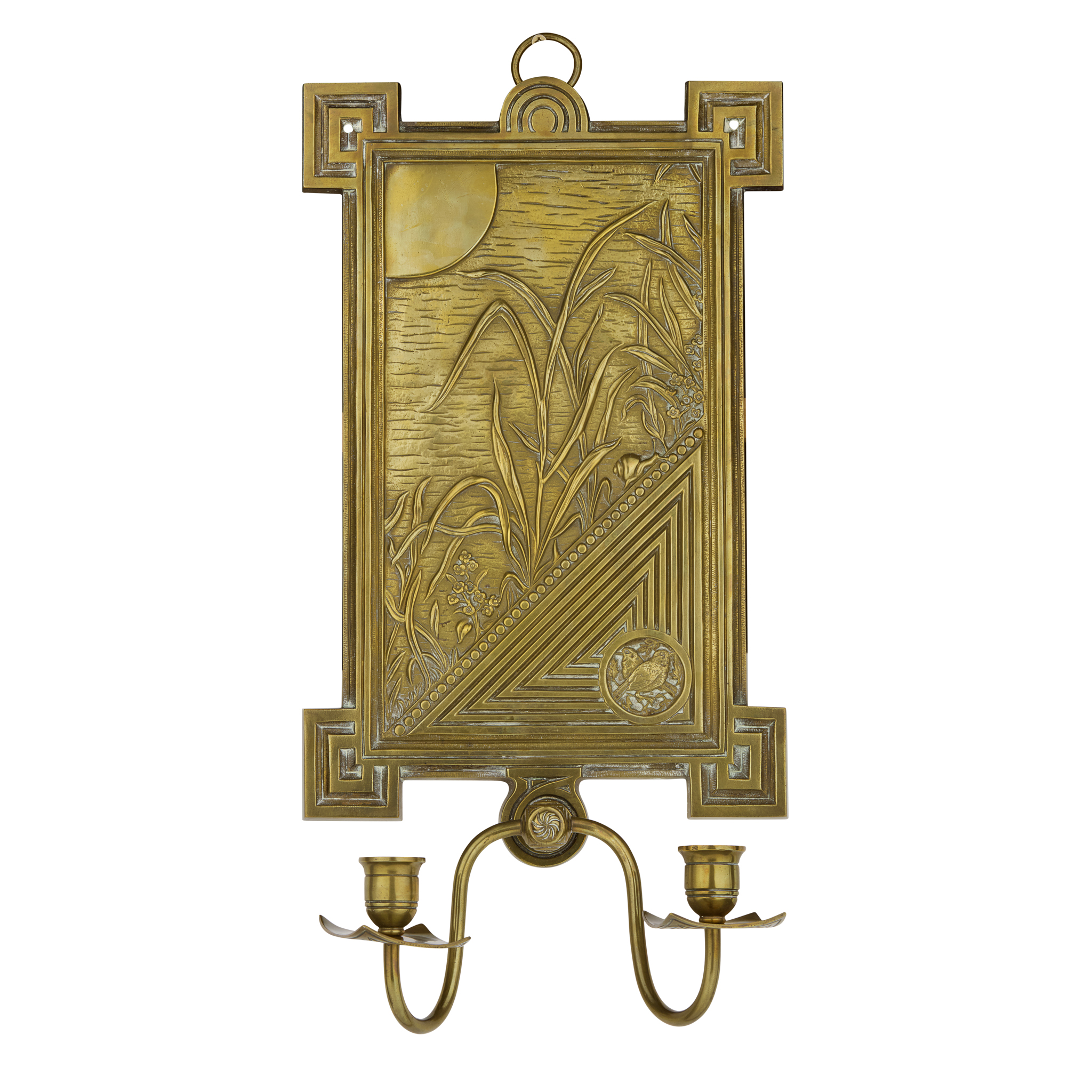
THOMAS JECKYLL (1827-1881) FOR ROBBINS & CO., DUDLEY
AESTHETIC MOVEMENT WALL SCONCE, 1881
Auction: Design Since 1860 Day One | Wed 14th October | Lots 1 to 245
Description
brass, stamped registration lozenge
Dimensions
24.2cm wide, 50cm high, 11.5cm deep
Footnote
Literature: Phillips, New York, December 17th 2003, lot 431 for a similar example
V&A Collection, Accession No. E.5448-1958 for similar treatment of a bird motif within bands of decoration
Born in 1827, Thomas Jeckyll began his career in his native East Anglia. Having trained as an architect, he set up a practice in Norwich in 1854, his initial work focusing on church restorations in the Gothic Revival Style. By the 1860s his work had expanded to embrace the Aesthetic Movement and it was not long until he was considered a leading light in the Anglo-Japanese branch of this style. His experimental synthesis of different design styles has been remarked upon, as he used variously Queen Anne Style, English vernacular with Anglo-Japanese, and Neo-Georgian to name a few.
It is for his metalwork however that Jeckyll is best known. Until the International Exhibition in London in 1862, metal products from France were considered superior to British examples. Jeckyll was one of the designers shaping the wrought-iron revival in Britain, his most regular partner since 1850 being the firm Barnard, Bishop & Barnards. Indeed, the naturalistic ‘Norwich Gates’ he designed for the International Exhibition earned him a national reputation such that he was referred to as ‘Jekyll [sic] of the gates’. Alongside him taking inspiration from natural forms, there is also evidence of Jeckyll incorporating Japanese art from the mid-1860's.
Jeckyll also worked for the firm Robbins & Co. based in Dudley, with whom his younger brother Henry Jeckell also collaborated. The end of Thomas's life is one of tragedy, his gradual mental deterioration culminating in insanity which saw him confined to an asylum for the majority of the latter half of the 1870's. It is thought that his brother, who was in charge of his personal effects, continued acting as his intermediary after the time when Thomas had capacity. This allows for the 1881 date of this sconce, a point at which Jeckyll was in a Norwich asylum and in his final days.