Lot 92
A. H. MACKMURDO (1851-1942)
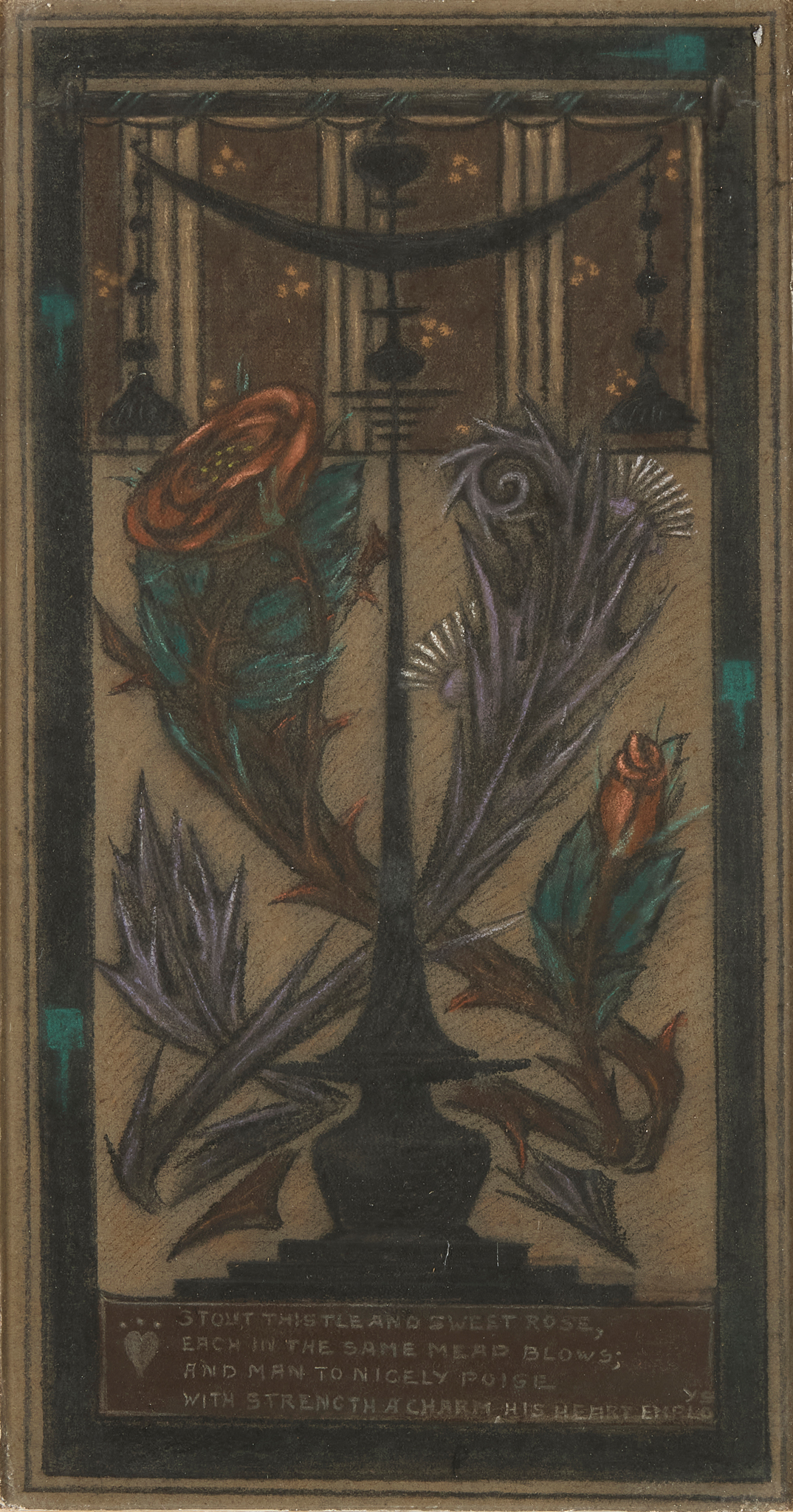
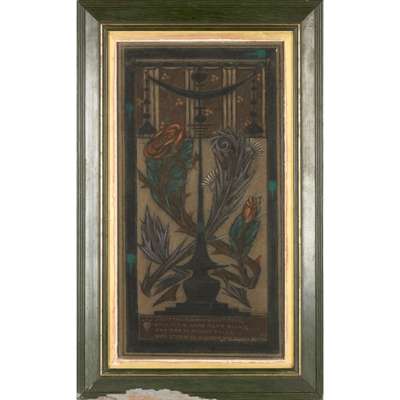
'STOUT THISTLE AND SWEET ROSE'
Auction: Day One | Lots 1 to 229 | Wed 15th April 2026 from 10am
Description
pastel, inscribed verses STOUT THISTLE AND SWEET ROSE/ EACH IN THE SAME MEAD BLOWS;/ AND MAN TO NICELY POISE/ WITH STRENGTH A CHARM HIS HEART EMPLOYS
Dimensions
41cm x 21.5cm (frame size 51.5cm x 32cm)
Footnote
This design is thought to have been for Mackmurdo's wife Eliza Carte, youngest sister of Richard D'Oyly Carte, the impresario famed for managing the first Gilbert and Sullivan opera productions and establishing the D'Oyly Carte Opera Company. Mackmurdo designed a bookplate circa 1880 dedicated to his wife with similar rose and thorn motifs. This work is now held by the William Morris Gallery. The thistle is a recurring motif in his work, most famously in a ground breaking chair he designed in the 1880's, which combines a Georgian base with an Aesthetic movement splat back comprising a stylised thistle. In the 1884 International Inventions Exhibition the Century Guild displayed one of these chairs in their music room. The back of the chair was illustrated in the influential periodical The Builder in August 1885 and praised for its originality.
Born in 1851, designer and architect Arthur Heygate Mackmurdo was an early member of the Arts & Crafts Movement and a founding member of the Century Guild.
Mackmurdo was first articled to Thomas Chatfield Clarke before moving to work for Gothic Revival architect James Brooks, aged twenty-two. Mackmurdo reputedly attended lectures and drawing lessons given by John Ruskin, and the pair became friends, travelling to Italy in 1874, however this has been disputed. In 1875 he established his own architectural firm. It was around this time in 1877 that Mackmurdo met William Morris, whose influence on Mackmurdo was lifelong. Morris's principles were ones Mackmurdo shared and both were founding members of Society for the Protection of Ancient Buildings.
Mackmurdo also founded the Century Guild, which encouraged a return to the Medieval structures of guilds and sought to elevate the status of the applied arts and craftsmen practicing them to that of fine art; no one medium was to be put before another, but rather all should work together in a unified scheme or ‘Gesamtkunstwerk'. Other members of the Guild included Selwyn Image and William De Morgan, the group collectively offering services of ‘complete furnishing’. Their publication ‘The Hobby Horse’ was printed from 1884-92, the demise of the publication only shortly predating the Guild's dissolution, caused by financial difficulties.
In 1888 Mackmurdo began designing the interior for the Savoy Hotel London, the owner being his cousin and brother-in-law Richard D'Oyly Carte. The luxurious interior scheme is now heralded as an early example of the Art Nouveau. He briefly entered into a partnership with George Hornblower and E.S. Walters, 1891-93, but in later life his architectural work was sporadic and relatively limited.
Mackmurdo married Eliza D'Oyly Carte in 1902 and the pair moved to Essex where Mackmurdo began work on their intended home Great Ruffins. Once again economic constraints thwarted the designer and he was forced to sell and move to nearby Little Ruffins. It was during this period that he redirected his attention towards social reform, campaigning and publishing works addressing issues ranging from wages to social isolation.
Mackmurdo died aged ninety one, a pioneer of both the Arts & Crafts and Art Nouveau movements in addition to being one of the first to consider design as having the power to benefit all members of society, not just the privileged few.