Lot 359
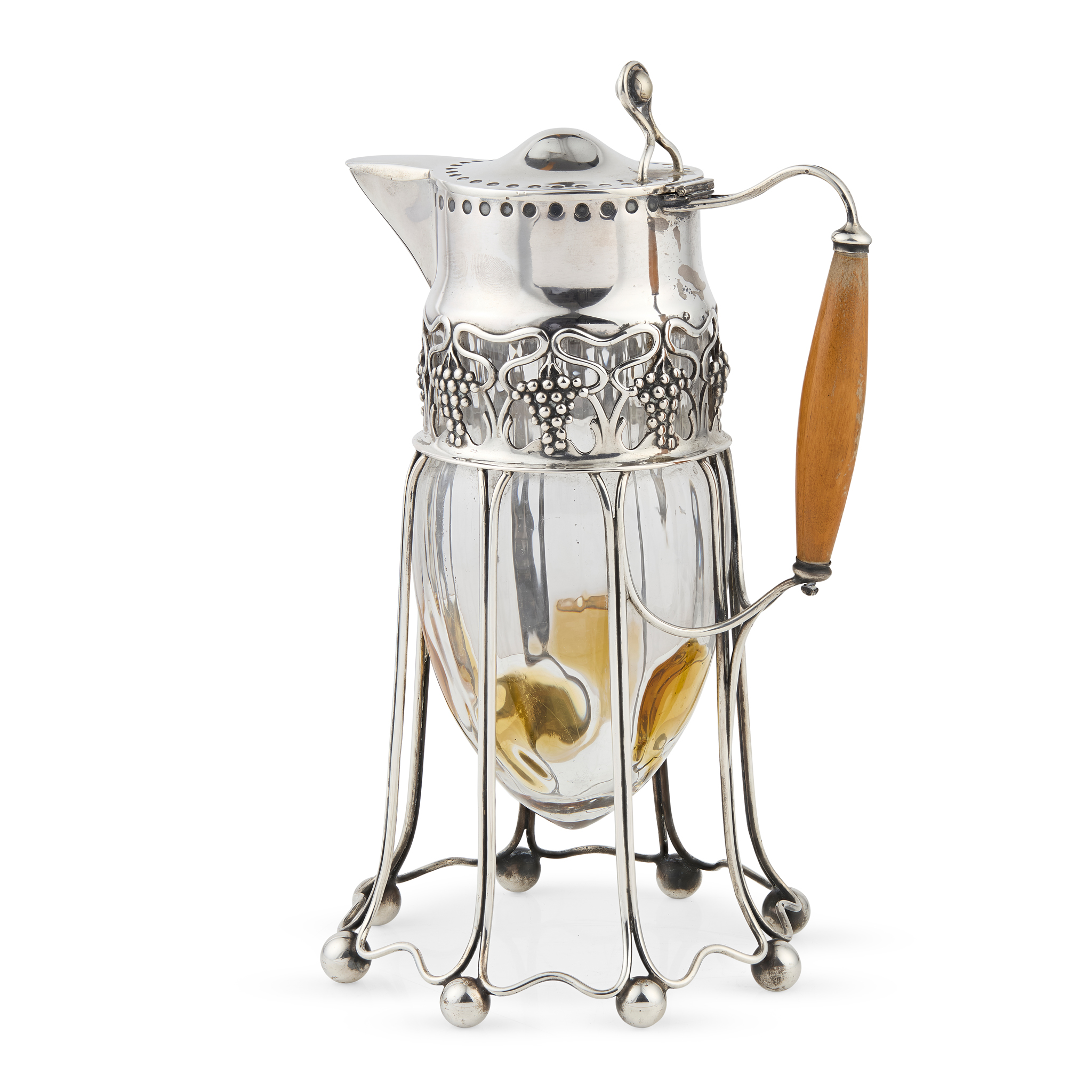
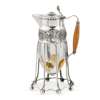
ATTRIBUTED TO C.R. ASHBEE (1863-1942) FOR GEBRUEDER FRANK, VIENNA
JUGENDSTIL CLARET JUG, CIRCA 1905
Auction: Day Two | Lots 304 to 482 | Thurs 16th April 2026 from 11am
Description
silver plated metal, glass, polished wood, stamped maker's marks
Dimensions
29.7cm high
Footnote
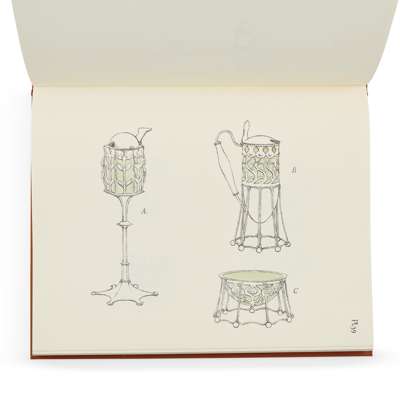
Literature: Ashbee C.R. Modern English Silverwork Essex House Press, 1909, pl. 39A where a mustard pot of similar design is illustrated.
Crawford A. C.R. Ashbee: Designer & Romantic Socialist, Yale University Press 1985, p. 318, pp. 411-416
Almost from the inception of the Vienna Secession, Charles Ashbee and his Guild of Handicraft was a designer greatly admired and sought after by the key figures of the movement. In 1899 the architect Josef Hoffman is documented stating that to include such works in a Kunstgewerbeschule exhibition would ‘hit the museum hard’. The Guild exhibited with the Secession in 1900, 1902, 1905 and 1906, in the first instance being the second largest exhibitor with fifty-three items. It is possible that when Hoffman and head of the Kunstgewerbeschule Felicien von Myrbach visited the UK is 1902 they not only met Mackintosh, but also Ashbee; other continental designers and critics certainly made the pilgrimage.
The presence of Ashbee's work in Vienna spilled over into the principles and designs of his continental contemporaries. For instance the thesis of the Wiener Werkstätte demonstrates alignment with Ashbee's beliefs, ‘a silver brooch can have as much intrinsic worth as a jewel made of gold… The merit of craftsmanship…must be recognised once more’. It has further been noted that motifs found in Ashbee's work, coloured stones, intentionally left hammer marks, found their way into Wiener Werkstätte works.
Such was the regard in which Ashbee was held that he was made an honorary member of the Vienna Secession, had his work purchased by museums in Vienna and Zurich and in 1906 was awarded the Diplôme d’ honneur at the Esposizione Internazionale in Milan. Ashbee's 1911 list of progressive Arts & Crafts architects, both English and European, included Hoffman and Moser, demonstrating the admiration was not one-sided. When this is considered in tandem with Ashbee's desirability and renown, there is certainly potential for cross-channel collaboration.