Lot 230
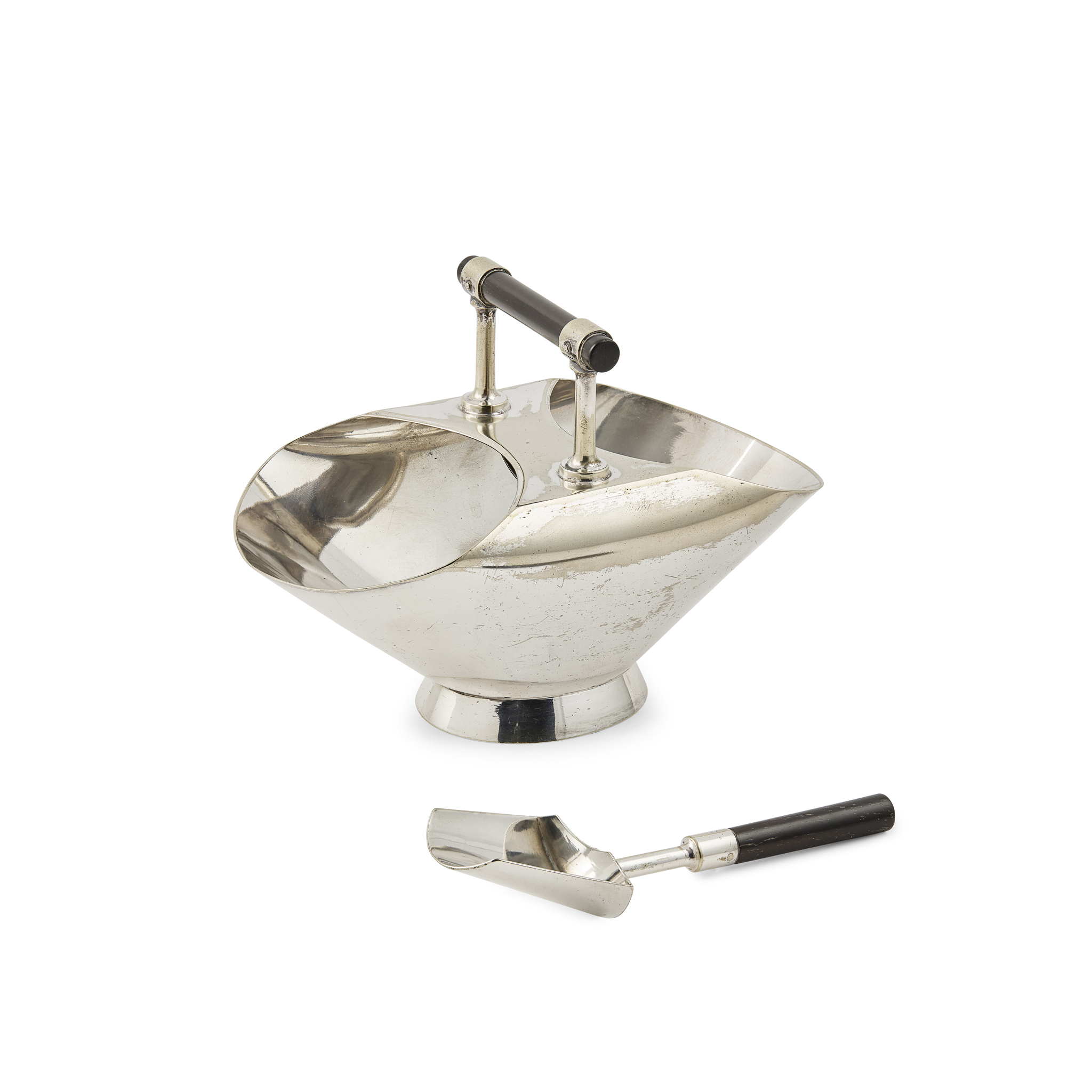
CHRISTOPHER DRESSER (1834-1904) FOR HUKIN & HEATH
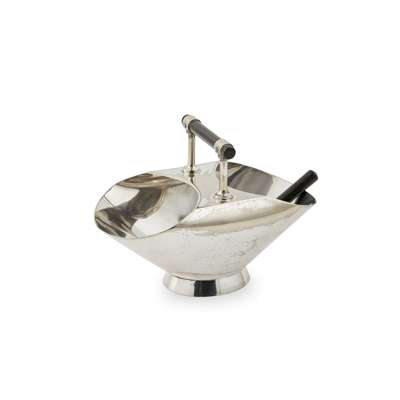
SUGAR BOWL WITH SCOOP, CIRCA 1880
Auction: By Hammer & Hand: Silver from a Private Collection | Lots 230 to 303 | Thurs 16th April 2026 from 10am
Description
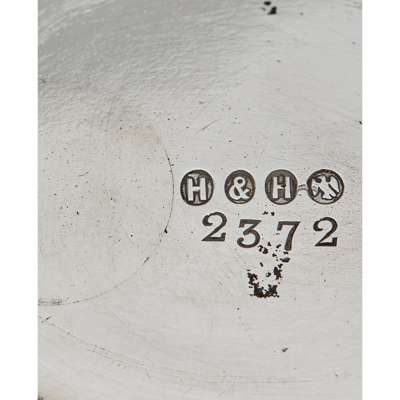
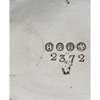
silver plate and ebonised wood, stamped maker's mark H&H, no. 2372 (2)
Dimensions
bowl 16.8cm wide, scoop 13.5cm long
Provenance
By Hammer & Hand: Silver from a Private Collection, London
Footnote
The late owner of this distinguished silver collection took considerable pride in assembling it over several decades of careful and deliberate acquisition. His aim was to create a collection of both depth and breadth, representing the major silversmiths of the twentieth century; individual works were selected judiciously to advance this objective.
The collection is predominantly British in focus, beginning with Christopher Dresser in the 1880s and extending into the Arts and Crafts Movement through figures such as Alexander Fisher, Gilbert Marks, and Omar Ramsden. A broader European dimension is introduced through works by the Danish firm Georg Jensen. Chronologically, the collection returns to Britain with examples of Art Deco and early modernist design, including pieces by H. G. Murphy, Charles Boyton, and the comparatively rare Reginald Hill, concluding in the 1970s with the work of Christopher Lawrence.
Silversmithing in the late nineteenth and early twentieth centuries was shaped by the tensions between industrialisation and a renewed commitment to craftsmanship. The growth of mechanised production in the Victorian period made silver more accessible yet raised concerns about the loss of individuality in mass-produced wares. Designers such as Dresser engaged constructively with industrial methods while advocating design reform, whereas proponents of the Arts and Crafts ethos, guided by the principles of William Morris, emphasised the primacy of handwork and the moral value of skilled labour. Workshops including the Guild of Handicraft and the Birmingham Guild of Handicraft fostered collaborative practices inspired by medieval guild traditions, integrating design and execution within a unified process.
Setting Dresser aside, the collector’s interest lay not in mass-produced silverware but in the work of individual designers and the human dimension of craftsmanship. This is evident in the visible marks of making and the emphasis on material integrity throughout the collection. Medievalist tendencies appear in the work of Ramsden and Alwyn Carr, while Archibald Knox drew upon early Celtic sources. In later works, shifts in social practice and taste are reflected in object types such as sugar casters and cigarette boxes of the 1920s, alongside a stylistic transition towards smoother, more linear, and abstract forms associated with Art Deco and emerging modernism.
Taken as a whole, the collection offers a coherent narrative of a period in which silversmithing negotiated between tradition and innovation, articulated through the medium of silver and exemplified by works of exceptional quality.