

Lot 115
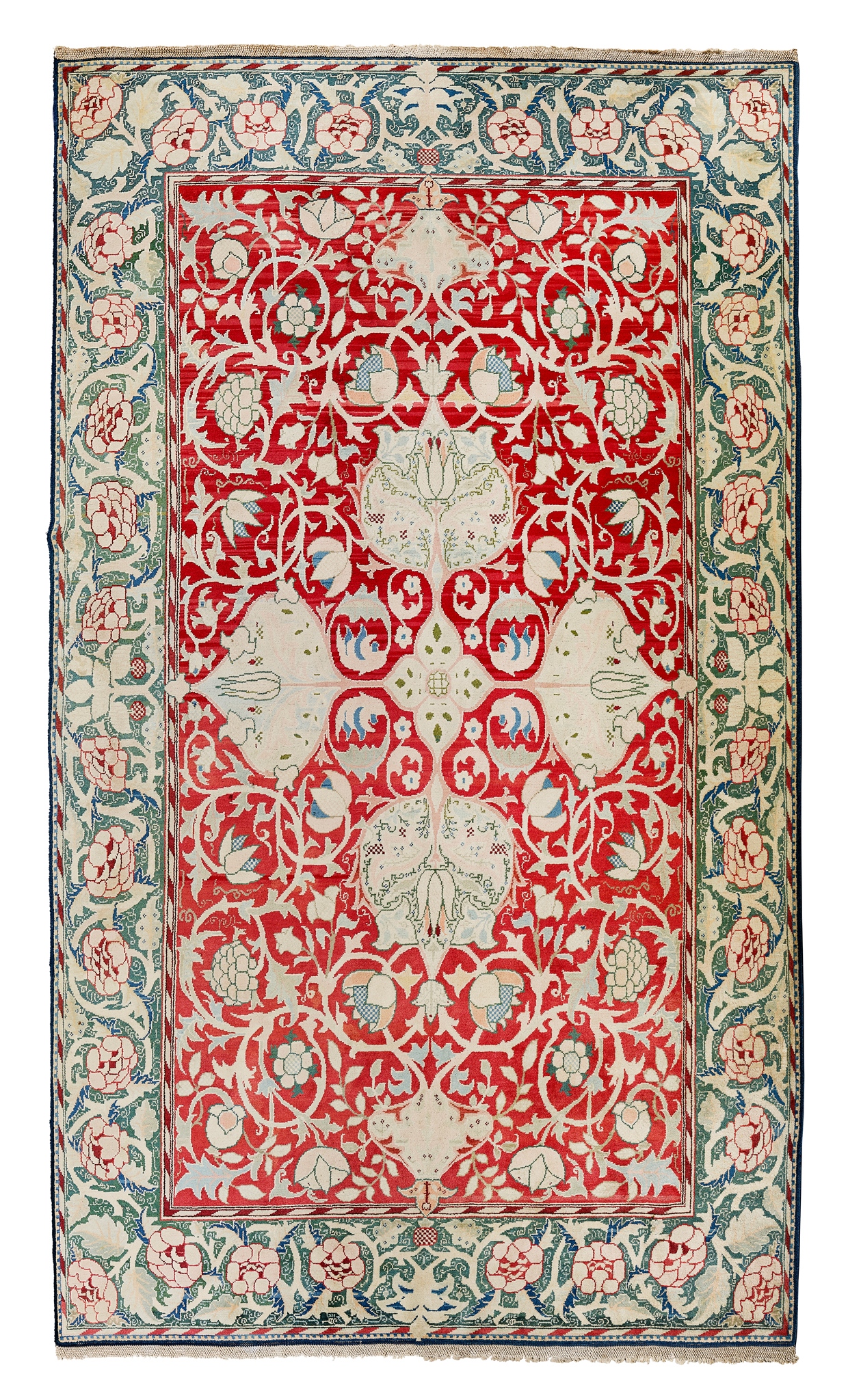
WILLIAM MORRIS (1834-1896) AND JOHN HENRY DEARLE (1859-1932) FOR MORRIS & COMPANY
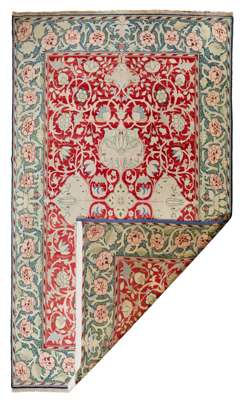
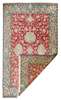
LARGE ARTS & CRAFTS 'HAMMERSMITH' CARPET, CIRCA 1890-95
Auction: Day One | Lots 1 to 229 | Wed 15th April 2026 from 10am
Description
hand-tufted wool on a linen and wool warp, with ‘Soumak’ knotted fringe
Dimensions
508cm x 335cm (without fringe), 520cm x 335cm (including fringe)
Provenance
Probably made for Stanmore Hall, Middlesex
Robert Kime, Dene House, Lockeridge, Marlborough
Private collection, London
Footnote
Literature: Parry L. Hammersmith Carpets, HALI, October/December 1985, p. 17 and p. 16, pl. 8 where the Bullerswood version of this design is illustrated.
Kirkham P. The Firm: Morris & Company, within Diane Waggoner D. (ed.), The Beauty of Life, William Morris & the Art of Design, (ex. cat.), New York, 2003, p. 54
Parry L. William Morris Textiles, V&A 2013, p. 114
William Morris began producing hand-knotted Hammersmith rugs in 1878–79. At that time, no other British manufacturer was working at the scale he envisaged. Morris had planned the initiative for many years and had collected historical Eastern carpets since at least the late 1850s. These were used extensively at Red House, designed for him by Philip Webb in 1859, where they covered both floors and walls.
In 1878 Morris established a carpet frame in an attic at Queen Square. With the assistance of a hand weaver from Glasgow, he learned the techniques required for knotting carpets. Additional frames were later installed in the coach house and stable loft at Kelmscott House, where Morris trained workers in the methods he had acquired. By 1880 his intentions were articulated in a circular announcing an exhibition of carpets and rugs. In this document he stated his aim “to make England independent of the East for carpets which may claim to be considered as independent works of art.” Morris argued that, although appreciation of Eastern design was increasing, the quality of Eastern carpet production was declining. In his view, Western production of handmade carpets would therefore be necessary to maintain high standards. At the same time, he maintained that such carpets should equal Eastern examples in materials and durability but should not imitate Eastern design. Instead, they should express contemporary Western artistic principles.
Carpet weaving was transferred to Merton Abbey Works in 1881, although the term “Hammersmith rugs” continued to be used to distinguish hand-knotted carpets from the firm’s machine-woven products. Carpets produced at Merton during the 1880s and 1890s were among the firm’s largest and most expensive works, costing approximately £4 per square yard. It took one day to weave 2 inches on a loom and a 16 by 13 feet carpet cost over £100. The high cost meant that they were only made to commission and were not kept as stock items. Together with the firm’s tapestry production, they represented the costliest output of Morris & Co.
Morris outlined his principles of carpet design in his 1883 paper “Textiles.” He described carpet weaving as analogous to tapestry in being “wholly unmechanical,” although its function as a floor covering, particularly in northern climates, diminished its artistic status. Because the technique was relatively coarse, he advised that designs should be simple in form and composed of stylised references to foliage, flowers, and animals. He rejected tonal shading and argued that variation in colour should instead be achieved through the juxtaposition of distinct tints, clearly outlined to maintain legibility. When executed effectively, he suggested, this method produced strong and coherent patterns in which motifs appeared visually flat and integrated within the overall composition.
Few designs for Hammersmith carpets survive, and the absence of day books makes precise dating difficult. Surviving examples are often identified by the houses for which they were commissioned—such as the “Clouds,” “Hurstbourne,” or “Bullerswood” carpets—or by the names of their patrons, such as the “McCulloch.” Many designs may derive from earlier work. The design and original owner of the carpet discussed here has a field and border which display stylistic affinities with both the “Holland Park” carpet (1883) and the “Clouds” carpet (1887). Linda Parry, the textile expert who curated the V & A’s definitive William Morris exhibition in 1996, describes the Holland Park carpet as “probably Morris’s most original carpet design,” noting that it reflects Morris’s principal influences: medieval art, naturalistic floral study, and Eastern design conventions. Between 1883 and approximately 1889 Morris often adopted a more classical and symmetrical compositional approach, frequently using quartered layouts with a central medallion, as seen in this example.
The design of the present lot was first used at Bullerswood House near Chislehurst in Kent in 1889. It was designed as part of the interior decoration which Morris & Co. carried out for their client Ernest Newton and was one of three new designs for carpets produced for this scheme. The interior decoration constituted an important commission for the firm and was likely the final decorative scheme personally supervised by William Morris.
The composition features four large palmettes radiating from a central rosette which was a suitable design for its placement in the Hall. These elements demonstrate a clear influence from sixteenth- and seventeenth-century Mughal and Safavid carpets, which Morris both collected and would have studied at the South Kensington Museum. When combined with floral motifs characteristic of Morris’s own design vocabulary, these elements create a carpet distinguished by visual harmony, balance, and aesthetic refinement.
The same carpet design was subsequently reused for another significant commission: the interior decoration of Stanmore Hall, Middlesex, undertaken between 1890 and 1896. A contemporary photograph of the Small Drawing Room at Stanmore Hall, one of a series of photographs taken of the house by Bedford Lemere Ltd., shows this carpet in situ. No other version of this design is known to exist or has been documented.
Stanmore Hall was originally built in 1847 by John Macduff Derick in the Victorian Tudor-Gothic style. In 1888 the house was purchased by the mining entrepreneur William Knox D'Arcy, who had accumulated his wealth during the Australian gold rush. D’Arcy commissioned the architect Brightwen Binyon to renovate the house and engaged Morris & Co. to furnish and decorate the interiors.
Although Morris expressed reservations about the house, its architect, and its owner, he nevertheless contributed to what became one of the firm’s most substantial commissions. The work carried out by Morris & Co. at Stanmore Hall included textiles, wallpapers, carpets, furniture, mosaic flooring, the Holy Grail tapestries (1890–95) designed by Edward Burne-Jones with Morris and John Henry Dearle, and the Stanmore Hall piano (1891–94), decorated by Kate Faulkner, Philip Webb, and Morris himself.