

Lot 108
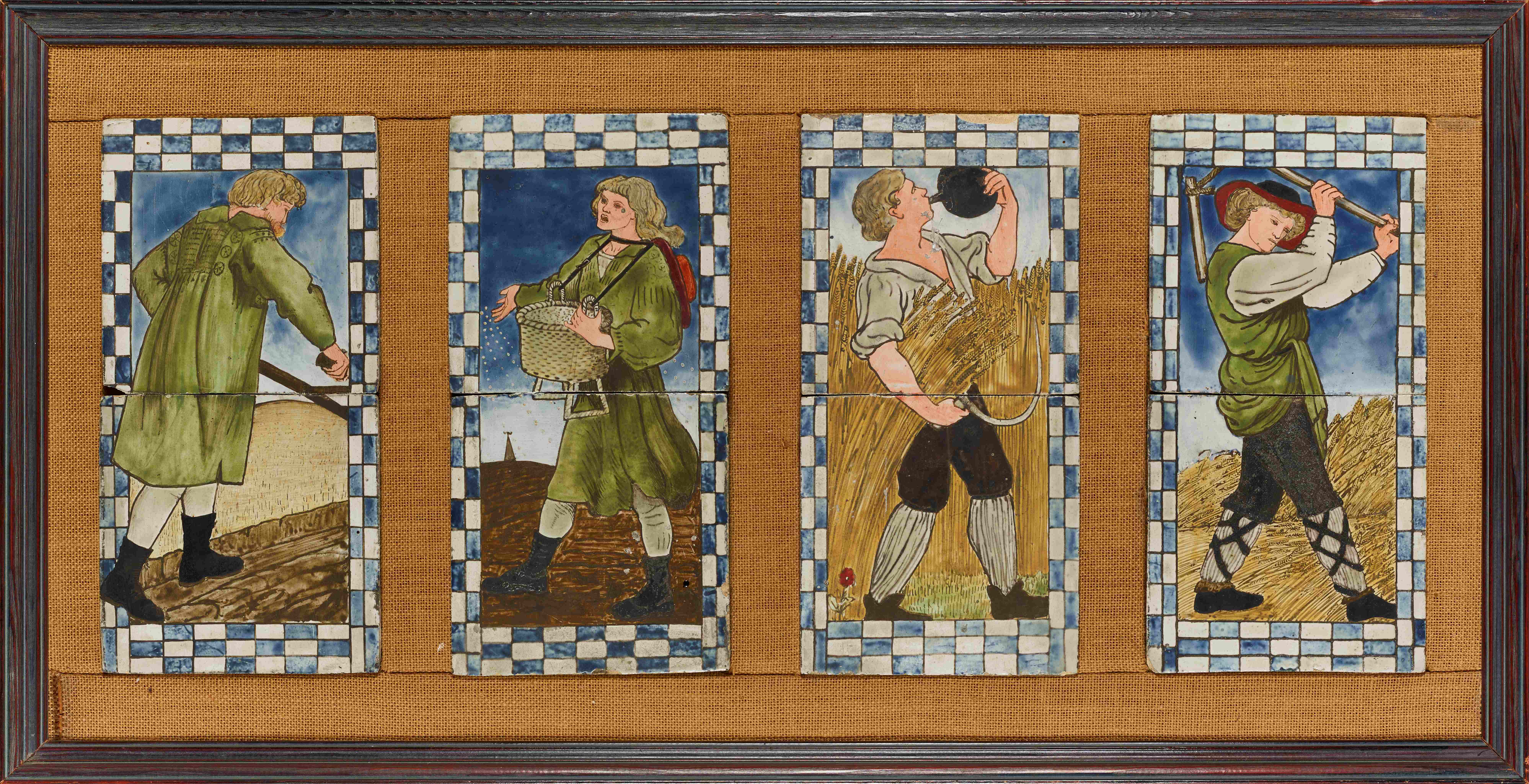
WILLIAM MORRIS (1834-1896), DANTE GABRIEL ROSSETTI (1828-1882) AND FORD MADOX BROWN (1821-1893) FOR MORRIS, MARSHALL, FAULKNER & CO. (1861–1875)
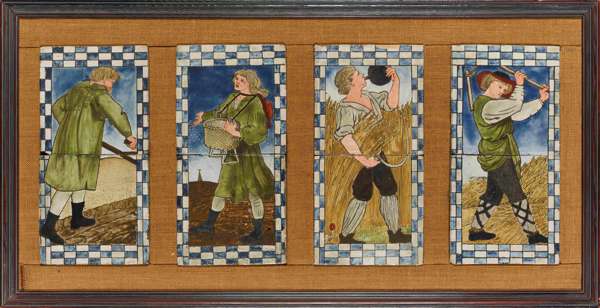
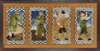
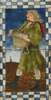
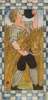
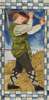
FOUR 'LABOURS OF THE MONTHS' TILE PANELS, CIRCA 1865
Auction: Day One | Lots 1 to 229 | Wed 15th April 2026 from 10am
Description
painted and glazed earthenware, later mounted together in one frame (4)
“The exceptional result achieved by these striking tiles in lot 108 reflects both their rarity and their early production within William Morris’s emerging firm in the early 1860s. Combined with the strength of their design and the significance of the artists behind them, they proved irresistible to collectors selling for a premium inclusive price of £94,000.” - John Mackie, Director & Head of Design.
Dimensions
each tile 15.5cm square (frame size 43cm x 84cm)
Provenance
From The Rectory in Cavendish
Footnote
Literature: Myers, Richard and Hilary William Morris Tiles, Richard Dennis 1996, pp. 62-66, back cover illustration
Robinson, Duncan and Wildman, Stephen, Morris & Company in Cambridge, September 30th-November 16th 1980, Fitzwilliam Museum Cambridge, Cambridge University Press 1980, pp. 26-28
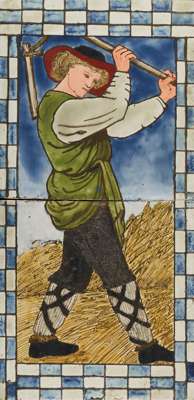
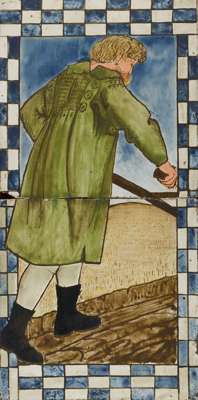
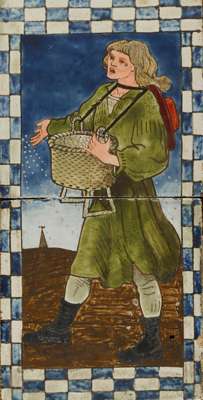
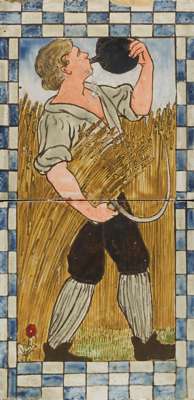
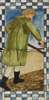
Produced by Morris & Co., these remarkable four Labours of the Months tiles come from a Rectory in Cavendish, Suffolk. Removed prior to the demolition of the building, they were given by the vicar to the current vendor's grandfather, and thence by descent. They represent one of three known partial sets of the Labours of the Months. Working left to right they comprise February (ploughing), November (sowing), July (reaping) and August (threshing). The February tile depicts William Morris as the ploughman and is thought to be a self-portrait as Morris makes a comment on his lot in life.
Another set of Morris & Co. ‘Labours of the Months’ tiles was installed 1862-3 in the Old Hall of Queens' College, University of Cambridge. Commissioned by architect G. F. Bodley as part of the fireplace and overmantel, they constitute an early important job for the new firm, only founded in 1861. Each of the twelve-month panels has a latinised label and the group are set amongst representations of the college's two patron saints and the Angels of Night and Day. Comparisons have been drawn between the medieval style of the tiles and the Books of Hours, the Morris & Co. sketchbooks referring to these fifteenth century calendars strengthening this tie. Regarding the forms of the months, the 1857 publication of the twelfth-century mosaic floor in Aosta Cathedral, North-west Italy has been suggested as possible inspiration. Morris and Co. contributed again to the Old Hall decorative scheme, providing ceiling painting designs around 1875.
A further full Labours set predates the Cambridge iteration, differing in some of the subjects and featuring inset Zodiac signs. Morris and Co. kept this earlier set until at least 1934. They were then bought by the great patron of the firm, Mrs Lucius Gubbins of Eastbourne, before eventually being offered in October 1995 at Phillips Auctioneers, Glasgow and now held at the William Morris Gallery, Walthamstow. A third set was destined for the home of Lord Justice and Lady White who lived on Unthank Road, Norwich, and is noted as being set with a blue and white pattern, perhaps a similar arrangement to the four tiles being sold.
It is not known whether the four tiles offered here were initially part of a full set or were made as a special commission. A lone January tile currently sits in the Ashmolean Museum Oxford and the top half of a representation of April has also been documented, but whether the remaining months were made and then lost is unresolved. Similarly, the Morris & Co. Minute Book does not record which of the designers was responsible for each month. The scheme was certainly a collaborative effort, with stylistic analysis leading to the following attributions: July by Rossetti or Morris, August by Rossetti, November by Madox Brown and February by Morris.