

Lot 9
Finlay, Ian Hamilton (1925-2006)
The Jackey Smith collection of Wild Hawthorn Press concrete poems, mail art and associated ephemera
Auction: Books & Manuscripts | 01 October 2026 from 10am | Lots 1 to 78
Description
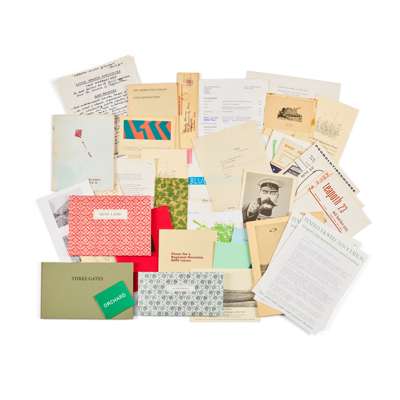
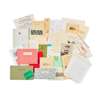
a) Typescript poem, ‘Corners’, dated Christmas 1962, with typescript dedication ‘for Jacqui’, initialled in manuscript ‘I. H. F.’ at foot, 1 leaf; 2 typed letters signed, 1981, each on both sides of a leaf of IHF’s ‘Stately Hovels Association’ stationery, and signed ‘Ian’ in pencil, on matters including the republication of biography of Rilke by Carcanet, the ‘awful visit from the exiled Iranian professor’ (i.e. Seyyed Hossein Nasr, 1981 Gifford lecturer), IHF’s feud with the Arts Council (‘one day people will realise that the idea of putting the Arts into the hands of committees of lawyers, academics, etc., etc. was just too extraordinary for words’), etc.;
b) Signed or inscribed pieces, all Wild Hawthorn Press: Apollo in Strathclyde, photographic card 14 x 18.2cm, and Reed-Pipe, printed bookmark, 5.7 x 20.2cm, both 1985 and addressed by hand to Jacky Benson by IHF on verso (latter inscription smudged); Improvisation No. I, photographic bookmark, 6.7 x 21cm, inscribed by IHF on verso, with postage stamp, franked, self-adhesive label in another hand over address; ‘Are waterhens Chance? Love, Ian 27.2.78 PS I have THE book on Dada’; Valses Pour Piano (Water Music), printed visiting card, 6 x 9.2cm, in envelope inscribed by IHF ‘Love from Ian 26.5.70’; ‘Betula Pendula (Silver Birch), wood-engraving on card, 10.8 x 13.5cm, inscribed by IHF on verso ‘Have a peaceful Christmas, Love from us all, Ian, 1977’ in red and blank ink (old staining on recto); prospectus for IHF’s Unnatural Pebbles exhibition, Edinburgh, 14.6 x 10.4cm, inscribed by IHF ‘Dear Vale, Here is the promised parcel Hope you had a good day on the Fens! [etc.]’; Wild Hawthorn Press, List of Publications, Spring 1970, 4 leaves of mimeographed typescript (printed on rectos only, stapled at one corner, ‘Rhymes for Lemons’ annotated ‘not ready yet’ by IHF;
c) [Mail art.] Two Horizons, Wild Hawthorn Press, 1998. 2 cotton reels (one blue, one grey), in original cardboard packaging printed by Wild Hawthorn Press stating 'Two Horizons, Ian Hamilton Finlay, Christmas 1998, Wild Hawthorn Press', addressed by hand to Jackey Smith Vale by IHF on one panel, with postmarked postage stamp and inscription ‘Fine’ in red ink to another panel, 3.5 x 10 x 3.5cm;
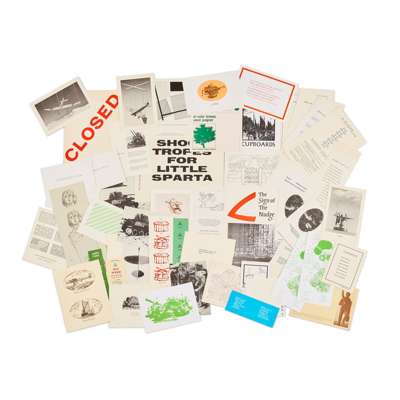
d) Further Wild Hawthorn Press concrete poems and mail-art pieces, including: Tea Kettle Drum Water Lily Cup (single sheet of printed card folded once, opening to 10 x 45cm), Blue Water’s Bark (single sheet of glossy card folded once, opening to 7.6 x 39.5cm); Butterfly Garden (12 card tags with ‘Butterfly’ printed in various styles, each with punch-hole, with several lengths of string, all loose in original printed envelope as issued); Trombone Carrier (single sheet of white card with title and cross-section of a ship printed in blue to one side, with 3 paperclips inserted across image via slits, laid into strip of folded green card as issued); Horloge de Flore (single strip of folded pink paper with printed design and text to inner panels); Homage to the L. A. Doust Art Manuals (single strip of printed tan card folded once; 3 copies); Chant for a Regional Occasion 2000 Voices (single sheet of laid paper, folded into 12 panels, with 3 words printed in red to each, on one side only, folded dimensions 14.4 x 15.2cm); Orchard/Larder (single unsigned gathering of 8 card leaves, stitched, text in white, pages alternately green or orange); A Boatyard, 1969 (single strip of wove blue-green card printed in black, folding in concertina format); A Memory of Summer (single sheet of card folded twice, one of 300 copies signed by IHF);
e) Wild Hawthorn Press books: Three Gates on the Way to Little Sparta, 1996, oblong 8vo, original boards, with Little Sparta Christmas card for 1996, signed by IHF (‘Love from Ian x’), laid in; A Proposal for the Grounds of the Serpentine Gallery, 1997, one of 250 copies, oblong narrow 8vo, original boards, with laid-in typed letter signed ‘Ian’ (‘Here is the little keepsake to mark the strange autumn in which you wept for Diana’); Huff Lane, 2000, one of 300 copies, oblong 8vo, original boards; Each in original card envelope addressed to Jackie by IHF, with stamps and postmarks;
f) Wild Hawthorn Press pamphlets: FS, [1978] (4to, original red card wrappers, contents depicting variations on the logo of the ‘SS’ ); Trailblazers, 14 ff., 7 x 9.5cm, original wrappers); Poor Old Tired Horse, nos. 13, 15, 19, 20, 21; Teapoth, no. 23;
g) Other items: 3 IHF postcards with handwritten messages from Sue Finlay, and one IHF ‘Neoclassicism Needs You’ postcard addressed in the hand of Sue Finlay; ‘Free Arts’ manifesto and specimen entry form (3 foolscap leaves of mimeographed typescript stapled at one corner, annotated in red ink apparently in the hand of Sue Finlay); Tarasque 11 & 12, Nottingham: Trent Book Shop, c.1970 (4to, original wrappers); approx. 50 further Wild Hawthorn Press postcards, bookmarks, and concrete poetry pieces; and more
Footnote
Jacqueline (Jackey) Vale Smith, later Benson, and often known (and addressed in this collection) as Vale Benson, was born in Edinburgh in 1946. She was introduced to Ian Hamilton Finlay in 1962 through mutual friend Gerry Zdanowicz while Finlay was living at 24 Fettes Row with Jessie McGuffie, his girlfriend and co-founder of the Wild Hawthorn Press. The following year Finlay set up what would now be called a ‘pop-up shop' during the Edinburgh festival in the city's Lawnmarket, with Jackey as his employee. In adult life Jackey has lived in various places across Britain and worked as a teacher of English as a foreign language. We are grateful to Jackey for providing the following recollection of her first meeting with Ian Hamilton Finlay from her unpublished memoir ‘Sitting on the Steps with IHF’:
'It was Gerry Zdanowicz who first took me to visit Ian Hamilton Finlay. Our bare feet padded down Dundas Street together to the room that Ian shared with Jessie McGuffie in number 24, Fettes Row. “Who is he again?” I asked.
Gerry, in his enthusiasm, nearly leapt off the rain-shiny Edinburgh pavement. It was spring, 1962, and a dark afternoon. The cars already had their headlights on. They glittered past us, sparkling light across wet cobble-stones, granite pavements and our toes.
Gerry waved his hands around his head, putting on one of his most grandiose affectations: “Ian Hamilton Finlay? Ian Hamilton Finlay! He’s the greatest – the GREATEST – poet in Scotland!”
And, of course, he was right. Ian and Jessie shared a large room in a large flat. The flat had been divided into bed-sitters, but, as was usually the case in 1962, these were not self-contained. Jessie and Ian’s room had their own cupboard-kitchen, but they had to use a communal toilet and a communal bathroom. Their room, again in keeping with the times, was furnished with two heavy, battered, pre-war armchairs, a table and a high double bed. The bed was an old one, with a brass head-rail. An ancient carpet, its pattern long faded into mottled shades of brown, covered the middle of the floor. There was a spluttering gas fire – the type that always had a broken radiant that the flames flickered around. A solid table stood in the middle of the room. It was covered with a pink plastic tablecloth, and had on it every type of food and absolutely everything that could be used for eating or cooking: half-used packets of Vesta curry; digestive biscuits; a packet of Typhoo tea; white sliced bread; jam; sugar; apples; potatoes; a tin of beans; spoons; carrots; knives; salt; a sieve; cocoa; pepper and much, much more. Their kitchen was a cupboard with a couple of gas rings on a shelf. Pink plastic curtains hung dismally at the sides of their large New Town window. I was fascinated by the pink plastic curtains – I’d never even known such things existed.
If the surroundings were humble, our welcome was warm. We had dropped in unexpectedly. This was what people did – no-one had phones, after all. We were greeted with simple, open hospitality. Gerry was seventeen, I was fifteen. We were two damp teenagers, but we were treated with the courtesy and respect that an art critic from The Times might receive. “Come away in – sit down, sit down,” Ian said, as if we had known him all our lives. While we were being given tea and biscuits, Ian asked me about myself, and showed us both the first copy of their Wild Hawthorn Press poetry broadsheet, POOR. OLD. TIRED. HORSE. – later always referred to as POTH. I was even roped into selling ten of them (ninepence each). When I remember some of the people Ian asked to be sellers, it’s a wonder that any copies of POTH survived; a chap who’d been in the year above me at the Edinburgh Steiner’s school, Stoooo, (“with four ‘o’s”) was given ten copies. I doubt if they ever left his bedroom. Gerry, on the other hand, was going to sell all the copies he could, spurred on by the fact that one of his poems was to be included in the next issue of POTH. He was immensely excited about this, and rightly so. “It’ll be the second time I’ll have seen my name in print,” he told the three of us. “The first time was when I was twelve – I had a letter published in 'Woman's Own.”'