

Lot 61
M. Samuel & Co. and Samuel Samuel & Co.
Archive relating to firms' business activities 1880s to 1920s
Auction: Books & Manuscripts | 01 October 2026 from 10am | Lots 1 to 78
Description
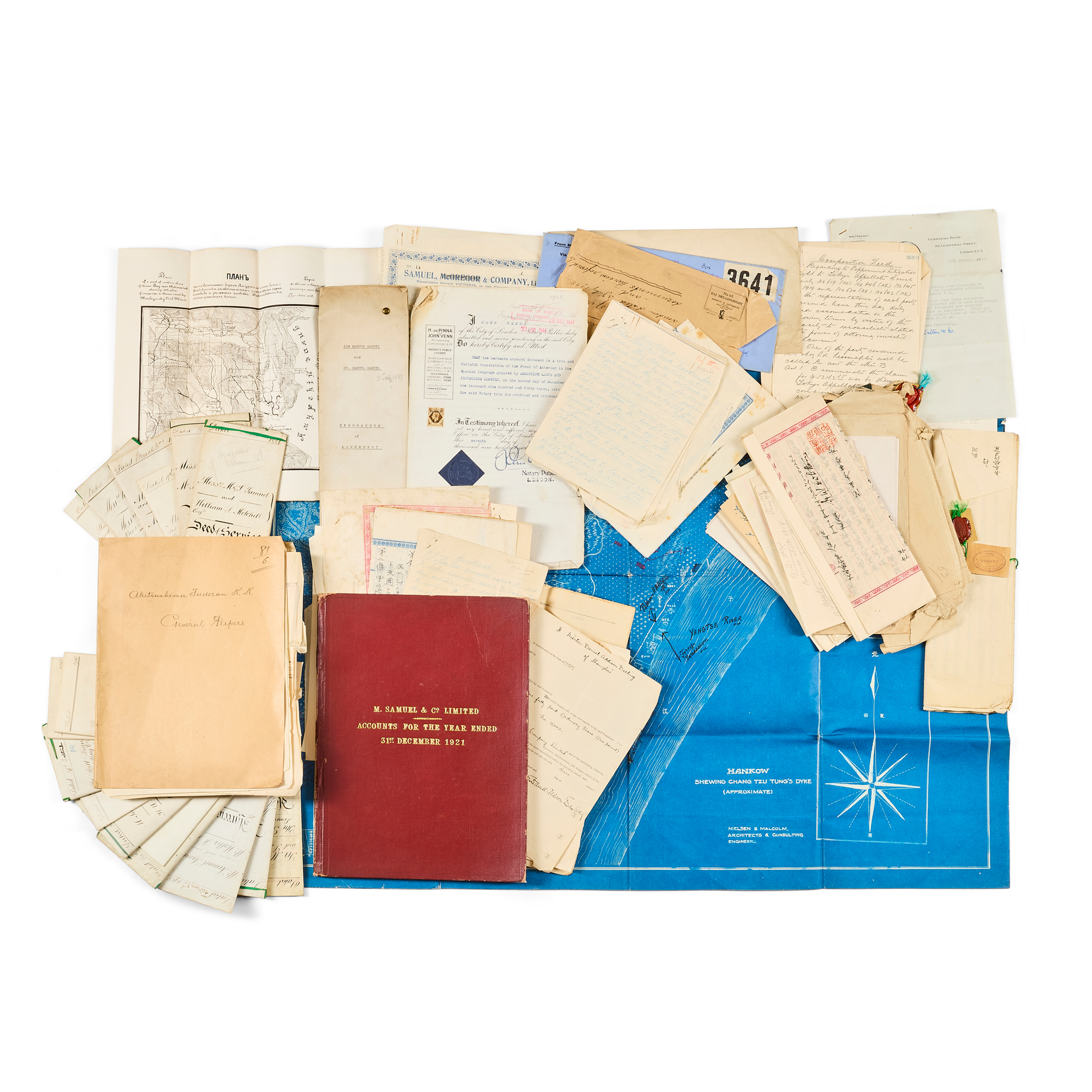
Collection of c. 70 items relating to the commercial activities of the two trading companies, including:
21 legal documents, mainly handwritten, including memoranda of agreement and tenancy agreements, also involving the Shell Transport and Trading Company, dating from 1886 to 1920, with a 1952 letter listing them;
correspondence, typescript and handwritten, relating to business activities in the Far East and Russia in the 1910s and 20s such as coal mining in Siberia, including documents in Japanese and possibly other Asian languages;
printed memorandum of agreement with the Chinese government, dated 1914, regarding the improvement loan for the Chinese port of Hankow [Hankou], text in English and Chinese, and typescript document, dated 1916, on negotiations regarding the loan;
M. Samuel & Co, account book for the year 1921;
large folded cyanotype copy of early 1920s map Hankow [Hankou], printed map of Amur Bay near Vladivostok;
annotated power of attorney document, dated 1943, relating to Argentine Lands and Industries Limited, a former British-registered land and investment company managing property, agriculture, and infrastructure investments in Argentina
Footnote
M. Samuel & Co. was established c. 1832 by Marcus Samuel as a firm trading with the Far East. It was later taken over by Marcus's two sons, Marcus and Samuel. Samuel Samuel & co. was founded in Yokohama, Japan in 1878 as an import and export business. It contributed greatly to Japan's rapid industrialisation in the late 19th century; M. Samuel & Co. dealt with business at the UK end. In the 1880s Samuel Samuel & Co. became increasingly involved in the import of kerosene to Japan from Russia, the firm subsequently expanded its activities to mainland China and Formosa [Taiwan]. After the discovery of oil reserves on the island of Borneo, in 1897 the Samuel brothers renamed their shipping company the Shell Transport and Trading Company, to promote their mineral oil-producing, refining, transporting and distributing business. Marcus Samuel was subsequently obliged to accept a full merger offer from Royal Dutch for Shell in 1906. The combined Royal Dutch-Shell became and remains one of the world's biggest oil companies.