

Lot 244
East India Company
Personal archive of John McDougal Hamilton and his family
Auction: From the Library of Professor Roland Paxton | 01 October 2026 from 10am | Lots 221 to 252
Description
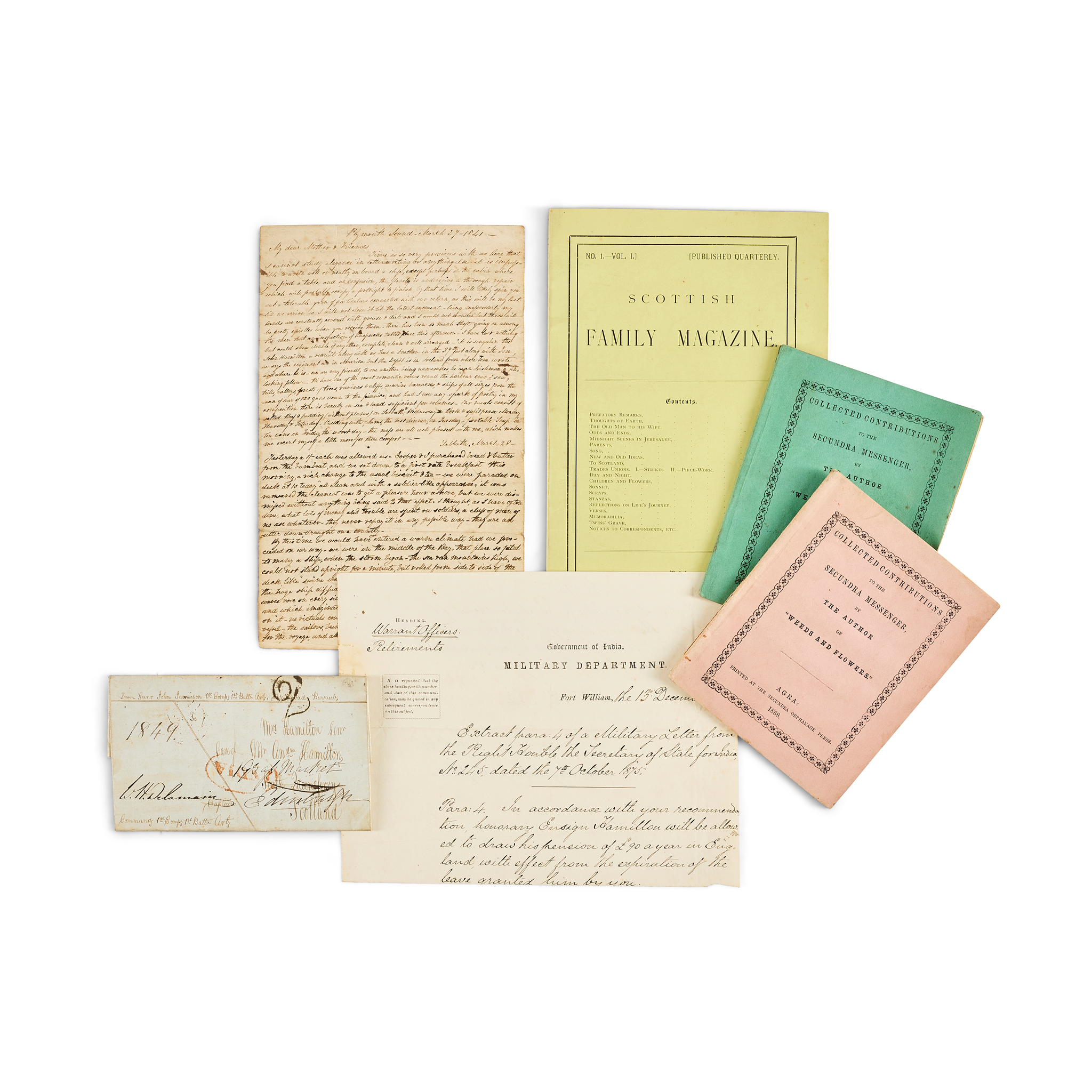
A collection of c. 150 manuscripts, mostly letters, but also official documents and certificates, books etc., relating to the Hamilton family of Edinburgh between 1812-1892. The majority of the collection consists of letters by John McDougal Hamilton (1818-88), soldier in the army of the East India Company to family members. The letters provide a fascinating record of life in the Indian sub-continent from a Scot from a relatively humble background, who devoted his life to the army, rising eventually to the rank of lieutenant. He gives detailed descriptions of local culture, religious practices, food and flora and fauna, accounts of his experiences as a teacher ("dominie"), his travels, and military life in a clerical, non-combatant, role. In a series of notes written during August and September 1857, intended to be sent back to his family, he gives his own personal experiences of the Indian Mutiny while stationed in Meerut. The main contents are as follows:
1812 marriage certificate of John McDougal Hamilton's parents, Andrew Hamilton, weaver, Canongate, Edinburgh to Margaret Robertson;
1835 printed document with blank spaces for manuscript details confirming that Andrew Hamilton has been receiving a pension of 9d. per day since being discharged from the 10th regiment of foot in 1805 for a lame arm and shoulder and had not been in receipt of any other pension;
1840 recruitment document (printed with blank spaces for manuscript details) recording answers given by John McDougal Hamilton (occupation clerk) to questions about his current circumstances when enlisting in the army of the East India Company);
ring binder containing c. 100 letters and documents mainly relating to and by John McDougal Hamilton while based in India, but also with 3 letters to John by his brother, Robert (d. 1856), also serving in the army in India, under the enlisted name of 'John Jamieson.' The letters, filed in chronological order, date from 1841 to c.1870 and were sent to various family members: his mother (d. 1860), his brother Andrew (d. 1878), his sister-in-law Martha (d. 1887), and Andrew's sons and daughter, John (d. 1892), Andrew (d. 1923) and Martha (d. 1889). Most, but not all, of the letters have a typescript transcription, done by John Buist. Also included in the ring binder are: a manuscript document confirming Hamilton's position in Calcutta as Deputy Assistant Commissary with the rank of Honorary Ensign, documents relating to the posthumous settlement of business affairs of Hamilton, his brother Andrew and sister-in-law, Martha, documents relating to his nephew John, who left the Midlothian and Peebles Asylum (Rosslynlee Hospital) in 1891, travelled to New York and died there of alcoholism in 1892; a copy of the article "India as it was" by John Buist in the 'Scottish Education Journal' (3.9.1975), manuscript texts, both 12 ff., of two short 'Mess stories': "Time Daly's Tiger" and "The letter of Introduction" presumably both written by Hamilton;
miscellaneous loose documents relating to Hamilton's career in Edinburgh and his family's business affairs, including: leaves of press clippings of stories written by Hamilton in India and published in instalments in a local newspaper or periodical, "Allan Armytage: a Chronicle of Edinburgh" "Diaries of Marches in In India, to a Friend at Home"; manuscript document dated 1875, confirming that the retired Hamilton will be entitled to draw a pension of £90 per year; correspondence 1882-85 relating to Hamilton's attempts to get his prose and verse collection 'Weeds and Flowers' (first published in Calcutta in 1863) re-published and sold to subscribers by The London and Provincial Literary Association and the latter's efforts to get him to pay the associated publication costs; 1892 New York death certificate for Hamilton's nephew, John;
printed material: 4 copies of Hamilton's pamphlet 'Collected Contributions to the Secundra Messenger' (Agra, 1868), volume, no.1 of an unrecorded printed periodical 'Scottish Family Magazine (Leith: John Hamilton, [1880s?]) presumably written by Hamilton; 2 books on the Indian Rebellion of 1857 (early 20th-century and 1970), presumably from the collection of John Buist;
three manuscript notebooks of Hamilton, a volume of press clippings of letters to newspapers/periodicals by Hamilton
Provenance
1) The archive was at one point owned by a Mr John Buist of Edinburgh, who used the contents to write an article on John Hamilton for the 'Scottish Education Journal,' published in 1975, about Hamilton's experiences in India as a schoolmaster.
2) From the collection of the late Professor Roland Paxton MBE FICE FRSE (1932-2025), 'Britain's foremost historian of civil engineering' (Telegraph, obituary, 12th November 2025); Professor Paxton was also a leading conservationist of Britain's engineering heritage, and led successful campaigns to restore two of the world's most important railway structures, the Laigh Milton Viaduct in Ayrshire, the world's oldest surviving railway bridge, and the Union Chain Bridge, the world's oldest suspension bridge still carrying road traffic.
Footnote
John 'Jack' McDougal Hamilton (1818-88) was the son of an Edinburgh weaver who enlisted to become a soldier in the East India Company in 1840. He arrived in India in 1841 and continued his former, civilian, profession of clerk, without seeing any frontline combat. In 1843, while stationed at Agra, he was acting as tutor to the families of local officers and then as 'school sergeant,' the official schoolmaster for children from soldiers' families and also for soldiers. In 1852 he transferred to the Army Commissariat Department in Kalka in Haryana and then had several other postings in India before moving to Calcutta [Kolkata] in 1869. He contributed letters and short stories to local newspapers and had a collection of prose and verse 'Weeds and flowers, or Essays on natural subjects' published in Calcutta in 1863. In the early 1870s, after a bout of serious illness, he retired from the army and eventually returned to Scotland. He is recorded in the 1881 census as living with his niece Martha in Edinburgh. In the 1880s he tried to get 'Weeds and flowers' re-published in London; he also self-published in Edinburgh one issue of a periodical 'Scottish Family Magazine,' "for the improvement of domestic life and character." He died in 1888 and is buried in Grange Cemetery, Edinburgh, along with other members of his family.