

Lot 243
India
Account of Operations of the Great Trigonometrical Survey of India
Auction: From the Library of Professor Roland Paxton | 01 October 2026 from 10am | Lots 221 to 252
Description
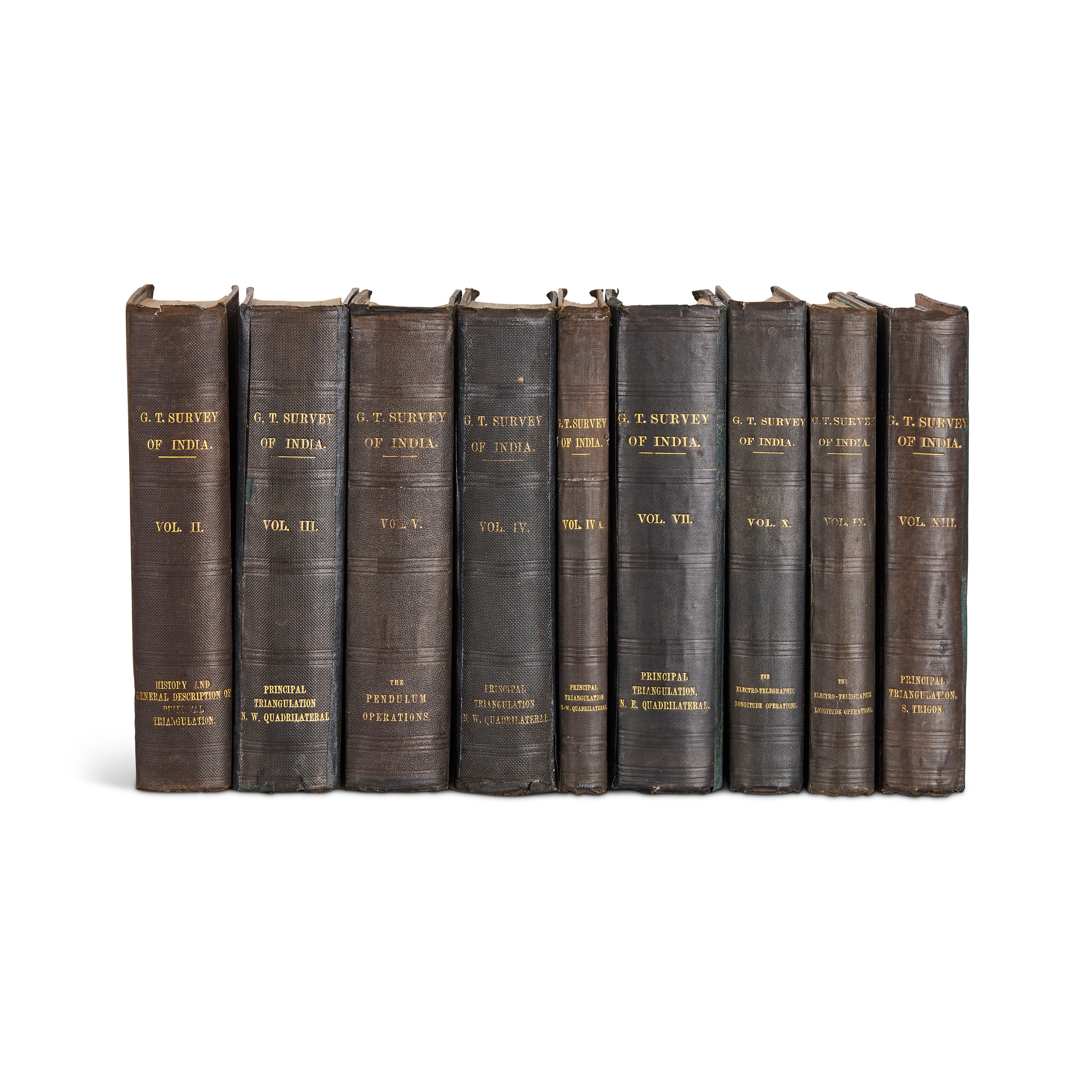
A selection of volumes from a 19-volume series, published between 1870-1910, consisting of the following:
[vol. 2] Walker, J.T. History and General Description of the Principal Triangulation and of its Reduction. Dehra Dun [Dehradun]: Office of the Great Trigonometrical Survey, 1879. First edition, large 4to, original black cloth, plates (some folding), including illustrations, charts and maps;
[vol. 3] Walker, J.T. The Principal Triangulation: the Base-line Figures, the Karachi Longitudinal, N.W. Himalaya, and Great Indus Series of the North-West Quadrilateral. Dehra Doon [Dehradun]: Office of the Great Trigonometrical Survey, 1873. First edition, large 4to, original black cloth (by Wyman of Calcutta), plates (1 folding), including charts and maps, joints repaired with black tape;
[vol. 4] Walker, J.T. The Principal Triangulation : the Great Arc (section 24°-30°), Rahun, Gurhagarh and Jogi-Tila Meridional Series, and the Sutlej Series of the North-West Quadrilateral. Dehra Dun: Office of the Great Trigonometrical Survey, 1876. First edition, large 4to, original black cloth (by Wyman of Calcutta), plates (1 folding), including charts and maps, joints repaired with black tape;
[vol. 4a] General Description of the Principal Triangulation of the Jodhpore and the Eastern Sind Meridional Series of the North-West Quadrilateral. Dehra Dun: Office of the Trigonometrical Branch, Survey of India, 1886. First edition, large 4to, original black cloth, plates (2 folding), including charts and maps;
[vol. 5] Basevi, J.P. and Heaviside, W.J. Details of the Pendulum Operations … and of their Reduction. Dehra Dun: Survey Office, 1879. First edition, large 4to, original black cloth, plates (some folding), including illustrations, charts and maps;
[vol. 7] General Description of the Principal Triangulation of the North-East Quadrilateral. Dehra Dun: Office of the Trigonometrical Branch, Survey of India, 1882. First edition, large 4to, original black cloth, plates (some folding), including charts and maps;
[vol. 9] Strahan, G. and Heaviside, W.J. Electro-telegraphic Longitude Operations Executed during the Years 1875-77, and 1880-81. Dehra Dun: Office of the Trigonometrical Branch, Survey of India, 1883. First edition, large 4to, original black cloth, plates (1 folding), including illustrations, charts and maps;
[vol. 10] Strahan, G. and Heaviside, W.J. Electro-telegraphic Longitude Operations Executed during the Years 1881-82, 1882-83 and 1883-84. Dehra Dun: Office of the Trigonometrical Branch, Survey of India, 1887. First edition, large 4to, original black cloth, plates (some folding), including illustrations, charts and maps, joints slightly cracking;
[vol. 13] Details of the Principal Triangulation of Five of the Component Series of the Southern Trigon. Dehra Dun: Office of the Trigonometrical Branch, Survey of India, 1890. First edition, large 4to, original black cloth, plates (some folding), including illustrations, charts and maps, rebacked (9)
Provenance
1) The library of the Royal Observatory, Edinburgh.
2) From the collection of the late Professor Roland Paxton MBE FICE FRSE (1932-2025), 'Britain's foremost historian of civil engineering' (Telegraph, obituary, 12th November 2025); Professor Paxton was also a leading conservationist of Britain's engineering heritage, and led successful campaigns to restore two of the world's most important railway structures, the Laigh Milton Viaduct in Ayrshire, the world's oldest surviving railway bridge, and the Union Chain Bridge, the world's oldest suspension bridge still carrying road traffic.
Footnote
The Great Trigonometrical Survey of India started in 1802, aiming to map the entire Indian subcontinent with scientific precision using theodolites. After a reduction in the size of the Survey budget in 1875, there was a reorganization which amalgamated the Great Trigonometrical, Topographical and Revenue Surveys into the Survey of India under the control of Surveyor-General Colonel J.T. Walker (1826-96). Based at Dehradun, in the foothills of the Himalayas, the Survey continues its work to the present day.