

Lot 63
Eminent Georgians
Autograph album
Auction: 16 June 2026 from 10:00 BST
Description
4to, 19th-century straight-grain skiver album (stationer's ticket, Sutherland's of Edinburgh, to front pastedown), containing some 130 items in total (complete letters, signed free fronts, clipped signatures and sentiments), mounted or tipped in, mainly 1820s-30s, including:
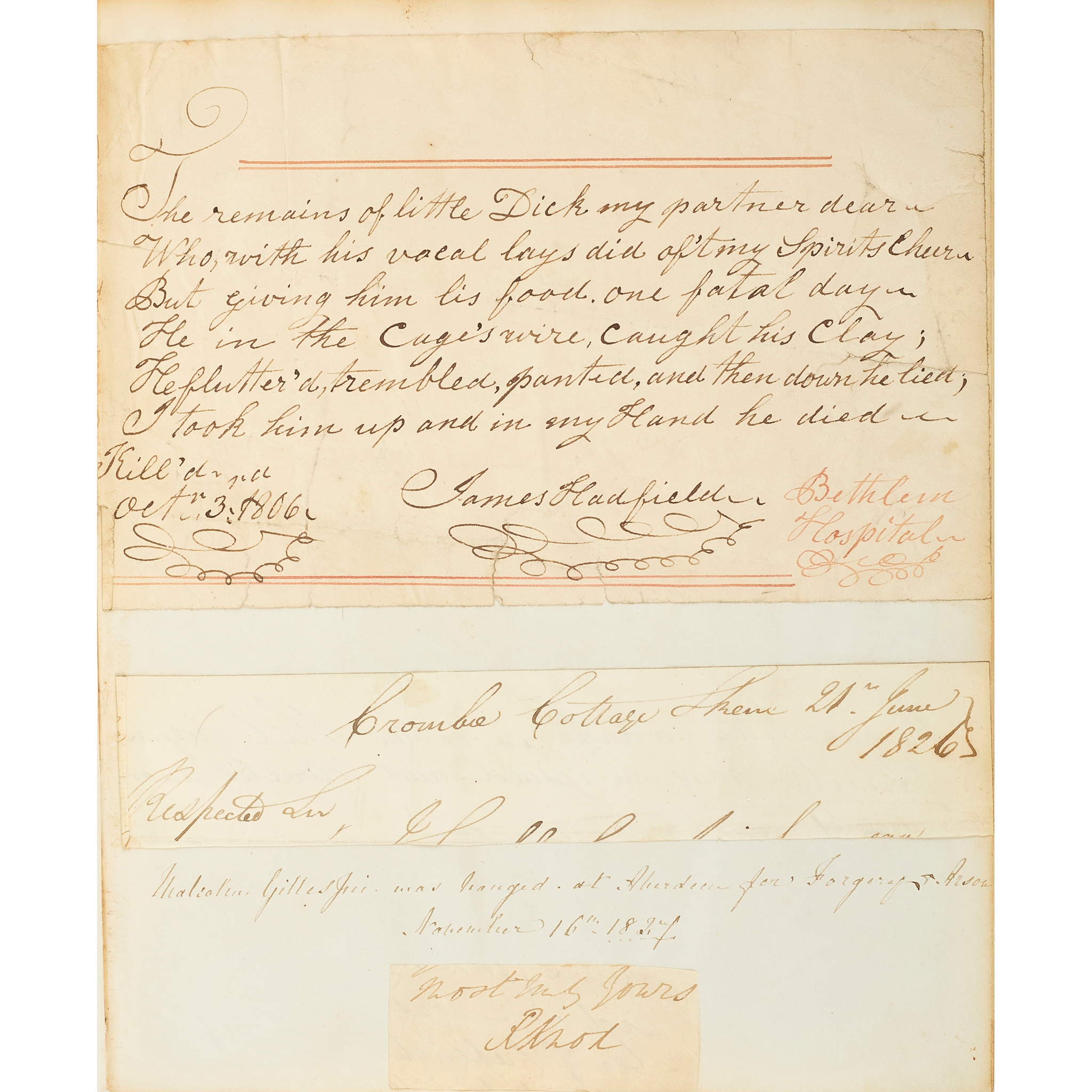
James Hadfield (1771/2-1841), assailant of George III and long-term inmate of Bethlem asylum, autograph poem on the death of ‘Little Dick my partner dear’, apparently a bird, dated ‘Kill’d October 3rd 1806’, signed ‘James Hadfield, Bethlem Hospital’, twin rules in red ink at head and foot;
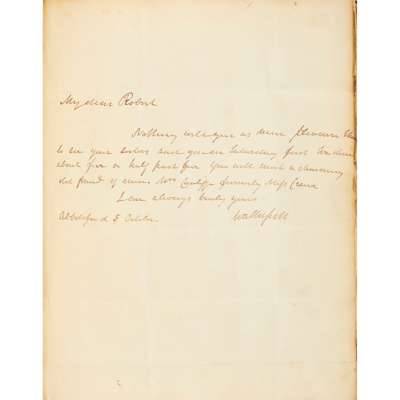
Sir Walter Scott (1771-1832), autograph letter signed to Robert Rutherford W.S., Abbotsford, 5th October 1828, inviting Rutherford to dinner, single bifolium, conjugate leaf with autograph address panel, Melrose post-mark, date-stamp of October 1828, and remains of Scott’s red wax seal, tipped in;
Walter Scott the younger (1801-1847), letter signed, Abbotsford, 22nd September 1832, to an unnamed recipient inviting him to the funeral of Sir Walter Scott at Dryburgh Abbey, single sheet, pasted down;
Charlotte Augusta (1766-1828), Princess Royal, daughter of George III and later Queen of Württemberg, autograph letter signed, written as a child, 1778, to a Miss Neve, probably a maid (‘[I] must beg your pardon for having been cross when I was dressing this morning, it was silly of me …’), single bifolium, tipped in;
William Wilberforce (1759-1832), letter signed, Bath, 16th November 1820, to a Mrs Keir, advising her on helpful contacts for the promotion of an unidentified scheme including ‘any individuals of respectability both native Russians & English at Petersburgh … for instance Prince Gallitzin’, single bifolium, tipped in, each leaf with closed transverse tear across width, shallow chipping with slight loss of text along fore edges;
Lady Charlotte Bury (1775-1861), novelist, autograph letter signed, 1833, recommending to James Wilson of Edinburgh a Monsieur Emiliani as ‘the finest violin player I ever heard Paganini excepted’;
and numerous others, including clipped signatures of William IV, prime ministers (Wellington, Canning, Sidmouth, Palmerston), soldiers (Anglesey, Hardinge, Beresford, Raglan), William Wordsworth (dated Thorny How, Grasmere, 22nd September 1842), free fronts from Wellington, Liverpool, Bute, Dalhousie, Rosslyn, Rosebery, etc., further complete letters from figures including Thomas Chalmers, the Duke of Buccleuch, etc., a University of Edinburgh engraved class card for Dugald Stewart's lectures on moral philosophy, 1790
Footnote
James Hadfield (1771-1842) spent 40 years as an inmate of Bethlem Hospital in Kent following his failed attempt to assassinate George III while the king was in the royal box at Drury Lane Theatre. He had been seriously wounded as a soldier fighting in the War of the First Coalition, and on returning to England ‘fell under the sway of a millenarian cult, becoming convinced that his death at the hands of the state would effect the second coming’ (ODNB). His trial for treason was halted on the instruction of the judge, and had a long-lasting effect on the treatment of defendants deemed insane, who, after the passing of the Criminal Lunatics Act of 1800, were to be indefinitely confined regardless of the verdict. While incarcerated, James Hadfield was permitted to keep pets and wrote elegies on their deaths, which he appears to have distributed to visitors. Other examples, including copies of an epitaph for a dead pet squirrel, are held by the Bethlem Museum of the Mind at what is now known as the Bethlem Royal Hospital.