

Lot 160
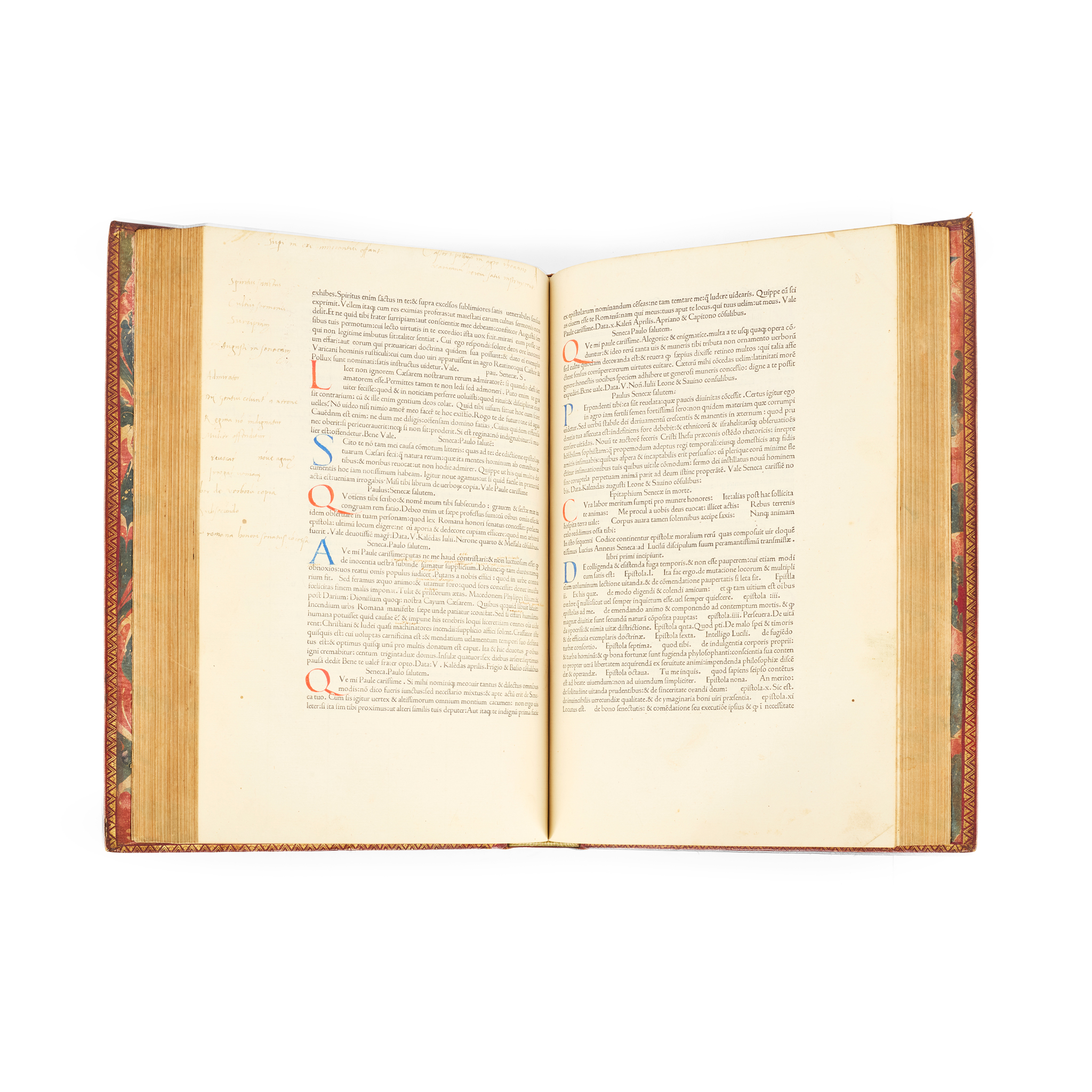
Seneca, Lucius Annaeus, the Younger (c.1-65 AD)
[Opera philosophica. Epistolae]
Auction: 16 June 2026 from 10:00 BST
Description
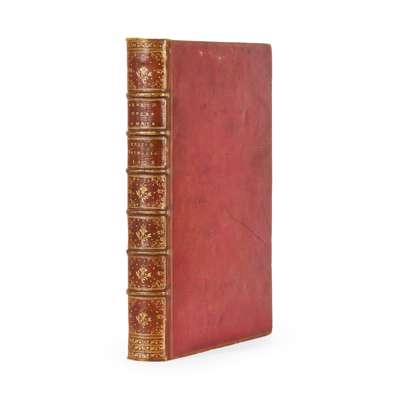
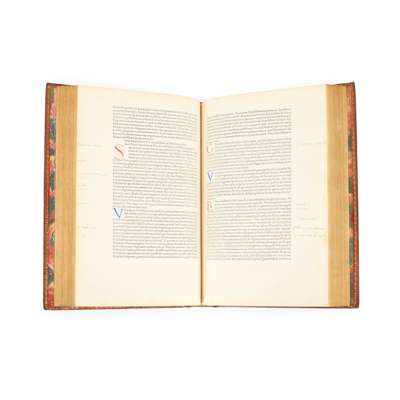
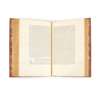
Naples: [Mathias Moravus], 1475. Folio (38 x 25cm), [252] leaves (of 253: lacking first blank only), 46 lines, roman letter, manuscript initials throughout (alternately in red and blue), 18th-century French binding of straight-grain red goatskin over heavy boards, sewn on 6 supports, gilt tooling on spine and turn-ins, marbled endpapers, plain paper fly-leaves, all edges gilt, with occasional annotations in margins in at least two separate contemporary or 16th-century hands, annotation noting the price paid for the La Vallière copy on the binder's blank, first text-leaf trimmed and inset (possibly supplied from another copy, being the sole leaf with the initial-space left blank, and with a few worm-holes not continuing to subsequent leaves), a few annotations shaved by the binder, browning to first quire and a few other leaves, spotting to margins, occasionally to the text, mainly in the Epistolae, a few old ink-stains and other marks, two leaves with small tears in lower margins, first few leaves with minor paper-disruption in gutter, small worm-hole in seventh line of text up to about f. [35], small worm-hole appearing in fore margin towards the end of the Opera at about f. [130], a second appearing early in the Epistola at about f. [160], spreading from about f. [210], into text of final few leaves, a very good copy with wide margins [BMC VI 861; ISTC is00368000; Goff S368; GW M41235]
Provenance
1) Presented by one W. D. Graham to a Mr Ramsay in Glasgow, 1843 (manuscript note tipped to first leaf of text).
2) Private collection, Scotland.
Footnote
Editio princeps of Seneca the Younger's moral and philosophical works and of the Declamations of his father Seneca the Elder (c.55 BC-34 AD), the latter a unique source for the ‘practices of orators (including Livy and Ovid) of the late Roman Republic and early empire, whose oratory is otherwise lost to us’ (Grafton et al., The Classical Tradition, 2010, p. 872. Three other editions of the Epistola were printed in the same year, at Paris, Rome, and Strassburg, with priority not established, though T. F. Dibdin was keen to assign it to the present edition (Bibliotheca Spenceriana, 1814, vol. 2, p. 338).
The printer, Mathias Moravus, was originally from Cetkovice, near Olmütz (Olomouc), Moravia, and may have worked as a scribe, possibly in Oxford, before adopting printing. By 1474 he was in Genoa, printing a single work, a digest of canon law, one of the first books if not the very first printed in the city, before moving to Naples at the instance of the Cistercian monk and humanist scholar Blasius Romerus, editor of the present work. Moravus was active in Naples until 1492, producing substantial corpus of editions of classical and humanist authors and devotional texts.