

Lot 152
Bible; English; Geneva Version
[The Bible and Holy Scriptures, conteyned in the Olde and Newe Testament]
Auction: 16 June 2026 from 10:00 BST
Description
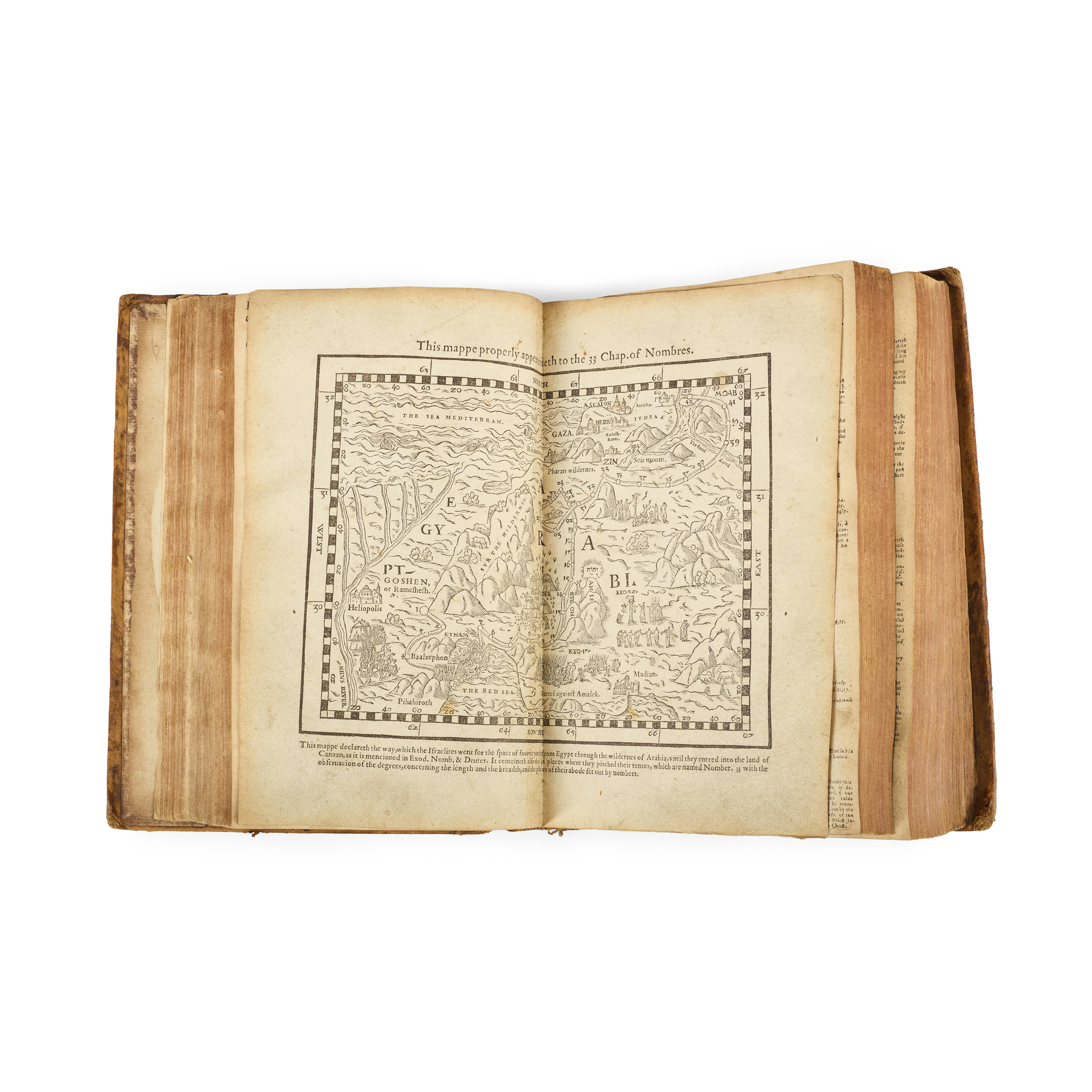
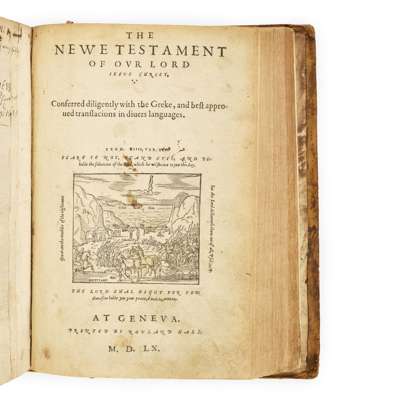
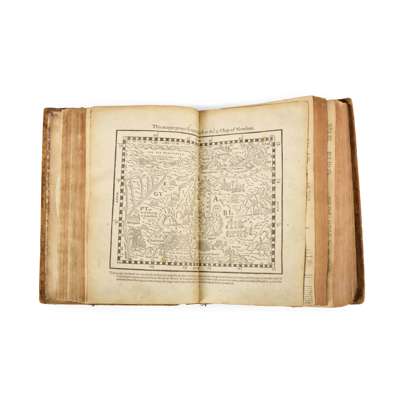
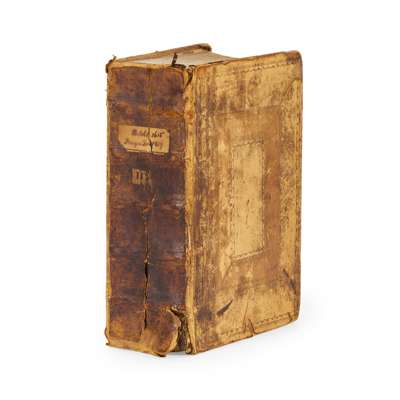
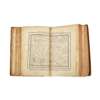
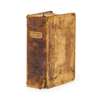
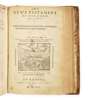
[Translated according to the Ebrue and Greke, and conferred with the Best Translations in Divers Langages]. Geneva: Rouland Hall, 1560. 4to (22.1 x 15.5cm), 17th-century panelled calf retaining earlier backstrip, lacking 4 leaves (*1, general title-page, replaced with a woodcut title-page from a 1615 Robert Barker edition of the Authorised version; *2-3, epistle to Elizabeth I; and 3K3, part of Jeremiah), retaining the address leaf *4 (‘To our Beloved in the Lord the Brethren of England, Scotland, Ireland’, dated Geneva, 10th April 1560) lNew Testament title-page (with woodcut depicting the crossing of the Red Sea), and all 5 double-page woodcut maps ('The way, which the Israelites went for the space of fourtie yeres'; ‘The division of the land of Canaan’; [The forme of the Temple and citie restored]; ‘The description of the holie land and other places mencioned in the foure Evangelistes’; ‘The description of the countreis and places mencioned in the Actes of the Apostles’), 26 woodcuts in text (including ‘The situacion of the garden of Eden’, the Flood, the crossing of the Red Sea, the Tabernacle, etc.), text printed in roman type in two columns, divided into verses. Binding worn, endpapers renewed perhaps c.1900, leaves closely trimmed at head and foot often shaving headlines and signature-marks, occasional light spotting and soiling (principally to margins), a few old ink- or damp-stains, stitching between OT quires 2N and 2O perished, OT with light worming to fore margins quires a-v (initially a pin-hole, gradually ramifying then shrinking, touching text with minimal effect on legibility), a3 and I2 each with small holes in text, i4 and 4I2 with repaired closed tears, O4 (Kings I) lower fore corner torn away with loss of several lines of text, 2T1 with small closed tear at foot, NT title-page marked, NT 2K3 with slight loss to lower core corner affecting side-note, one map of (the Temple and Citie restored) shaved at foot, ‘The description of the holie land’ map with small tear to upper margin and show-through from 17th-century manuscript genealogy on verso (the genealogy continuing from 5B4, final leaf of the Apocrypha) [ESTC S101758; Herbert 107; PMM 83; STC 2093].
[Bound with at front]: The Booke of Common Prayer (London: Bonham Norton and John Bill, 1619, ESTC S123375). [And at rear:] The Whole Booke of Psalmes (London: John Windet for the Assignes of Richard Day, 1601, ESTC S115292)
Provenance
17th-century manuscript family genealogy to end of the Apocrypha and verso of ‘The description of the holie land' map recording births principally in the Ward family of Kilby, Leicestershire from 1663 onward; front pastedown with ownership inscriptions ‘B. F. Smith, Rusthall' and ‘Arthur Eden … 1901’, with a note in the hand of the latter identifying Smith as the Archdeacon of Maidstone.
Footnote
First edition of the Geneva Bible, the most important and widely-read version of the Bible in English in the late 16th and early 17th centuries. Printed in Geneva by Marian exiles, it was the first complete translation into English to be made directly from the original biblical languages, and the first English Bible to be printed in roman type and with verse divisions. Intended as a portable and readable Bible for everyday devotion and study, it retained its popular pre-eminence until its suppression and gradual displacement after the introduction of the King James Version in 1611.
‘The Geneva Bible showed a distinct advance on its predecessors, and appearing as it did in compact form, with roman type and verse divisions, obtained speedy and permanent popularity. Its arguments and numerous explanatory notes (often distinctly Calvinistic in tone), which amount to a running commentary, endeared it especially to the puritans, and for three generations it maintained its supremacy as the Bible of the people. Its phrases find an echo in Scripture quotations from Shakespeare to Bunyan. Between 1560 and 1644 at least one hundred and forty editions appeared … Examination of the King James’ Bible of 1611 shows that its translators in correcting the Bishops' Bible were influenced more by the Geneva than any other English version' (Herbert).