

Lot 96
Younghusband Expedition to Tibet, 1904
Photographs attributed to Lieutenant-Colonel Gerard Irvine Davys
Auction: Books & Manuscripts | Wed 25 February from 10am | Lots 63 to 255
Description
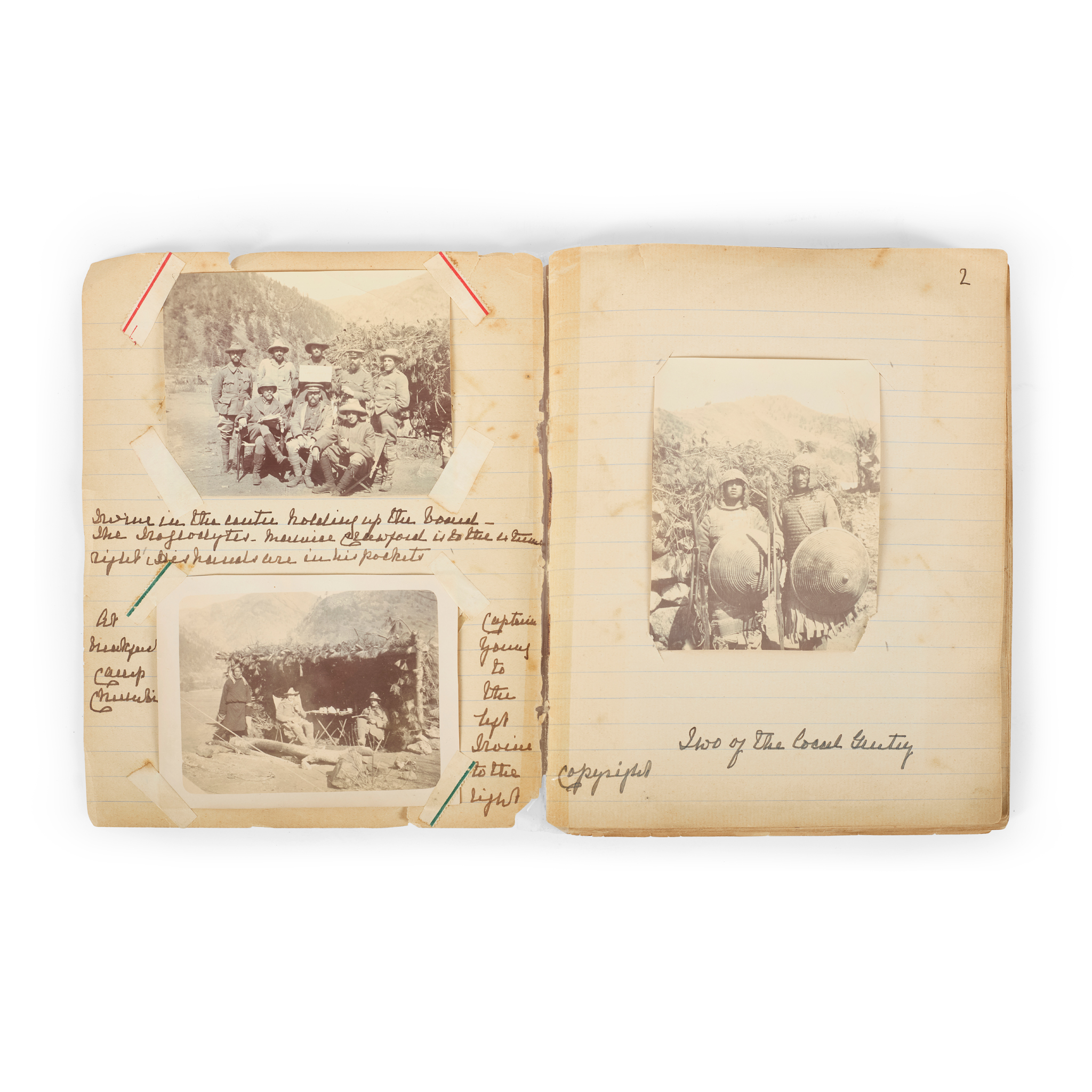
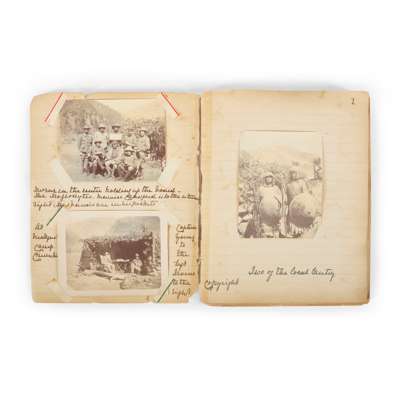
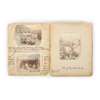
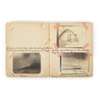
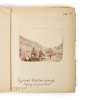
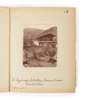
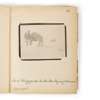
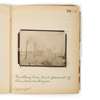
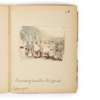
Ruled notebook containing 51 photographs, each approx. 10.5 x 8cm, mainly silver gelatin prints, ink captions to pages with many including ‘copyright’ in ink, pencil notes to reverse of photographs, notebook lacks cover, photographs faded and taped across corners into notebook.
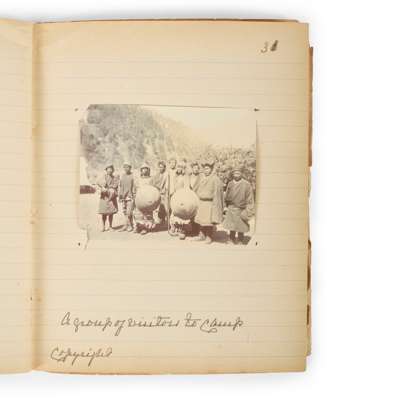
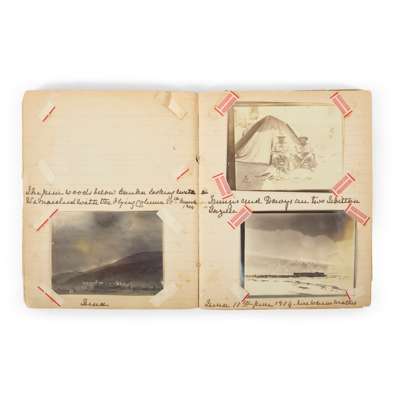
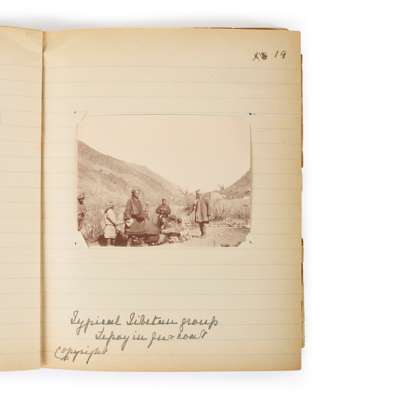
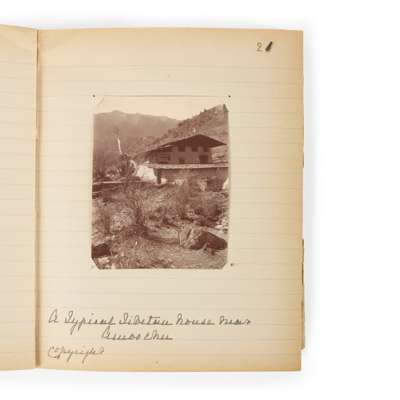
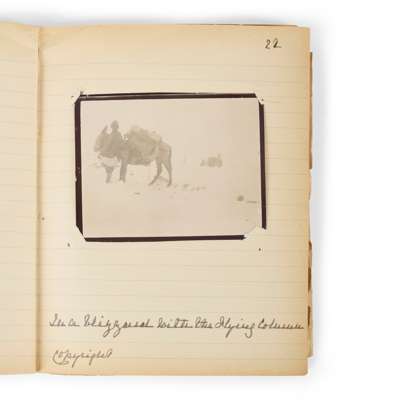
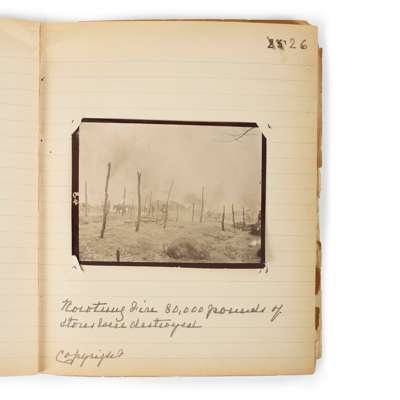
Captions of the images include: In camp near Amoo Choo (Amochu?); Irvine in the centre holding up the board…; At breakfast Camp Chumbie; Two of the local gentry; Davys operating on wounded Tibetan…; Lingmothang Pass; Tibetan women bringing in fodder to the camp in Chumbie; The village of Old Chumbi; A typical village in South Central Tibet; ; Fort Guntong[?] [Gyantze?]; Truninger and Davys and two Tibetan Gazelle; Glaciers…; June 10th 1904 … snow; A desert storm …; Gazelle heads; Truninger & Davys with two Tibetan gazelle; The first yak worked[?] in a wheeled vehicle; A coolie being flogged and tied to a triangle; Tibetan defences beyond Chumbi; Our camp in the snow; Branding[?] Government mullocks; Loading up; The great fort of Phari; ‘The roof of the World’; Chumbi stores; ‘The Tibetan Ngor who commanded the left sangar at Hot Springs. He is dying, his left hand shot away and his right leg torn to pieces by a shell’; Trading a yak in Southern Tibet; Upper Tibet. Camp in snow; Typical Tibetan group. Sepoy in fur coat; The road near ?; A typical Tibetan house…; In a blizzard with the flying column; Grass cutters and loads. They are nearly all women; On the way to Phari with the flying column; The gate of Tibet-Gutung [?]…; Rorotung[?] fire 80,000 pounds of stores were destroyed; Camp on the Amoo Choo [Amochu] river; The only captive Showa[?] [Tibetan red deer] in the world the rarest deer known; Yaks at camp near Chumbi; A group of visitors to camp; The top of Phari fort; A view of Phari village…; The frozen waterfall…
Provenance
Attributed by family repute to Gerard Irvine Davys (1879-1967), army medic on the Younghusband Expedition. Thence by descent to the present owner.
Footnote
Commanded by Major Francis Younghusband, the British mission to Tibet in 1903-4 was ostensibly to establish political and commercial links. However, it soon became a military expedition and, reinforced mainly by Indian soldiers and eventually exceeding 10,000, advanced in stages towards the Tibetan capital Lhasa.
The Tibetans' resistance was no match for the superior weaponry of Younghusband’s troops. The massacre of Tibetans in combat caused public unease in Britain and the British Government felt the treaty negotiated by Younghusband at Lhasa in 1904 exceeded his instructions. Recent appraisals regard the mission as 'the embodiment of empire at its overstretched zenith' (Oxford Dictionary of National Biography).
Various photographic records of the Younghusband expedition exist in library and museum collections. The best-known images were taken by engineer and Indian civil servant John Claude White, an accomplished photographer, who was Younghusband’s deputy.
The present collection is unusual as the immediacy of the images suggests they were taken spontaneously and informally, and they provide a more personal record of the expedition. Gerard Irvine Davys was a lieutenant in the Medical Service who took part in the mission. A number of the captions reference him in the first person, although a couple in the third person and a photograph with Davys shown treating an injured Tibetan, are presumably by someone else.
None of the photographs have been traced to any of the contemporary illustrated publication although Davys' picture of the fatally injured Tibetan soldier, and others by him and John Claude White, appeared in a 2017 exhibition in Tibet ‘Capturing Tibet: Colonialism and the Camera during the Mission to Lhasa,’ a collaboration between the Tibet Museum, National Museums Liverpool and the University of Manchester.