

Lot 65
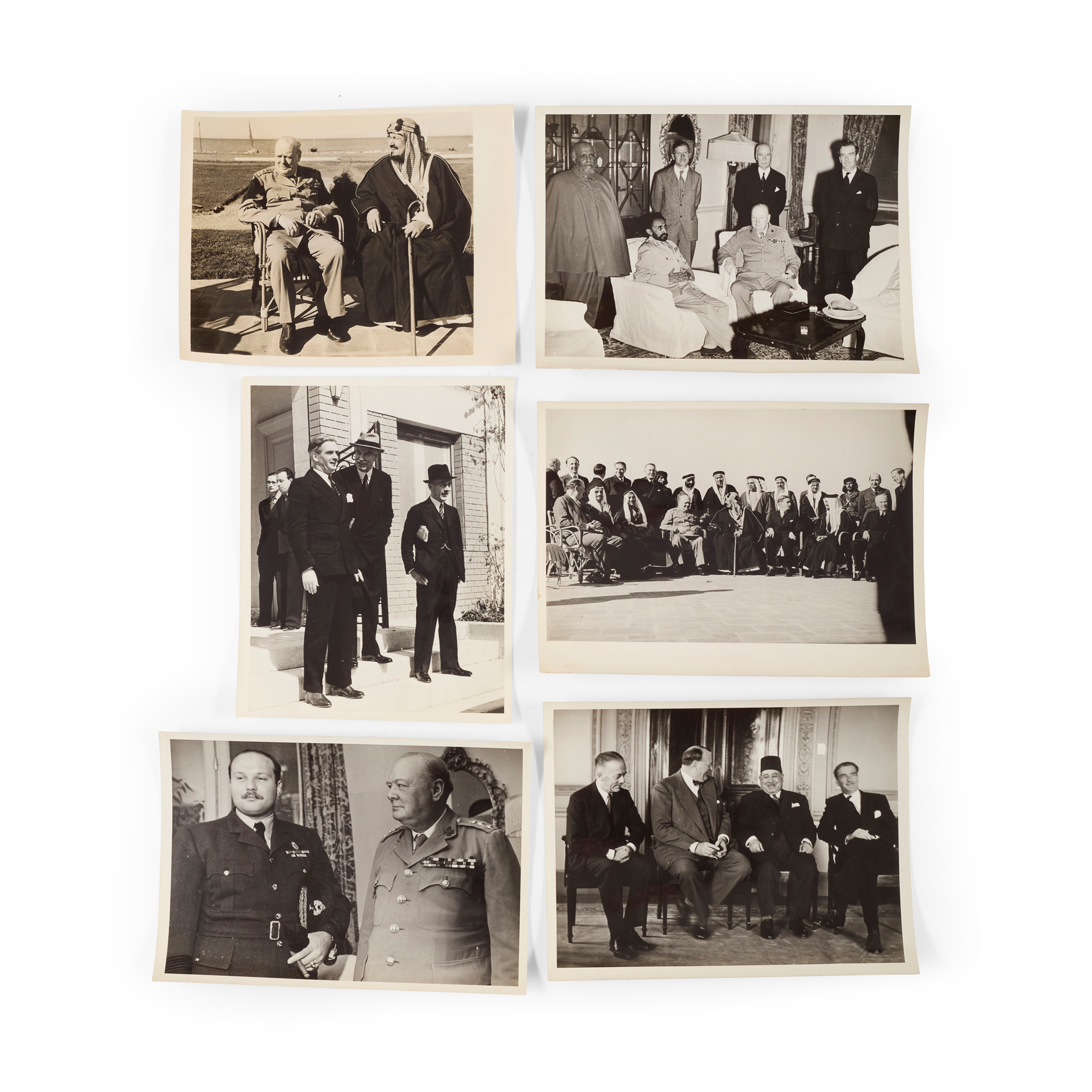
Churchill, Sir Winston S., & Ibn Saud
Official photographs of Churchill's meeting with Ibn Saud and other leaders in Egypt, February 1945
Auction: Books & Manuscripts | Wed 25 February from 10am | Lots 63 to 255
Description
6 gelatin silver prints, 16.9 x 21.6cm, each with wet-stamp of the British Ministry of Information, Middle East, and mounted typescript caption to verso, each caption commencing with series-title ‘Visit of Mr. Churchill to Cairo, February 1945', with individual titles as follows: ‘Mr Churchill and King Ibn Saud photographed on the terrace of the Auberge du Lac, Fayoum’; ‘Another picture taken on the occasion of Mr Churchill’s meeting with H. M. King Ibn Saud at Auxberge [sic] du Lac, Fayum'; 'Mr Churchill with H. M. King Faruk of Egypt'; ‘Photographed during Mr. Eden’s talks with the Egyptian prime Minister in his Ministry: L. to R. Sir A. Cadogan; Lord Killearn; Ahmed Maher Pasha and Mr. Eden'; ‘Mr Churchill met H.I.M. Haile Selassie at the Headquarters of the Prime Minister’; ‘Mr. Eden … Sir Edward Grigg … and Sir Alexander Cadogan photographed at the Prime Minister’s H.Q.' (6)
Footnote
After the close of the Yalta Conference in February 1945, Churchill flew straight to Egypt where he had a further meeting with President Roosevelt in Alexandria, followed by meetings in Cairo with Emperor Haile Selassie of Abyssinia, King Farouk of Egypt and President Shukri al-Quwatli of Syria, and, in the oasis city of Faiyum, with Ibn Saud of Saudi Arabia. It was his encounter with Ibn Saud which was arguably the most important: ‘The King had long been a staunch friend of Britain, and Saudi Arabia was of growing influence and prestige in the Middle East, especially after the recent discovery of its huge resources of oil; it was clearly destined to play an important part in the postwar world in such a strategic area. Moreover, both Churchill and Roosevelt hoped to persuade the King to use his influence to moderate the hostile Arab position on the plans to create the State of Israel … [A]s Churchill told the War Cabinet on his return home, ‘Ibn Saud was a marvellous and most impressive figure’’ (Rose, ed., Naval Miscellany, 2003, vol. VI, p. 427).