

Lot 39
Alexander, Sir James Edward (1803-1885)
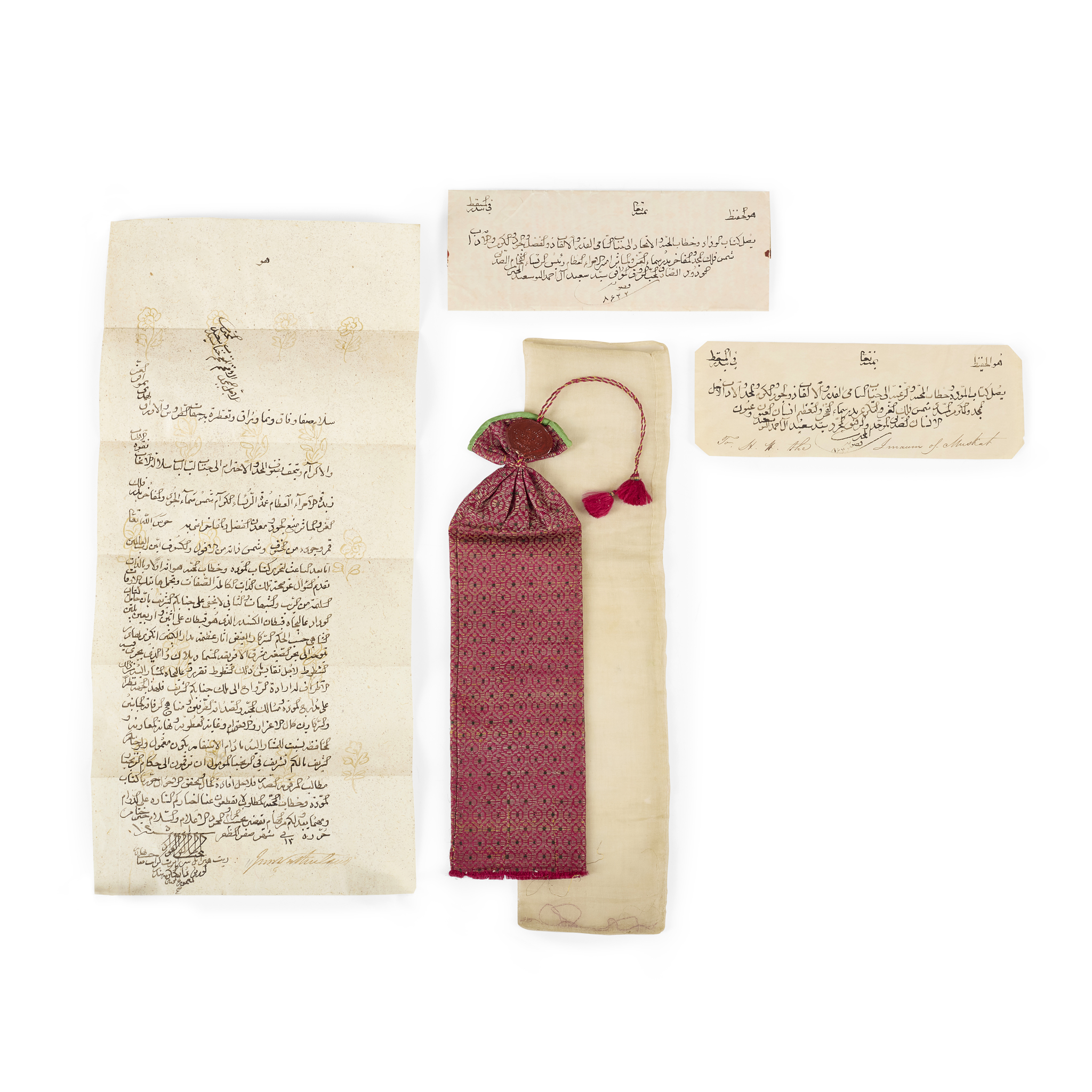
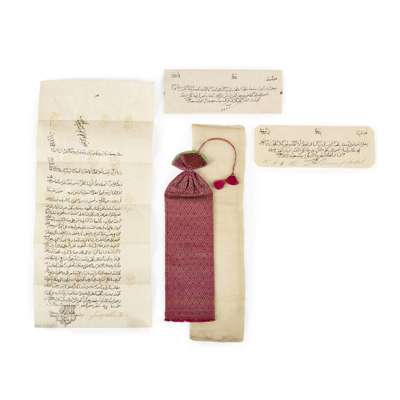
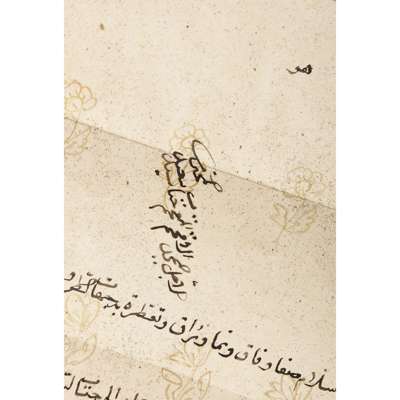
Illuminated manuscript petition in Arabic addressed to Sa'id bin Sultan (1795-1856), Imam of Muscat
Auction: The Library of General Sir James Alexander | Wed 25 February from 10am | Lots 31 to 62
Description
13 Safar 1251 AH [i.e. 9th June 1835 CE].
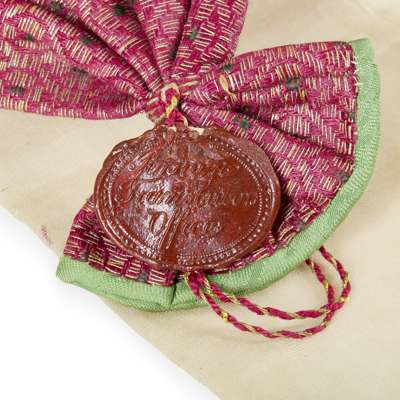
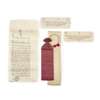
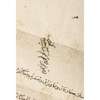
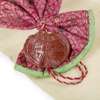
Arabic manuscript in black ink on one side of single sheet of polished wove paper sprinkled with gold, 47.5 x 22cm, naskh script, 21 lines, decorated with rows of floral and foliate motifs in gold, addressed at head to Sayyid Sa’id, colophon (in Arabic) in the name of the ‘Right Honourable Sir Robert Grant … Governor, Government House, the Flourishing Port of Mumbai’, with a British functionary's signature lower right, the document being a request for ‘Alexander who is a captain in the 42nd platoon [sic: 'blatun'] to travel to ‘the small sea east of Africa named Dilak’ (i.e. Delagoa Bay, now Maputo Bay, Mozambique) to investigate its shoreline ('shutut') and water ('bir', lit. well), the document folding into an envelope annotated in Arabic with an extensive salutation to Sayyid Sa’id Al Ahmad Al Busa'id and with the destination ‘fi Bandar al-Masqat’ ('at the port of Muscat') noted to upper left, together with another slip with the same salutation repeated and with an additional annotation in English, ‘To H. H. the Imaum of Muskat', housed in a red silk draw-string bag embroidered with gilt metal and green fabric threads forming floral pattern, and a cream gauze outer sleeve, the envelope and draw-string bag each with red wax seal reading ‘Persian Translators Office’;
together with a contemporary manuscript copy of a letter in English from ‘the Right Honourable the Governor’ (presumably Sir Robert Grant) to ‘His Highness the Immaum of Muskat' 11th June 1835: ‘I beg to introduce to Your Highness's notice the bearer of this letter Captain Alexander, His Majesty's 42nd Regiment, who has been sent out by the British Government in ordered to explorer the Rivers which discharge themselves into Delagoa Bay on the East Coast of Africa, and as it his intention to proceed along the coast to your Highness's territories, I request that Your Highness will .. extend your favor and protection to the officer … and that should Your Highness not be at Zanziebar, you will give instructions to your officers there' (single leaf, written on both sides, containing 2 copies of the same letter, 22.4 x 18.5cm) (2)
Provenance
THE LIBRARY OF GENERAL SIR JAMES ALEXANDER (1803-1885)
Footnote
A British soldier seeks permission from the Imam of Muscat to undertake a journey of exploration through his territories on the east African coast. A remarkable primary source for the style and objectives of Anglo-Arab diplomacy at a crucial moment in the growth of British influence in the Indian Ocean and Arabia in the early 19th century: 1835 was the year of the Maritime Truce between Britain and the Gulf Arab sheikhdoms, commonly identified as marking the advent of British supremacy in the region, as well as the first commercial treaty between Oman and the United States, and James Wellsted's exploration of the Omani interior. Alexander had travelled to Africa from Britain the previous year with a commission from the Royal Geographical Society to explore ‘certain regions of East Africa, from Delagoa Bay westwards’ (Alexander, Narrative of a Voyage of Observation, 1837, vol. 1, p. vii). His plans were soon disrupted by the outbreak of hostilities with the Xhosa people of the Eastern Cape, and he was required instead to serve as aide-de-camp to British commander-in-chief Sir Benjamin D'Urban. It was only in 1836 that he was able to travel into the African interior, covering 4,000 miles across Nama Land and Damaraland, for which efforts he received a knighthood in 1838.