

Lot 28
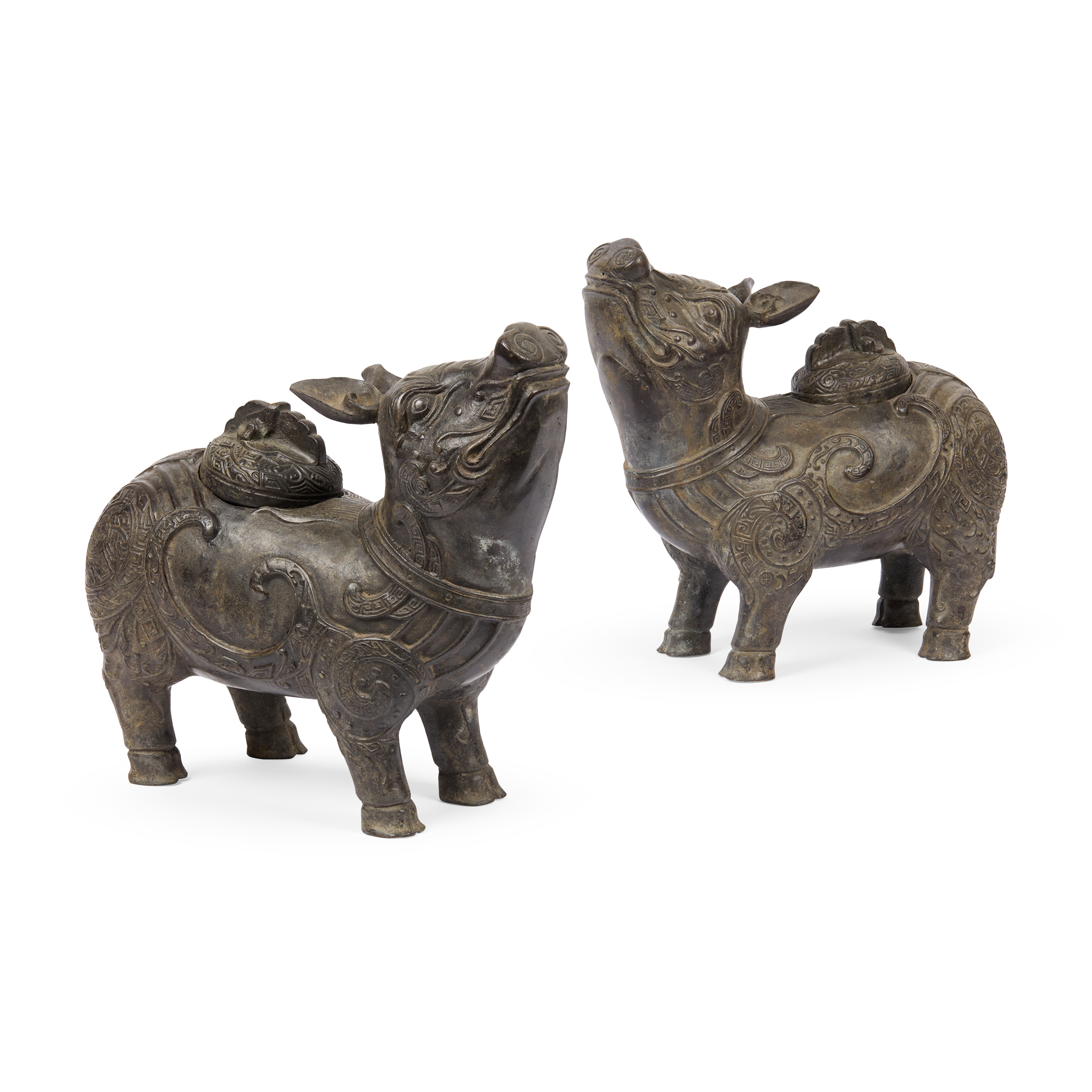
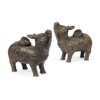
PAIR OF CHINESE ARCHAISTIC BRONZE TAPIR-FORM VESSELS AND COVERS, XIZUN
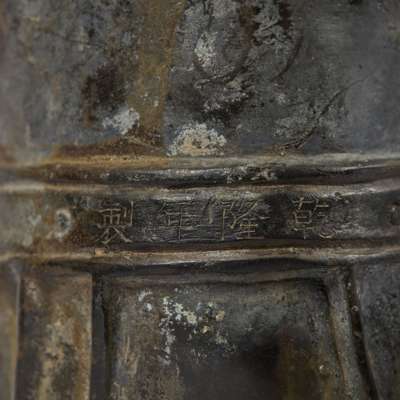
QING DYNASTY, QIANLONG MARK, 19TH CENTURY
Auction: 06 November 2026 from 10:00 GMT
Description
清 乾隆款 銅鑄仿古犧尊(一對)
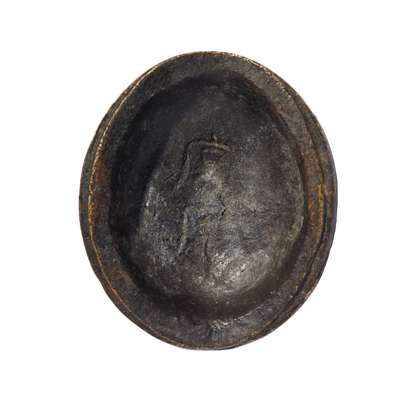
each mythical beast heavily cast standing foursquare with head raised and ears pricked, decorated on the body and face in relief with geometric archaistic scrolls, a domed cover with arched finial on its back, the underside of the cover cast with two archaistic characters, front of the chest incised with a four-character Qianlong mark (2)
Dimensions
26cm high; 8.4kg each
Footnote
This zoomorphic vessel derives from ancient bronze prototypes dating to at least the Western Zhou dynasty, with tapir-form vessels becoming more prevalent during the Eastern Zhou period. The word xi meaning 'sacrificial victim', often refers to an ox or another animal. See two examples from the National Palace Museum, Taipei, one with metal wire and turquoise inlay, mid Warring States period, accession no. Gu Tong 故銅002382N; and another with metal and turquoise inlay, Han or later, accession no. Gu Tong 故銅001835N. The form was later recorded in the Xuanhe Bogu tulu, the illustrated antiquities catalogue commissioned by the antiquarian Northern Song Emperor Huizong (r. 1100–1126), and subsequently reproduced in later editions, including the 1528 Bogu tulu.
Tapir-form vessels are generally dated to the Yuan and Ming dynasties. A comparable Yuan dynasty gold and silver-inlaid bronze tapir vessel is in the collection of the Saint Louis Art Museum, Saint Louis, object no. 14:2005. Also see another rare gold and silver-inlaid bronze tapir-shaped vessel and cover, xizun, Ming/ early Qing dynasty, formerly in the collection of Michael Goedhuis, later sold at Bonhams London, 17 May 2023, lot 342. Further compare to an archaistic cast bronze tapir, 17/18th century, sold at Bonhams San Francisco, 23 August 2010, lot 6304.