

Lot 61
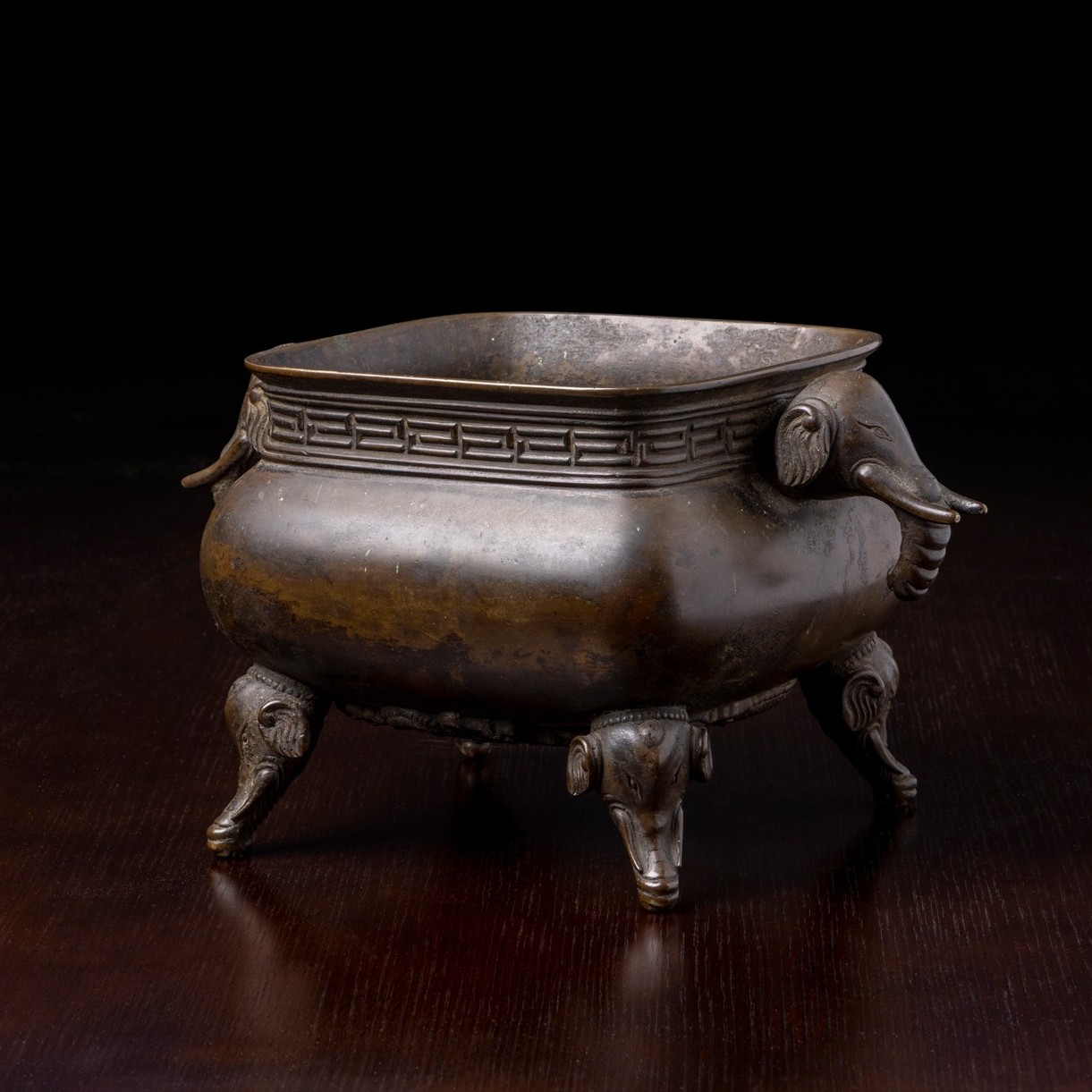
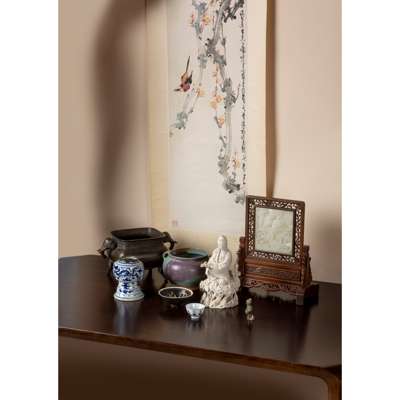
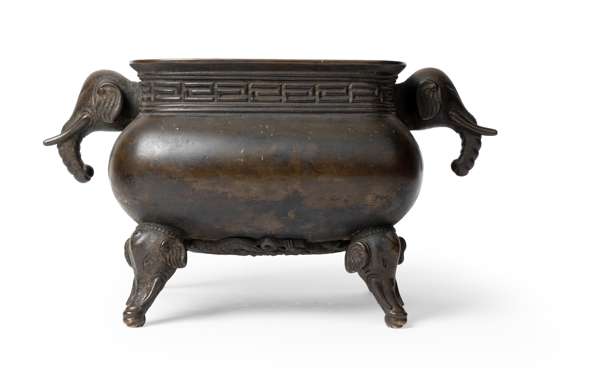
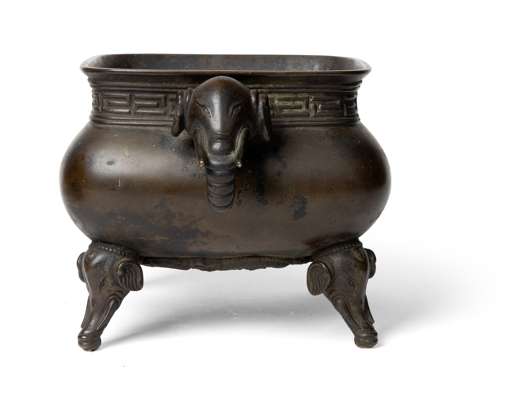
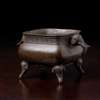
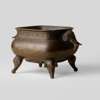
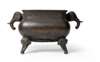
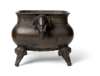
RARE CHINESE BRONZE 'ELEPHANT' SQUARE CENSER
XUANDE AND TAIJIDIAN MARKS, QING DYNASTY
Auction: 15 May 2026 from 10:00 BST
Description
清 「太極殿用 第拾壹號」內款 及 雙龍環抱減地陽文「大明宣德年製」底款 銅鑄象耳象足方爐
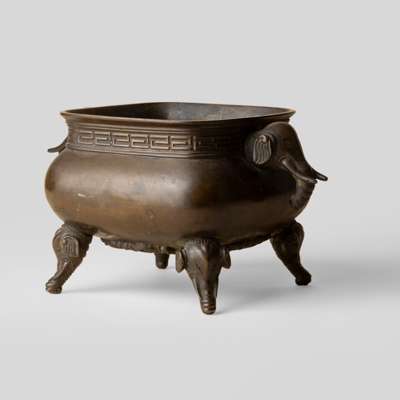
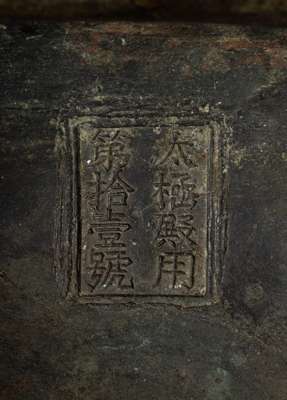
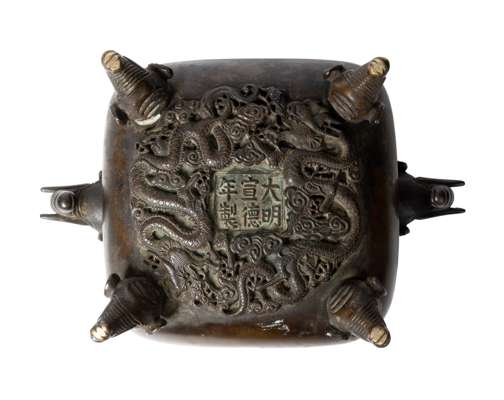
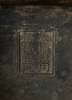
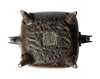
cast in rounded square form with sides rising to waisted neck with key-fret band, two sides flanked with elephant-head handles, all raised on four elephant head feet, the base finely cast with a six-character Xuande mark in a recessed rectangular panel, enclosed by a pair of sinuous five-clawed dragons chasing flaming pearls amidst clouds in high relief, one side of the interior with an eight-character ‘Tai Ji Dian Yong, Di Shi Yi Hao’ (for the usage of The Taiji Hall/ Hall of the Supreme Principle, number eleven)
Dimensions
32cm wide including handles; 5089g
Provenance
Private English collection, London;
Formerly in a private Scottish collection
倫敦私人收藏;
前蘇格蘭私人收藏
Footnote
This finely cast censer is extremely rare due to its Taiji Hall mark on the interior, the double-dragon enclosed Xuande mark on the base, the elephant-headed feet and handles and square form. All of these indicate that this is an extremely rare piece made in the Imperial Foundry of the Qing dynasty, and possibly during the Qianlong reign for the Daoist temple Taiji Hall.
Taiji Hall (Taijidian, The Hall of the Supreme Principle) could be referred to two locations. One of the most commonly known Taiji Halls is one of the Six Western Palaces in the Inner Court of the Forbidden City. It was first built in the 18th year of the Yongle reign of the Ming dynasty (1420 CE) and originally named "Weiyang Gong" (Weiyang Palace). In the 14th year of the Jiajing reign (1535 CE), it was renamed "Qixiang Gong" (Qixiang Palace); and later, in the Tongzhi reign (1862-1874) of the Qing dynasty, it was given its current name, "Taiji Dian".[1]
The other lesser-known Taiji Hall is located at Daguangmingdian (The Great Hall of the Brightness) near the Forbidden City, Beijing. Daguangmingdian was a group of Daoist temples for the royal family during the Ming and Qing dynasties. Its construction began in the eleventh month of the 36th year of the Jiajing reign of the Ming dynasty (1557 CE). It was renovated in the 11th year of the Yongzheng reign of the Qing dynasty (1733) and again in the 38th year of the Qianlong reign (1773 CE). Inside was enshrined the Jade Emperor, making it a royal Daoist temple. In addition to the main Daguangmingdian, there were also auxiliary buildings, including the Taichu Hall, Taishi Hall, and Taiji Hall. In the 8th month of the 26th year of the Guangxu reign (1900 CE), the Daguangmingdian and its auxiliary buildings were destroyed in the warfare, therefore no trace of remains today.[2]
According to the Complete Archives of the Qing Imperial Household Department's Workshop (Volume 51, pp. 558–560), between the 55th and 56th years of the Qianlong reign (1790–1791), the Imperial Foundry produced several batches of "bronze five offerings with cloud-and-dragon pattern" in various sizes for the Taiji Hall within the Daguangmingdian.[3] The set of five offerings necessarily includes one censer, and the present example might be one of them.
On the other hand, such finely cast double-dragon enclosed mark on the base only has few comparable examples in the Qing Court collection, and two are in the Palace Museum, Beijing: two circular handled censer with comparable double-dragon enclosed four-character ‘Nei Tan Jiao She (refers to the altar to Heaven and Earth within the inner walls of the Temple of Heaven)’ mark on the base, dated to the Ming dynasty, museum number: Gu 177014[4]; the other cast on the bronze base of a censer, enclosed with a three-character ‘Lu Gu Zhai’ mark, also dated to the Ming dynasty, museum number: Gu 179155.[5] According to Li Mijia, the curator at the Palace Museum, Beijing: “Among the Xuande bronzes from the Qing Court collection, there are also similar patterns of two dragons encircling the mark on the base of the vessel. However, the depiction of the dragons differs somewhat, and the engraving varies in thickness and refinement.”[6]
The tradition of using elephant heads as the feet of imperial bronze censers can be traced back at least as far as the Xuande reign (1426 -1435). An example of a censer, bearing a six-character Xuande reign mark and dated to the Ming dynasty, on which the elephants balance on their rolled trunks, comparable to the present lot, is in the collection of the National Palace Museum, Taipei, museum number: Gu Tong 002612.
Square-form censers are extremely rare in the Qing Court. In modern religious traditions, square or rectangular censers are normally known as Tiangong censer, a distinctive type of incense burner traditionally used in the religious veneration of the Jade Emperor, the supreme deity in traditional Daoist cosmology. Such a tradition might be traced back to the Qing dynasty. A comparable Ming dynasty rectangular censer supported on four lingzhi fungus feet, flanked with two dragon handles and with a Daoist immortal as the finial of the reticulated cover, is in the collection of the National Palace Museum, Taipei, museum number: Gu Tong 002630.
此爐鑄造精美,因其內部太極殿款、雙龍環抱減地陽文四字宣德款、象首足與耳及方形器身,極為罕見。凡此種種皆表明,此為清宮鑄爐處所製之極其稀有之作,且很可能製作於乾隆年間,供奉於太極殿道觀。
太極殿可指兩處地點。最廣為人知的太極殿,是紫禁城內廷西六宮之一。明朝永樂十八年(1420年)建成(1420年),初名「未央宮」,嘉靖十四年(1535年)更名為「啟祥宮」,後於清朝同治年間(1862-1874年)改稱「太極殿」。[7]
另一處較鮮為人知的太極殿,位於北京紫禁城附近的大光明殿。大光明殿是明清兩代皇室的道教建築群。其始建於明嘉靖三十六年(1557年)十一月。清雍正十一年(1733年)重修,乾隆三十八年(1773年)再度重修,內供奉玉皇大帝,是一處皇家道觀。除主殿大光明殿外,還有太初殿、太始殿及太極殿等附屬殿宇。光緒二十六年(1900年)八月,大光明殿及其附屬殿宇毀於戰火,因此今日已無任何遺跡留存。[8]
根據《清宮內務府造辦處檔案總滙》冊51,頁558-560記載 ,乾隆五十五至五十六年間(1790-1791年),鑄爐處為大光明殿內太極殿承作了數批大小不一的「雲龍花紋黃銅燒古五供」。[i]一套五供中必包含爐一件,而本品或為即為其中之一。
另一方面,此類鑄造精細的雙龍環抱底款,在清宮舊藏中僅有少數例子,其中兩件藏於北京故宮博物院:一件為蚰龍耳圈足爐,底部帶有雙龍環抱減地陽文四字「內壇郊社」底款,定年明代,館藏號:故177014[9];另一件鑄於銅爐底座上,帶有雙龍環抱三字「侶古齋」款,亦為明代,館藏號:故179155[10]。據北京故宮博物院研究員李米佳所述:「清宮舊藏的宣銅器中,也有在器底款識外圍繞二龍的類似圖案,但龍的形象不太相同,刻劃也粗細有别。」[11]
以象首作為宮廷銅爐足部的傳統,至少可追溯至宣德年間(1426–1435)。一件帶有六字宣德年款、年代為明代的銅爐,其象足立於捲曲的象鼻上,與本拍品相似,現藏於台北國立故宮博物院,館藏號:故銅002612。
方形爐於清宮中極為罕見。於現代宗教傳統中,方形或長方形的爐通常被稱為「天公爐」,這是一種傳統上用於祭拜玉皇大帝(傳統道教宇宙觀中的至高神祇)的特殊香爐。此傳統或可追溯至清朝。一件可比之明代長方形爐,下承四靈芝足,兩側飾雙龍耳,鏤空蓋上以道教仙人為頂飾,現藏於台北國立故宮博物院,館藏號:故銅002630。
[1] Chi Jo-hsin, ‘The Hall of Self-Fulfilment in the Ch’ien-lung Court, in The National Palace Museum Research Quarterly 23:3 (2006), p.127; to download the article, via The National Palace Museum Research Quarterly -Search Articles
[2] Lin Qiaowei, ‘A Research into Zhengyi Daoist Lou Jinyuan in the Qing Dynasty and Beijing’s Da-guang-ming Hall’ in Studies in World Religions, 2022 (12); the full article also published at China Religious Academic Network
[3] Searched via Qing Dynasty Memorial Archives, under “Modern History Databases” by Institute of Modern History, Academia Sinica, see webpage archive Qing Dynasty Memorial Archives- Taiji Hall (in Chinese)
[4] Palace Museum online collection archive, museum number: Gu 177014. The same censer also published in Li Mi Jia, ‘On the Naming of 'Xuan Copper' Ware, Standard Vessels, and Related Issues’, The Forbidden City, 2015 (3), p. 30; the same article is also published on The Palace Museum online archive.
[5] Li Mi Jia, 'Appreciation of 'Xuan Bronze': Classified Selections and Critical Comments on Xuan Bronze Vessels from the Qing Imperial Palace Collection', The Forbidden City, 2015 (3), p. 67; the same article is also published on The Palace Museum online archive
[6] See Li Mi Jia, ‘On the Naming of 'Xuan Copper' Ware, Standard Vessels, and Related Issues’, The Forbidden City, 2015 (3), p. 30
[7] 稽若晞,〈乾隆時期的如意館〉,《 故宮學術季刊》2006年第23卷第3期,頁127;請至故宮學術季刊-文章搜尋下載全文。
[8] 林巧薇,清代正一道士娄近垣与北京大光明殿探研,世界宗教研究,2022 (12);全文亦刊載於中国宗教学术网。
[9] 北京故宮線上藏品檢索故177014。該銅爐亦刊載於李米佳,〈“宣铜”之器定名、标准器及其他〉,《紫禁城》,2015年第3期, 頁30; 全文亦刊載於北京故宮線上資料庫。
[10] 李米佳,〈“宣铜”之鉴—清宫旧藏宣铜器分类精选点评〉,《紫禁城》,2015年第3期,頁67;全文亦刊載於北京故宮線上資料庫。
[11] 李米佳,〈“宣铜”之器定名、标准器及其他〉,《紫禁城》,2015年第3期, 頁30
[i] 透過中央研究院近代史研究所之《 近代史資料庫》中的〈 清代奏摺檔案〉進行檢索,參見網頁存檔: 清代奏摺檔案- 太極殿
[rel1]