

Lot 246
![[PRIVATE SCOTTISH COLLECTION, PERTHSHIRE] CHINESE HUALI TABLE CABINET, GUANPIXIANG](https://media.app.artisio.co/media/104cbde6-0d38-43cb-9e0f-bb721ef57bcf/inventory/8b679beb-7c88-42f8-91f8-727138cb0e88/cfa0f2e1-3ca3-4a28-aec3-33ffec903346/0001_bVgzSh_original.jpeg)
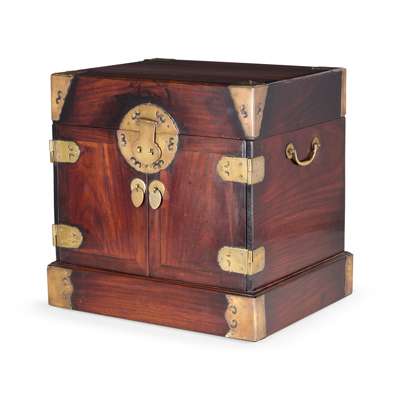
[PRIVATE SCOTTISH COLLECTION, PERTHSHIRE] CHINESE HUALI TABLE CABINET, GUANPIXIANG
QING DYNASTY
Auction: Asian Works of Art | Wed 11th March 2026 from 11.30am | Lots 180 to 346
Description
清 花梨官皮箱
of rectangular form, the hinged cover lifting to reveal a separate compartment above a pair of doors on a low base, the doors opening to reveal four drawers with metal plates and oval-shaped pulls, the front mounted with circular metal lock-plate and a cloud-form hasp, flanked by a pair of bail handles at the sides, the vividly-grained wood of a rich reddish-brown tone
Dimensions
34.2 cm wide x 27.8 cm height x 35.2 cm deep
Provenance
Private Scottish collection, Perthshire
蘇格蘭私人收藏, 珀斯郡
Footnote
This exceptionally elegant seal chest is finely constructed from dense, finely figured huanghuali wood, prized since the Ming dynasty for its aromatic scent, durability, and richly variegated grain. The surface displays a lustrous, warm golden-amber patina, now emerging as the original darkened surface finish has gently softened over centuries of careful use and natural oxidation — a phenomenon highly valued by connoisseurs and collectors.
The rectangular chest is ingeniously designed with a hinged top that, when lifted, simultaneously releases the front doors — a sophisticated mechanical feature reflecting the ingenuity of classical Chinese cabinetmaking. The interior is fitted with a removable tray and a finely arranged series of graduated drawers, meticulously proportioned to accommodate scholars’ seals of varying dimensions. This functional interior configuration underscores the object’s intended role within the refined world of the literati, where seals were essential instruments of identity, authorship, and aesthetic expression.
The chest is mounted with delicately worked brass fittings, their restrained form and warm tone providing a harmonious visual counterpoint to the richly figured wood. These mounts are not merely decorative but also serve a structural purpose, reinforcing the corners and edges while subtly articulating the chest’s refined architectural proportions. Raised on its original integral stand, the piece achieves a graceful elevation that enhances both its presence and usability, allowing it to function as an independent furnishing element within the scholar’s studio. The stand’s proportions are perfectly calibrated to the chest, demonstrating the sophisticated sense of balance and restraint characteristic of high-quality huanghuali furniture of the late Ming and early Qing periods.
Seal chests of this type are rare, as they were personal implements made for the scholar’s private use and seldom survived in pristine condition. The present example, distinguished by its elegant form, warm patina, ingenious construction, and finely preserved fittings, stands as a superb and highly refined example of classical Chinese scholar’s furniture, embodying both functional ingenuity and aesthetic restraint — core ideals of the literati tradition.