

Lot 243
![[PRIVATE SCOTTISH COLLECTION, PERTHSHIRE] CHINESE BRONZE TRIPOD CENSER](https://media.app.artisio.co/media/104cbde6-0d38-43cb-9e0f-bb721ef57bcf/inventory/29ac14fe-9bef-4b31-b5e1-d87f5ff34bcd/bfec560d-131a-499e-9d01-ed73250897ab/0001_PjpvdM_original.jpeg)
[PRIVATE SCOTTISH COLLECTION, PERTHSHIRE] CHINESE BRONZE TRIPOD CENSER
XUANDE MARK, QING DYNASTY
Auction: Asian Works of Art | Wed 11th March 2026 from 11.30am | Lots 180 to 346
Description
清 '大明宣德五年監督工部官臣吳邦佐造'底款 銅鑄橋耳三足爐
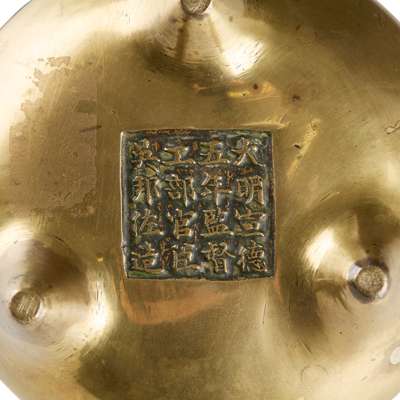
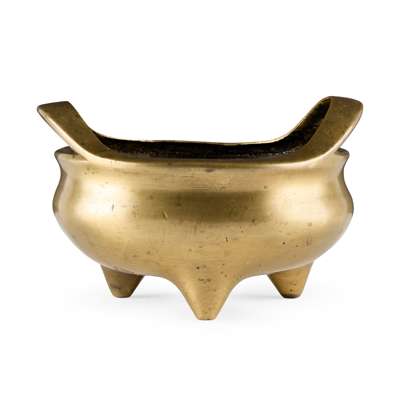
of compressed bulbous form supported on three short conical feet, flanked by a pair of arching handles on the rim, the base cast with a sixteen-character mark reading 'Daming Xuande wunian jiandu gongbu guanchen Wu Bangzuo zao (Made for the Board of Works under the Supervision of Wu Bangzuo in the Fifth Year of Xuande)' in a recessed square panel
Dimensions
14.4cm wide; 775g
Provenance
Private Scottish collection, Perthshire
蘇格蘭私人收藏, 珀斯郡
Footnote
The compressed globular body finely cast with a domed coverless form raised on three short rounded feet, the surface softly polished to a warm golden-brown patina, the base cast with a recessed rectangular panel containing a sixteen-character inscription in clerical script reading: 大明宣德五年监造工部官臣吴邦佐造 Da Ming Xuande wu nian jiandu gongbu guanchen Wu Bangzuo zao (“Made in the fifth year of the Xuande reign of the Great Ming, under the supervision of the Ministry of Works, by the official Wu Bangzuo.”)
This elegant tripod censer belongs to a distinguished tradition of Xuande-style bronzes produced during the late Ming and Qing dynasties in conscious emulation of the celebrated imperial bronzes of the Xuande reign (1426–1435). Xuande censers were revered for their refined proportions, mellow patina, and restrained archaic dignity, and they became the most copied and admired model for later scholars and collectors.
The inscription on the base is of particular interest. While it purports to identify the piece as an officially supervised imperial production of 1430, the extended formula naming a specific supervising ministry and official is not found on securely dated Xuande bronzes. Rather, such learned and highly specific inscriptions are characteristic of later historicizing bronzes, in which craftsmen and patrons sought to embed their works within the aura of the Ming golden age.
The named official, Wu Bangzuo, is not recorded in Ming bureaucratic sources associated with bronze casting, further indicating the inscription’s apocryphal, commemorative nature. Stylistically, the censer accords well with late Ming and Qing reinterpretations: the form is fuller and more rounded than early 15th-century examples, the surface exhibits a softly lustrous polish rather than the sharper, more austere finish of true Xuande bronzes, and the overall impression is one of warmth, tactility, and cultivated elegance — qualities especially prized by Qing scholars and collectors. Such censers were intended for the scholar’s studio or refined domestic ritual, where incense was burned not only for fragrance but as an aid to contemplation, calligraphy, and meditation.
The object thus embodies both material beauty and intellectual aspiration, serving as a tangible link between Qing antiquarian taste and the imagined perfection of the Ming past.