Tom Wesselmann was born in Cincinnati, Ohio in 1931 and became one of the leading figures of American Pop Art during the 1960s. Originally interested in cartoon drawing, Wesselmann developed a visual language rooted in popular culture, advertising and the aesthetics of post-war consumer America. His work is particularly recognised for its bold treatment of the female form and its engagement with themes of desire, domesticity and mass media imagery.
Wesselmann initially studied psychology at the University of Cincinnati before serving in the United States Army during the Korean War. Following his military service, he studied at the Art Academy of Cincinnati and later moved to New York to attend Cooper Union. It was in New York that he became immersed in the rapidly developing Pop Art movement alongside artists such as Andy Warhol, Roy Lichtenstein and Claes Oldenburg.
Unlike the detached irony found in some Pop Art, Wesselmann’s work retained a strong interest in formal composition and art historical tradition, drawing inspiration from artists such as Matisse while reinterpreting themes of the nude and still life through contemporary visual culture.
Pop Art in Print
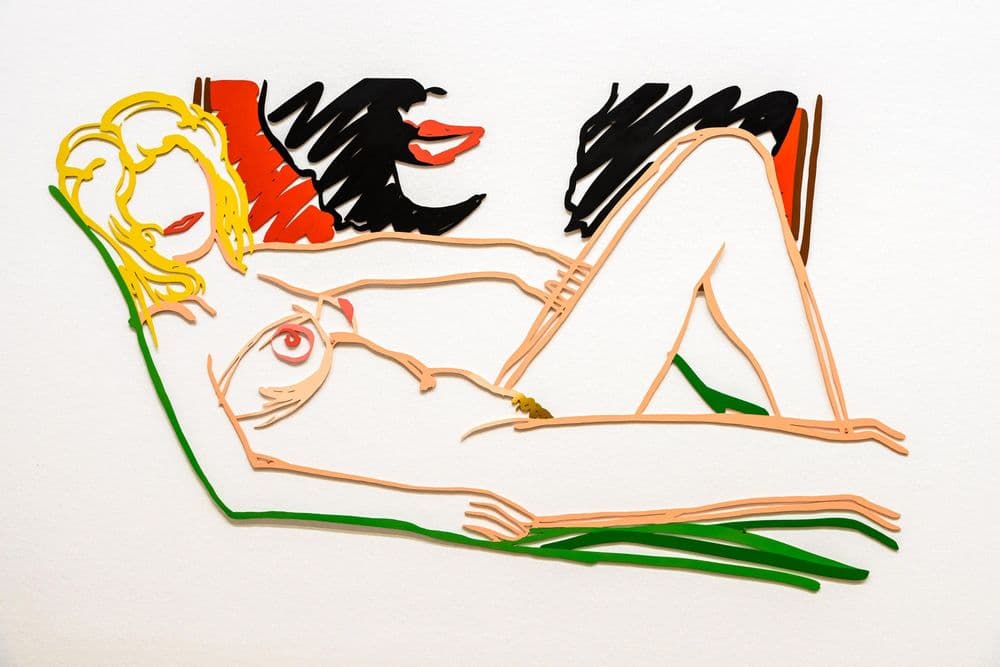
Printmaking played a significant role in Wesselmann’s practice, particularly through screenprint and laser-cut metal editions. His prints translate the bold outlines, saturated colours and graphic immediacy of his paintings into highly refined editioned works. Many revisit themes from his major painted series, including stylised nudes, still lifes and interior scenes, while emphasising flatness, repetition and commercial visual language.
Wesselmann is best known for prints such as Still Life with Liz, Big Blonde, and Still Life with Lichtenstein and Two Oranges, which combine flattened forms, vivid colour and cropped compositions inspired by advertising, cinema and public or artistic figures. His work often isolates fragments of the body or domestic objects, creating compositions that are simultaneously sensual, graphic and self-aware.
Wesselmann also experimented with shaped prints and cut-out compositions, blurring the distinction between print, painting and object. His editions remain highly collectible for their striking colour, clean graphic design and iconic representation of mid-century American Pop aesthetics.
Tom Wesselmann is regarded as one of the central figures of Pop Art, helping redefine representations of the body and consumer culture in post-war American art. His fusion of commercial aesthetics with painterly composition influenced later generations of artists working across painting, printmaking and graphic design. Today, his works are held in major museum collections internationally and continue to be valued for their bold visual language, technical precision and enduring association with American Pop culture.