Rolex: A History
Rolex is one of the most influential and recognisable luxury watch manufacturers in the world. Founded in 1905 by Hans Wilsdorf and Alfred Davis, Rolex has played a pivotal role in the development of the modern wristwatch, setting technical, aesthetic and quality standards that continue to define the global watch industry.
Originally established in London, the company relocated to Geneva, Switzerland in 1919, aligning itself with the heart of Swiss horology. From its earliest years, Rolex focused on creating wristwatches that were not only elegant but also accurate, robust, and reliable, a radical ambition at a time when pocket watches still dominated.
Leading the Way
Rolex’s reputation was built on a series of groundbreaking innovations. In 1910, Rolex became the first wristwatch to receive a Swiss Certificate of Chronometric Precision. Just four years later, it earned the first Class A chronometer certificate ever awarded to a wristwatch by the Kew Observatory in England, firmly establishing Rolex as a leader in precision timekeeping.
In 1926, Rolex introduced the Oyster, the world’s first waterproof and dustproof wristwatch, thanks to its hermetically sealed case. This innovation was famously demonstrated in 1927 when British swimmer Mercedes Gleitze wore a Rolex Oyster while swimming across the English Channel, cementing the brand’s association with real-world performance.
Another milestone followed in 1931 with the invention of the Perpetual rotor, the first self-winding mechanism using a centrally mounted rotor. This technology remains the foundation of automatic watchmaking today and is still used in all modern Rolex self-winding movements.
Iconic Models and Professional Watches
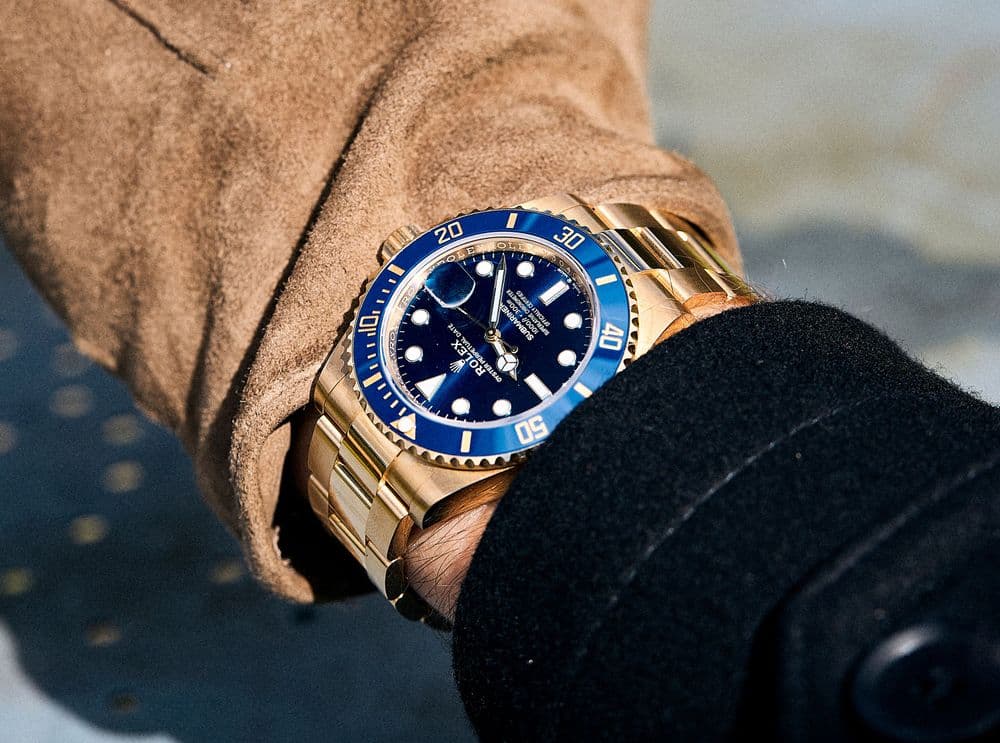
Throughout the mid-20th century, Rolex introduced a series of professional tool watches that have since become horological icons. These include the Submariner (1953), designed for professional divers; the GMT-Master (1955), developed in collaboration with Pan Am for international pilots; the Day-Date (1956), the first wristwatch to display both the day and date spelled out in full; and the Cosmograph Daytona (1963), created for motorsport timing.
Each model was engineered for a specific purpose, yet designed with enduring aesthetics that transcend their original function. Today, these references are among the most collectible and sought-after watches in the world.
Manufacturing Excellence and Materials
Rolex is notable for its vertically integrated manufacturing, producing nearly every component of its watches in-house across its Swiss facilities. The brand operates its own foundry, where it develops proprietary alloys such as Oystersteel, Everose gold, and Rolesor (a combination of steel and gold). Rolex movements are entirely designed, manufactured, assembled, and tested internally, with each watch undergoing rigorous quality control before leaving the manufacture.
All modern Rolex watches are certified as Superlative Chronometers, exceeding standard COSC requirements and tested to ensure exceptional accuracy, power reserve, water resistance, and durability.
Cultural Impact and Collectability
Beyond technical achievement, Rolex has achieved unparalleled cultural significance. The brand is closely associated with exploration, sport, science, and the arts, supporting expeditions to Mount Everest, deep-sea exploration with the Bathyscaphe Trieste, and long-standing partnerships with tennis, golf, sailing, and motorsport.
In the secondary and auction markets, vintage and contemporary Rolex watches are among the most actively traded and highly valued timepieces. Rare references, early sports models, and watches with exceptional provenance regularly achieve record prices, reinforcing Rolex’s reputation as both a functional instrument and a lasting store of value.
Rolex Today
Today, Rolex remains independently owned by the Hans Wilsdorf Foundation and continues to operate with a long-term vision free from shareholder pressure. Combining tradition with continual innovation, Rolex produces approximately one million watches annually while maintaining extraordinary demand worldwide.