Tadeusz Piotr ‘Peter’ Potworowski was a Polish painter whose career spanned the European avant-garde, inter-war Poland and post-war British art. An émigré who arrived in Britain during the Second World War, Potworowski became an important figure within the British art world, both through his painting and his influential teaching at the Bath Academy of Art, Corsham.
Like his compatriot Jankel Adler, Potworowski was part of a generation of European émigré artists whose arrival in Britain brought new ideas and perspectives to post-war art. His paintings combined the lessons of European Modernism with his experience of the British landscape, developing a distinctive language poised between abstraction and figuration.
Early Life and Art in Poland
Potworowski was born in Warsaw in 1898. After serving in the First World War, he enrolled at the Warsaw University of Technology to study architecture.
His studies were disrupted by the newly formed Soviet Union’s invasion of Poland. When Potworowski returned to Warsaw in 1921, he abandoned architecture in favour of painting.
In 1922, he enrolled at the Academy of Fine Arts in Krakow, where he studied under Józef Pankiewicz. It was with Pankiewicz’s encouragement that Potworowski travelled to Paris, then still very much the epicentre of the avant-garde.
Paris and the Kapists
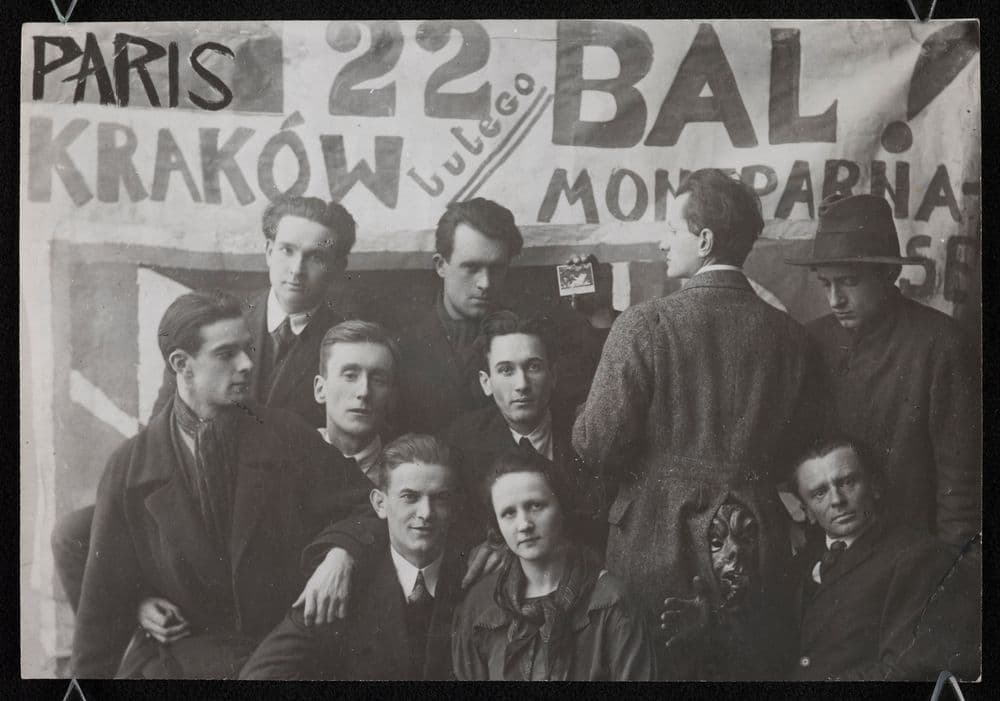
In Paris, Potworowski joined the Kapists, a group of young Polish Modernist artists associated with the city’s artistic circles. During his time there, Potworowski encountered some of the defining figures of European Modernism, spending time with Pablo Picasso, Pierre Bonnard, Jean Cocteau and Constantin Brancusi, as well as undertaking a short period of work in Fernand Léger’s studio.
It was through this job that he met his first wife, Magdalena Makowska, then an anthropology student. They married in Paris before returning to Poland in 1930.
The 1930s were a period of sustained success for Potworowski in his home country, where he became regarded as one of Poland’s leading Modernist painters.
War and Potworowski’s Arrival in Britain
War was to disrupt Potworowski’s life for a second time. Following the Nazi invasion of Poland in 1939, Potworowski, his wife and their two young children escaped to Sweden via Lithuania. He eventually made his way to Britain in 1943.
As with many of his contemporaries, he initially found himself in Scotland, where he was processed as an ‘alien’ from an Allied country, before settling in London.
His arrival placed Potworowski among a remarkable generation of European émigré artists, writers and cultural figures who would make an important contribution to British cultural life during and after the Second World War.
Peter Potworowski and Post-War British Art
In January 1946, Potworowski held an exhibition of 33 works at the Redfern Gallery, announcing himself to British collectors as an artist of ‘note and promise’.
Regular exhibitions followed with the Redfern Gallery, Gimpel Fils from 1948 onwards and The London Group, to which he was elected a member in 1949. His growing position within British artistic life was reflected in the Anglicisation of his Christian name from Piotr to Peter.
Potworowski was also president of the Association of Polish Artists and published regularly in the monthly magazine Nowa Polska.
Teaching at the Bath Academy of Art, Corsham
Potworowski’s influence on British art extended beyond his own painting. From 1949 until 1957, he was Professor of Painting at the Bath Academy of Art at Corsham, then one of the most progressive art schools in Britain.
Its teaching staff represented a remarkable concentration of post-war British artistic talent, including Peter Lanyon, Terry Frost, Bryan Wynter and Adrian Heath, with artists including Howard Hodgkin and Robyn Denny later associated with the school.
Potworowski therefore occupied an important position within a network of artists who would play significant roles in the development of abstraction in post-war Britain.
Cornwall and the Landscape
From Bath, Potworowski followed Lanyon, Frost and Wynter to Cornwall, taking a studio at Sancreed near Penzance. Like these painters, he responded to the landscape of Penwith while drawing on the lessons of the European avant-garde. The influence of Picasso, Kandinsky and, particularly, Paul Klee combined with the wild landscape of west Cornwall to produce an art that balances finely between abstraction and figuration.
Rather than abandoning the visible world entirely, Potworowski transformed landscape through colour, shape and form. His paintings occupy the fertile territory between an observed place and an abstract response to it.
Later Life and Return to Poland
After considerable upheaval earlier in his life, Potworowski found a degree of stability during the 1950s. He travelled and painted extensively with his professional and romantic partner Doreen Heaton Potworowska, whom he met in 1952 while teaching at Corsham. Together they travelled through a Europe recovering from war, including France, Spain and Italy.
In 1958, Potworowski returned to his native Poland, where he spent the final four years of his life. He died in Warsaw in 1962.
Peter Potworowski’s Legacy
Potworowski’s career connected several important strands of twentieth-century European and British art: the Polish avant-garde, the émigré experience, the development of post-war abstraction in Britain and the artistic community surrounding Cornwall.
A major retrospective of his work was held at the Polish National Gallery of Contemporary Art in Warsaw in 1996, and his work is held in major public collections in Poland and Britain, including Tate, the Victoria Art Gallery in Bath and the Royal West of England Academy in Bristol.
His work also forms part of a wider story of émigré artists whose ideas and experiences helped shape British cultural life during the post-war period.
Ilustrated: Members of the Paris Committee artistic group in 1925, including Hanna Rudzka-Cybis (bottom right), Jan Cybis (bottom left), Józef Czapski, Artur Nacht-Cymborski, Tytus Czyżewski, Zygmunt Waliszewski, Piotr Potworowski (with back to camera), Seweryn Boraczok and Józef Jarema. Public domain, via Wikimedia Commons