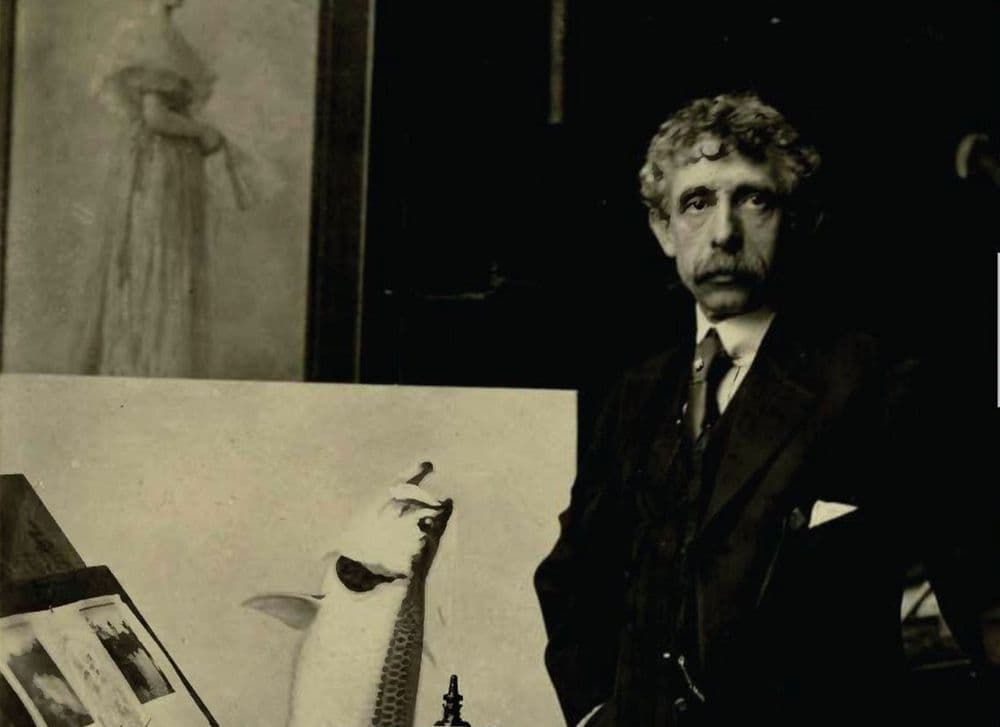
Louis Rhead was an English-born illustrator, author, and graphic designer who became an influential figure in the American art scene after emigrating to the United States at the age of twenty-four.
Born into an artistic family, Rhead’s father, a respected gilder and ceramicist, provided a strong foundation in the arts, ensuring that Louis had access to a creative environment from a young age. As a child, he frequently attended his father’s art classes and worked in the Staffordshire art potteries, where he was immersed in the world of craftsmanship and design. This exposure to the practical side of art was crucial in developing his understanding of form, colour, and composition.
Recognising his son’s exceptional talent, Rhead’s father arranged for him to study in Paris for three years, where Louis continued his education at the prestigious École des Beaux-Arts. The opportunity to study in Paris greatly expanded his artistic horizons, and upon his return to England, Rhead pursued further education at the National Art Training School (now the Royal College of Art) in London. There, he honed his skills in design and illustration, setting the stage for his successful career.
After graduation, Rhead’s career took a significant turn when he was offered the position of Art Director for the U.S. publishing firm D. Appleton & Co. in New York. This role provided him with an ideal platform to pursue his artistic ambitions, and he emigrated to the United States, where his work quickly gained recognition.
In the 1890s, Rhead made a name for himself as a poster artist, capitalising on the growing popularity of graphic design as a marketing tool. His posters, often vibrant and detailed, were featured in prominent publications such as Century Magazine and Harper’s Bazaar. In 1895, Rhead’s poster design earned him the Gold Medal for Best American Poster Design at the first International Poster Show in Boston, cementing his reputation as one of the leading designers of his time.
However, by the early 1900s, poster art began to decline as a medium, and Rhead shifted his focus to children’s book illustration. His work in this genre became highly regarded, as he brought to life treasured classics with his distinctive, detailed style. Among his most famous works are the illustrations for books like The Swiss Family Robinson, Treasure Island, Kidnapped, and Robin Hood. These illustrations were admired for their ability to capture the adventure and imagination of the stories, enriching the reader’s experience with visual storytelling that complemented the narratives.