Neo-Renaissance or Renaissance Revival is a form of architecture and art that draws inspiration from a wide range of Classic Italian works. Designers of the 19th Century went beyond the styles of Florence and Central Italy to include Mannerist and Baroque imagery to round out this artistic movement.
It can be difficult to determine just what Renaissance Revival is as it incorporates so many different design elements and influences but, in many ways, ‘when you see it, you know it’. This movement was heavily influenced by the Romantic and the Gothic, with sumptuous curves and rich foliate details. Subject matters could include anything from dragons and grotesques to cherubs and heroes of the Classics.
One of the finest silver and goldsmiths of the 19th Century, Jules Wièse was the leading authority on Neo-Renaissance jewellery. Born in Berlin 1818, Jules Wièse apprenticed under the court goldsmith, Johann Georg Hossaeur, at the young age of sixteen. This courtly influence would go on to show in his work as he grew older and more confident in his abilities and could be what initially drew him to Renaissance Revival. Not long after his apprenticeship ended, Wièse made his way to the centre of the art world at the time, Paris. There, he worked shortly, under the skilled hand of Jean-Valentin Morel or J-V Morel. Morel was a native Parisian and grew up surrounded by craftsmen. His father was a lapidarist and his mother’s family were silversmiths. The tendency to seek out talented artists as mentors would become a regularity for Wièse as he then moved on to work with François-Désiré Froment-Meurice, who was one of the most famous silver and goldsmiths of his time.
Just slightly senior to Wièse, Froment-Meurice was the son of a goldsmith. His father died when Froment-Meurice was young and when his mother remarried, it was to another goldsmith. His life was enriched by jewellery and small ornate objet. After Froment-Meurice finished his education and jewellers’ apprenticeships, he took over the family workshop and gradually built it into a fine and particularly famous establishment. They specialised in Romantic jewels that drew inspiration from Neo-Gothic and Renaissance styles. The pieces were sculptural and bold and called to Wiése who began working in the shop. Wiése quickly rose to prominence as workshop manager, taking the styles of Froment-Meurice and adding his own elements, making them more delicate, finer.
By 1845, Wiése had outgrown his mentor’s workshop and decided it was time to branch out. He moved to 7 Rue Jean-Pain-Mollet and established his own jewellers’ bench. While this street no longer exists today, having been covered by Rue de Rivoli, it was only about a 30-minute walk from another soon-to-be-famous institution, 13 Rue de la Paix. Also known by the family name of, Cartier.
1849 saw the Exposition Industrielle where Wiése, while still working exclusively for Froment-Meurice, was awarded a Collaborators Medal for his invaluable contribution to his mentor’s works. Six years later, Wiése was showcasing under his own name. He was awarded a First Class Medal at the Exposition Universelle for his work and the exposure he gained significantly added to his already increasing stardom.
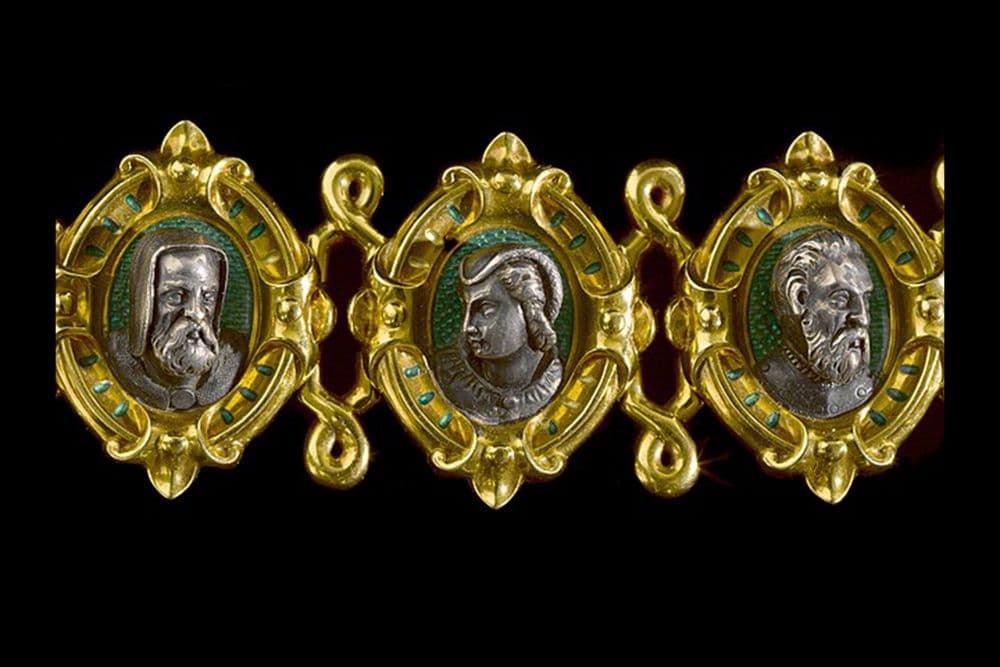
Wiése was becoming known for his distinctive style and his ability to raise and chase jewellery motifs in fine detail. He was inspired not only by the stylistic leanings of Froment-Meurice, but Arthurian Legend and Chivalric tales filled with drama and magic. The brave knight rescuing the fair maiden. The slaying of the dragon. Dark magic and intrigue. He would frequently artificially age his pieces by adding a dusting of jewellers’ rouge or mercury oxide to their surfaces. This would give the pieces a patina as if they had just been pulled out of the ground. He was creating contemporary artefacts; they were inspired by the nostalgia for the past that was extant at the time. Simultaneous with the creation of Wiése’s jewels was the restoration of one of the most iconic landmarks in Paris, Notre-Dame Cathedral. Gargoyles created by Eugène Emmanuel Viollet-le-Duc for the Cathedral can be seen graced in gold by Wiése. These pieces were not only of an older time but of a Romantic and mystical era.
At the height of his career, in 1880, Wiése retired from his workbench and handed the reigns to his son, Louis Wiése. Louis Wiése proved to be just as talented as his father, with a penchant for enamel work, the likes of which can be seen at the Victoria & Albert Museum in South Kensington London.