Joseph Mougin was one of the leading figures in twentieth-century French ceramics, celebrated for his technical innovation and his contribution to both the Art Nouveau and Art Deco movements.
Born in Nancy, a city at the heart of the flourishing decorative arts movement in Lorraine, Mougin initially pursued sculpture, enrolling at the École des Beaux-Arts in Paris in 1896 where he studied under the distinguished sculptor Louis-Ernest Barrias. His interest soon turned to ceramics, however, and he abandoned his formal sculptural training to explore the creative possibilities of clay alongside his brother, Pierre Mougin.
The brothers quickly established themselves within the vibrant artistic circles of eastern France and exhibited their work at the Exposition Universelle in Paris in 1900, one of the most important international exhibitions of the period. The following year, Joseph broadened his technical knowledge through a period of study with his friend Ernest Baudin, director of the Manufacture Nationale de Sèvres, where he also met the ceramicist Georges Vogt. Determined to master every aspect of his craft, Mougin sought guidance from a wide range of artists and designers, including Henri Bergé, Louis Castex, Louis Majorelle, and Pierre Roche, absorbing influences from sculpture, design and the decorative arts.
In 1904, Mougin became involved with the Société Lorraine des Amis des Arts, collaborating with prominent figures of the Nancy artistic community such as Alfred Finot, Victor Prouvé and Ernest Wittmann. Closely associated with the ideals of the École de Nancy, the movement championed the unity of art, craft and industry and proved a significant influence on his development. Inspired by this creative environment, Mougin returned permanently to Nancy in 1905, where he established himself as one of the region's foremost ceramic artists.
Throughout his career, Mougin combined artistic ambition with technical experimentation. Between 1923 and 1933, he worked with the celebrated ceramics manufacturer Keller & Guérin at Lunéville, producing works that reflected the evolving aesthetic of the Art Deco period. His achievements were recognised internationally when he was awarded a Grand Prix at the landmark Exposition Internationale des Arts Décoratifs et Industriels Modernes in Paris in 1925, the exhibition that gave Art Deco its name.
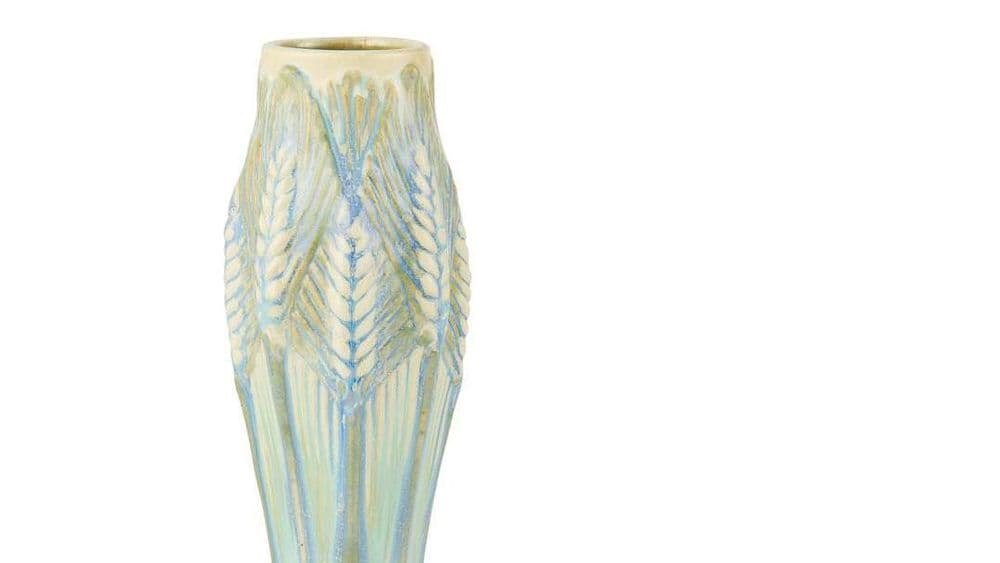
Mougin's oeuvre encompasses both stoneware and porcelain, with many of his most admired works distinguished by their sophisticated crystalline and high-fired glazes. Whether creating sculptural vessels, decorative objects or architectural ceramics, he demonstrated a remarkable command of form and surface, combining technical mastery with the artistic ideals of the French decorative arts tradition.