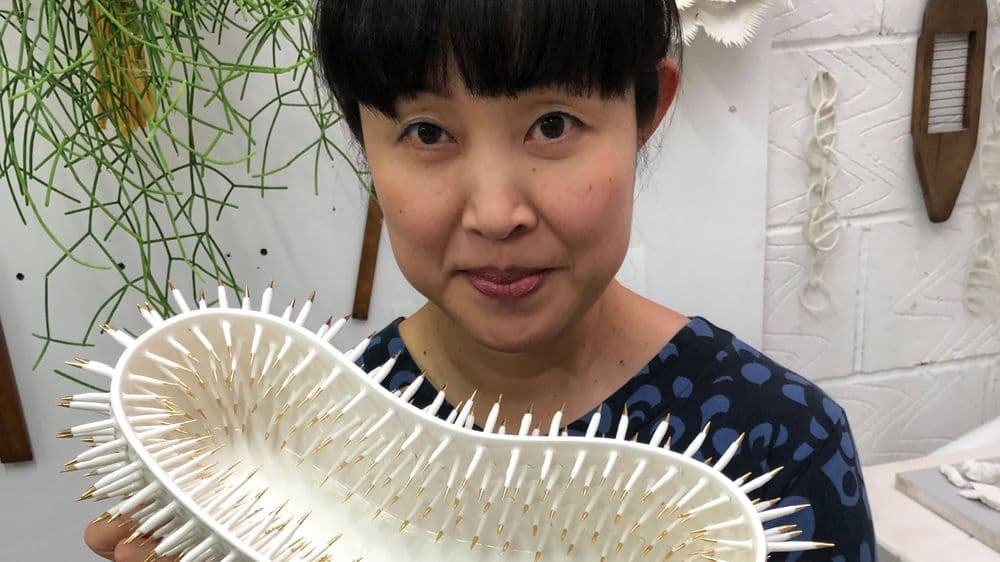
Ikuko Iwamoto is a Japanese ceramic artist based in London, celebrated for her intricate porcelain vessels and sculptural works inspired by the microscopic world. Drawing on forms found in cells, marine organisms and other natural structures invisible to the naked eye, she creates highly detailed pieces that balance delicacy with technical precision. Her work spans both functional tableware and ambitious sculptural installations, challenging conventional ideas of porcelain while celebrating its extraordinary versatility.
Born in Japan, Iwamoto began studying ceramics at Tezukayama College in Nara in 1990 under the influential ceramic artist Asuka Tsuboi. After several years teaching and assisting in Japan, she moved to London in 2001 to study at Camberwell College of Arts before completing an MA in Ceramics and Glass at the Royal College of Art in 2006. It was during her time at the RCA that she developed the slip-casting techniques that have become central to her practice.
Every porcelain form begins with hand-made plaster moulds before being meticulously built up with individually applied spikes, dots and textured surfaces. The resulting works evoke coral, sea urchins, microorganisms and botanical forms, creating objects that feel simultaneously organic and otherworldly. Alongside porcelain, Iwamoto has incorporated found materials such as metal wire, coiled cables and antique objects, expanding her practice beyond the purely ceramic. More recently, her work has focused on environmental themes, exploring sustainable making through traditional Japanese urushi lacquer and kintsugi repair techniques.
Iwamoto has exhibited extensively in the UK and internationally, including at Collect, the Royal Academy Summer Exhibition, Ceramic Art London, and the Young Masters exhibition. Her work is held in major public collections including the Victoria and Albert Museum, Manchester Art Gallery, The Holburne Museum and Touchstones Rochdale. She received the Young Masters Maylis Grand Ceramics Prize in 2019 and the Ceramic Review Prize for Innovation in 2009.
In 2025, Iwamoto was awarded a QEST Andrew and Jane Winch Scholarship, enabling her to return to Japan to study traditional urushi lacquer and kintsugi with master craftsmen. The scholarship supports her ambition to integrate renewable, natural materials into her ceramics, reflecting a growing commitment to environmentally responsible making while reconnecting with centuries-old Japanese craft traditions.
Illustrated: Image supplied by the artist with thanks.