Born in North Yorkshire in 1964, Harland Miller is a British artist and writer who lives and works in London. Celebrated for his distinctive, text-based paintings and prints, Miller combines a lifelong fascination with language and literature with a visual vocabulary informed by Pop Art, Abstract Expressionism and Colour Field painting. His works are characterised by bold typography, saturated colour and a distinctly irreverent strain of northern English humour.
Miller left school at sixteen to study graphic design before enrolling at Chelsea School of Art in 1988, where he later completed a master’s degree. During the 1980s and 1990s he travelled extensively, living and working in New York, New Orleans, Berlin and Paris. His time in New York proved particularly influential, exposing him to the work of mid-century American artists and strengthening his interest in the relationship between abstraction, colour and popular culture.
Literature has been equally central to Miller’s artistic development. Growing up in Yorkshire during the 1970s, books and humour provided important sources of inspiration, and his fascination with the written word eventually became inseparable from his visual practice. Miller states ‘Where I grew up, it was an industrial town, people saw life as carnage, just one long, ongoing difficulty, but relieved here and there with humour.’
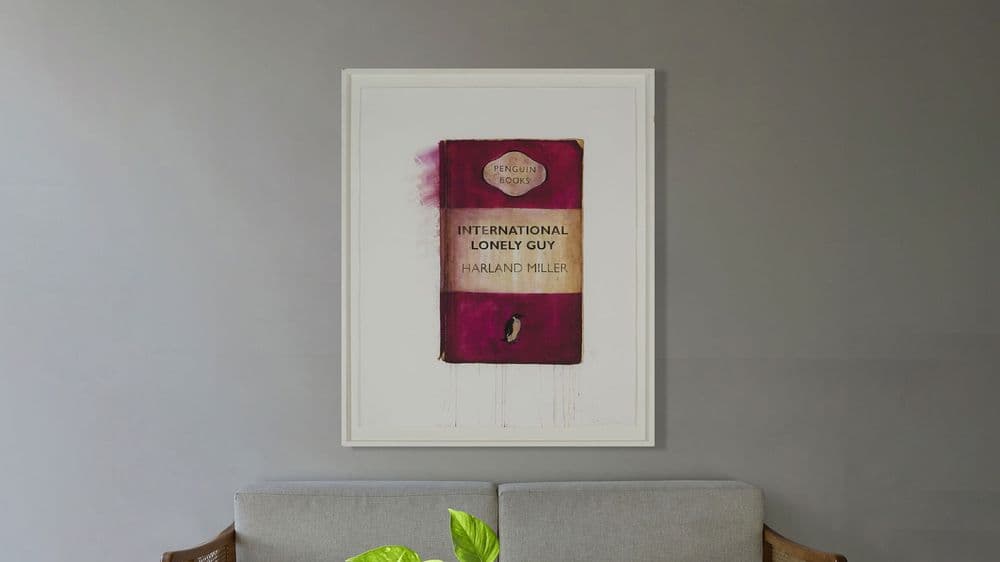
While living in Paris, Miller encountered a collection of second-hand Penguin paperbacks whose instantly recognisable graphic design would provide the basis for his best-known body of work. Miller began experimenting with the Penguin format in the early 1990s, appropriating the familiar dust jackets and replacing their original titles with his own witty, provocative and frequently ambiguous phrases. Through these works, he brought together his interests in painting, graphic design and literature, exploring the tension between words as carriers of meaning and text as a purely visual element. His invented titles range from the comic and absurd to the melancholic and psychologically charged, often inviting multiple interpretations.
Miller’s printmaking forms an important extension of his wider artistic practice. Often produced on a large scale, his screenprints are bold, colourful and immediately recognisable, translating the graphic impact and saturated palette of his paintings into the medium of print. His use of screenprinting also connects his work to Pop Art predecessors such as Andy Warhol and Roy Lichtenstein, for whom the technique offered a means of bringing together fine art and the visual language of commercial printing and mass culture. Miller’s striking prints have become a highly sought-after aspect of his practice.
Alongside his visual practice, Miller has established himself as a writer. His debut novel, Slow Down Arthur, Stick to Thirty, published in 2000, is a semi-autobiographical account of a young man travelling through northern England with a David Bowie impersonator. His dual identity as artist and writer remains fundamental to his practice, with language functioning simultaneously as subject, image and narrative device.