Georges Flamand a French sculptor and decorative artist associated with the transition between Art Nouveau and Art Deco design. Although uncertainty remains surrounding the exact date of his death, which is variously recorded as 1925 or 1931, Flamand’s work remains distinctive for its elegant female subjects and richly decorative style.
Flamand studied under the celebrated sculptor Alexandre Falguière at the École des Beaux-Arts in Paris. Falguière was one of the leading academic sculptors of his generation and gained widespread attention in 1898 after winning the commission for the Monument to Balzac over Auguste Rodin. Under this influential training, Flamand developed a refined sculptural language that combined academic modelling with the decorative sensibilities of early twentieth-century French art.
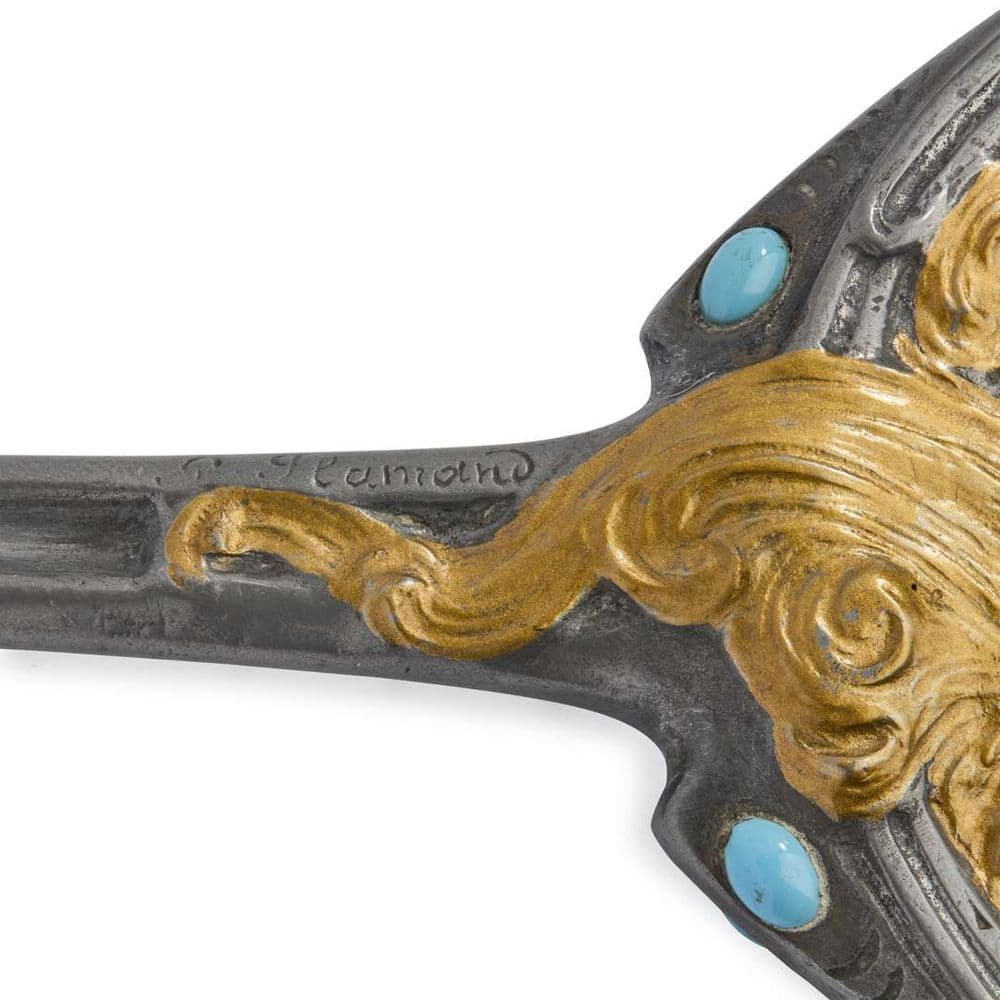
His work frequently centred on idealised female figures, often focusing solely on the head or bust. These expressive forms were regularly incorporated into functional decorative objects including trays, mirrors, dishes, and handles, blurring the boundary between sculpture and decorative arts. Flamand’s graceful maidens often evoke mythology and Symbolist themes, appearing as enigmatic and sensual femme fatales characteristic of late Art Nouveau aesthetics.
An innovative designer, Flamand also experimented with mixed media, embellishing his sculptures with gemstones and ceramic elements to enhance their ornamental richness.