Francis Grose "a fine, fat, fodgel wight": antiquarian extraordinaire and friend of Robert Burns
In 1788 the English antiquarian and bon viveur Captain Francis Grose embarked on what turned out to be his last major project, to describe and sketch the antiquities of Scotland. In the course of his travels he met an up-and-coming Scottish poet, Robert Burns, and an unlikely friendship was formed.
Grose was the son of an immigrant Swiss jeweller, who served on and off in the army up to the 1780s, having also tried his hand at being a militia paymaster, artist, herald, and draughtsman. He had started sketching medieval buildings in his teens, developing a keen interest in antiquities in what was the golden age of the 'antiquarian,' the amateur enthusiast in all things ancient.
By the 1760s his sketches were being published at etchings, leading to the publication of his first major work The Antiquities of England and Wales in individual parts from 1772 onwards. Grose travelled widely to make sketches but also relied on a network of fellow antiquaries to supply him with images, and also the text which accompanied the etchings. As well as making money from his venture, he appears to have had a genuine wish to make British history and ancient buildings more accessible to a wider readership.
In the 1780s he added a new string to his bow, that of lexicographer. A Classical Dictionary of the Vulgar Tongue: A Dictionary of Buckish Slang, University Wit, and Pickpocket Eloquence appeared in 1785 as a compendium of bawdy slang, with obscene words and expressions that would not have appeared in a conventional dictionary. Grose had been accumulating material from the 1750s onwards. He took his research seriously, travelling the country to find new expressions and making 'nocturnal sallies' into the slums and drinking dens of London.
He continued to publish prolifically in the 1780s, in order to supplement his military pension. His love of the high life contributed to his corpulent figure, which was source of pride, rather than shame, to him. In his constant search for new material, Grose decided to venture north of the Border to record the antiquities of Scotland. He made tours of Scotland between 1788 and 1790, despite claiming to be too fat to ride a horse and too poor to keep a carriage.
Grose first met Robert Burns at Friar's Carse, near Dumfries, the home of Burns's friend and patron Robert Riddell, during his second Scottish tour in 1789. Grose made an immediate and favourable impression on the poet. Their meeting later inspired a humorous poem,
"On the Late Captain Grose's Peregrinations Thro' Scotland," where the intrepid Captain is described as being “a fine, fat, fodgel wight. O’ stature short, but genius bright.” Burns commented in a letter to his friend Frances Dunlop, "I have never seen a man of more original observation, anecdote and remark ... His delight is to steal thro’ the country almost unknown, both as most favorable to his humour and his business."
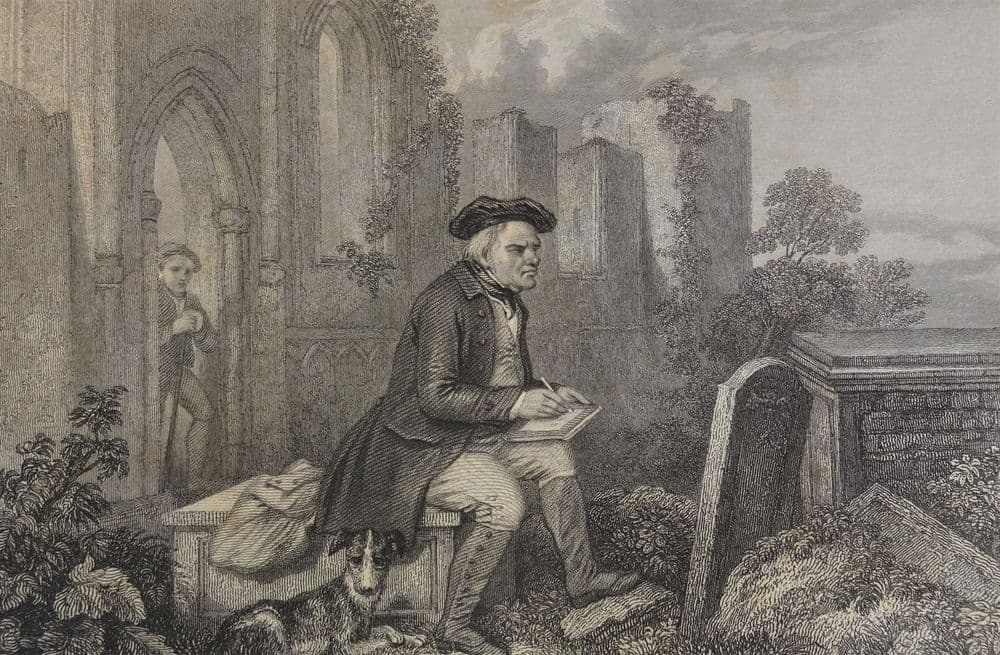
Illustrated: Captain Frances Grose working on his antiquities of Scotland - 1838. Land of Burns. Published by George Virtue. J.Rogers. 1838., Public domain, via Wikimedia Commons